
Livraison le jour même ou le lendemain

Qualité garantie

Débloquez vos offres de bienvenue: Livraison GRATUITE | Jusqu'à -80 % | 30 jours d'essai gratuits à JoyPlus
Téléchargez l'application
By the Joybuy Team, Our Equipment Experts Published August 26, 2026
For any RVer, on-road safety is the number one priority. An underinflated or overheating tyre leads to a double penalty: premature wear, increased fuel consumption, and above all, the risk of a potentially devastating blowout mid-journey. This is why a tyre pressure monitoring system (TPMS) isn't a gadget, but an essential piece of safety equipment. The only problem: the market is flooded with options, and it's easy to fall into common traps that make a purchase completely useless.
To make the right choice, let's start by identifying the 3 most common mistakes when buying an RV TPMS:
For a successful purchase, focus on the features that truly make a difference on large vehicles. Here are the technical points you absolutely must validate.
A wireless TPMS transmits data from each sensor, screwed onto the valve stem, to a monitor in your cabin. On an RV, and even more so on a rig with a trailer, the distance and metal obstacles (chassis, coach body, etc.) can easily act as a shield and block the transmission.
This is where a TPMS with a repeater comes in. This small box, often placed at the rear of the vehicle or on the trailer, captures the signal from the furthest sensors and relays it, amplified, to the monitor. For any vehicle or convoy over 10 metres (about 33 feet), a repeater is no longer an option: it's a requirement to ensure reliable long-range tyre pressure monitoring. It's your guarantee of receiving real-time data without the intermittent disconnections that render the system useless.
Before you even start comparing models, check the recommended pressure for your RV's tyres and those of any trailer you might have. This information can be found on the tyre's sidewall or in the vehicle's manual.
A good TPMS does more than just display numbers. Its role is to actively alert you in case of danger. Check that the system offers several types of tyre pressure alarms:
Finally, the display must be perfectly legible (including at night, thanks to backlighting) and the external sensors should use standard batteries (like CR1632 or CR2032), which are easy to find commercially and replace yourself.
Here is a selection of systems that check all the right boxes, for different types of RVers.
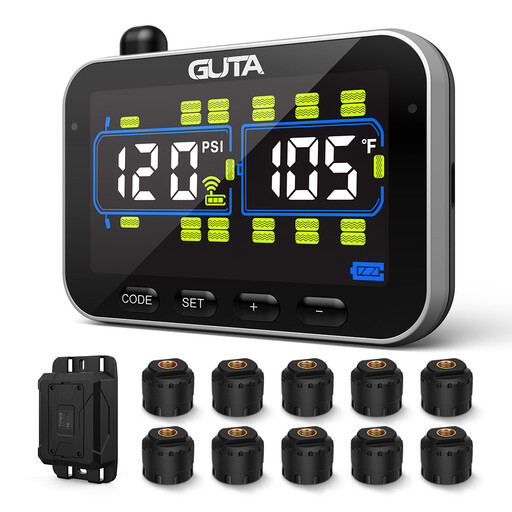
Why this model: The perfect solution for owners of large RVs with a dual-axle trailer or car hauler. It allows you to monitor up to 10 tyres simultaneously, for complete peace of mind on very long journeys.
Its included repeater guarantees a stable signal along the entire length of the rig. With a pressure range up to 188 PSI, it's built for heavy-duty tyres and avoids the pitfall of an undersized system.
A complete, ready-to-use kit for 10 tyres. GUTA states a battery life of about 4 years for the sensor batteries (CR2032), which significantly extends maintenance intervals.
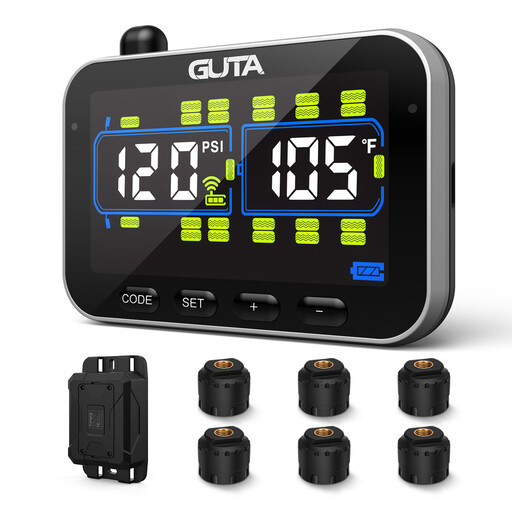
Why this model: A very well-balanced solution for most RVs (Class C, Class A) up to 15 metres (50 feet). It covers the 4 to 6 tyres of the chassis while offering premium performance.
This model also includes a repeater for flawless communication and the same very high pressure range of 188 PSI. This ensures compatibility with almost all recreational vehicle tyres.
Its large colour screen makes it easy to read data from all 6 tyres at a glance. The system is expandable: it can manage up to 24 tyres if you decide to add more sensors later.
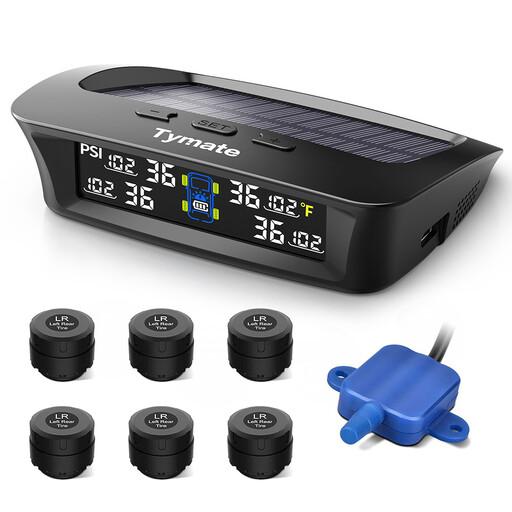
Why this model: An excellent option for owners of camper vans, converted vans, or lighter RVs who want comprehensive monitoring without necessarily needing an extreme pressure range.
This kit includes a repeater, a rare and decisive advantage in this price range for preventing signal loss. The CR1632 batteries are standard and user-replaceable.
Its monitor recharges via a solar panel or USB-C. The pressure range up to 87 PSI (6 bar) is more than sufficient for the majority of RVs and light trailers.
We have put together a complete selection of products that meet our demanding selection criteria and current safety standards.
What is the battery life of the sensors and are they easy to change? Battery life depends on the model and usage, but you can generally expect between 2 and 4 years. The majority of RV systems use standard coin cell batteries (CR1632 or CR2032). They are designed to be replaced by the user with a small tool that is often included. The process is very simple and only takes a few minutes per sensor.
Is a repeater really essential for my 8-metre (26-foot) RV? For an 8-metre vehicle, a system without a repeater might work, but signal reliability is never guaranteed. Interference (metal chassis structure, radio environment, etc.) can cause disconnections. For constant and reliable monitoring, especially on long trips, a repeater is highly recommended as soon as the vehicle exceeds 7-8 metres. It's a small extra cost for significant peace of mind.
Aren't external sensors at risk of being stolen? This is a legitimate concern. To prevent this, most external sensor TPMS kits include anti-theft lock nuts. They are screwed onto the valve stem before the sensor and can only be unlocked using a special wrench provided with the kit. This simple system makes casual theft nearly impossible.