
Livraison le jour même ou le lendemain

Qualité garantie

Débloquez vos offres de bienvenue: Livraison GRATUITE | Jusqu'à -80 % | 30 jours d'essai gratuits à JoyPlus
Téléchargez l'application
A five-tier stainless steel steamer lets you cook several foods at once, from vegetables, fish and dumplings to rice and steamed buns. But some models focus more on the number of tiers than on everyday practicality. Before you buy, take a close look at the material, diameter, stability and compatibility with your hob.
Five tiers don’t necessarily mean five spacious baskets. The usable diameter, the space between the tiers and whether you can remove some of them all affect how much food you can actually cook. A compact model may suit a couple, but it could be much less practical for a family or catering business.
Not all stainless steel offers the same level of performance. For regular use, check the alloy grade. A 304 stainless steel steamer is generally described as corrosion-resistant and suitable for contact with food. Make sure this information is clearly stated in the product listing, rather than appearing only in an image or a vague title.
A stackable steamer gets heavy when several tiers are full. Weak handles, poorly finished edges or an imprecise fit can make it harder to remove the food. Steam also poses a risk of burns, so take care when handling the handles, lid and base, and use suitable protection.
Look for 304 stainless steel construction when the specification is clearly stated. A polished finish makes cleaning easier, while properly deburred edges help reduce the risk of cuts when assembling the steamer. A tempered glass or heat-resistant lid lets you keep an eye on the food without having to lift it constantly.
Product listings sometimes describe materials as ‘food-grade’ or ‘durable’. These claims don’t replace precise details such as the material of each component, thickness, handle type and care instructions.
Sizes from 26 to 32 cm suit different needs. A 26 cm model takes up less space and is easier to store. A 30 or 32 cm diameter, on the other hand, gives you more room for vegetables, dumplings or family-sized portions, but you’ll need a large enough hob and suitable storage space.
A practical multi-tier steamer should work with fewer than five tiers. This lets you adjust its height to suit the amount of food and avoid heating empty baskets.
A steamer compatible with induction hobs should be explicitly described as such. Compatibility with gas, electric and ceramic hobs can also be useful if your home has more than one type of hob. Check the diameter of the pot base against your cooking zone: a base that’s too small won’t heat as efficiently, while a pot that’s too wide may overhang the hob.
For regular use, also choose a well-fitting lid and a base deep enough to hold water without it touching the food. Never heat the pot when it’s empty, and keep an eye on the water level during longer cooking times.
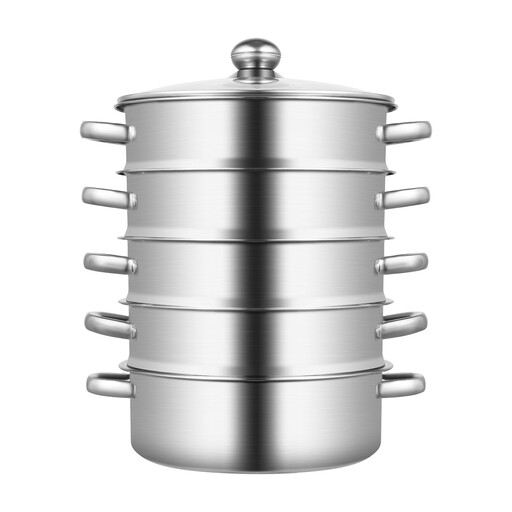
Why it suits this type of user : Its 26 cm diameter keeps it compact, making it ideal for trying out steam cooking for a small household.
The listing specifies four steamer baskets and a pot. This means you can adjust the height of the steamer instead of always using all five tiers.
Glass lid, composite-bottom base and stated compatibility with induction, gas and electric hobs.
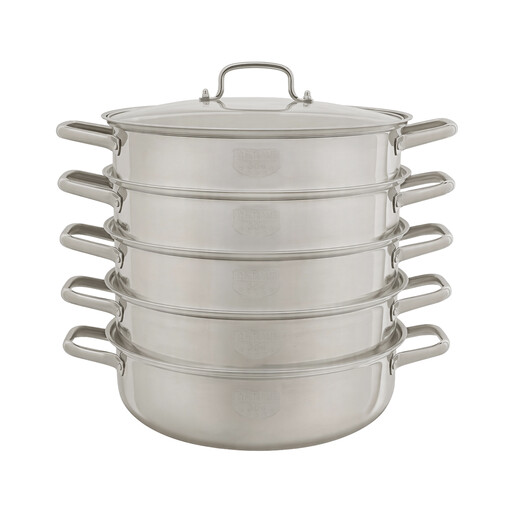
Why it suits this type of user : Its generous diameter is well suited to family meals and a variety of dishes that need several compartments.
The 304 steel grade is clearly stated, unlike listings that rely on the vague term ‘stainless steel’.
304 stainless steel, five stackable tiers, heat-resistant glass lid and compatibility with several types of hob.
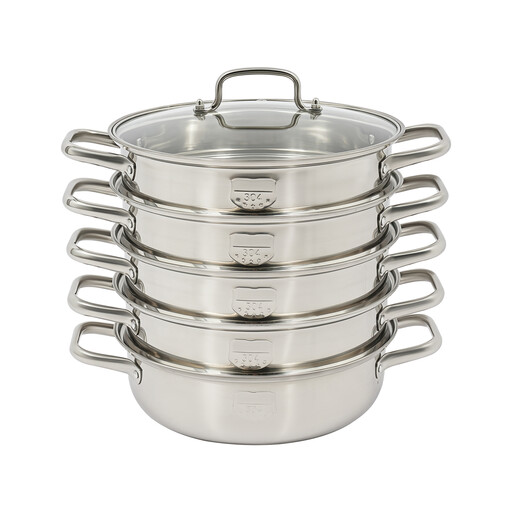
Why it suits this type of user : Its mid-sized design strikes a good balance between cooking capacity, ease of handling and storage, making it a practical choice for frequent use.
The base and four baskets are described as usable without assembly, making it easier to cook with repeatedly.
Handles on the different components, glass lid, 304 steel and a base compatible with induction, gas, electric and ceramic hobs.
We’ve put together a comprehensive list, updated in real time, of products that meet these strict selection criteria and European safety requirements.
Stainless steel is generally easy to clean, but hard water can leave mineral deposits. Descaling the steamer in line with the manufacturer’s recommendations helps keep the steam circulating properly.
Energy use depends mainly on the heating time, hob power and amount of water used. Stacking several tiers lets you cook different portions during the same heating cycle. However, avoid extending the cooking time if there’s very little water left in the base.
Yes, as long as the product listing clearly states induction compatibility and the pot base is suitable. The fact that a product is made of stainless steel doesn’t automatically mean it will work on an induction hob. Also check that the base diameter matches your cooking zone.
There’s no guaranteed lifespan: it depends on how often you use it, the quality of the construction, how you clean it and how you store it. A 304 steel model that’s dried properly and handled with care can last for many years with regular use, provided you follow the manufacturer’s recommendations.