
Livraison le jour même ou le lendemain

Qualité garantie

Débloquez vos offres de bienvenue: Livraison GRATUITE | Jusqu'à -80 % | 30 jours d'essai gratuits à JoyPlus
Téléchargez l'application
A portable air pump can be a lifesaver by the roadside, at the campsite or on the beach. But not all models are created equal and, more importantly, they are not designed for the same tasks. A device intended to adjust tyre pressure will not necessarily inflate a paddleboard quickly. Conversely, a manual mattress pump will not be suitable for a car tyre.
Before getting your bank card out, it is therefore worth looking beyond claims such as “high pressure” and the maximum number of bars. Airflow, battery life, nozzles, power supply and cooling time: here are the criteria to consider, the mistakes to avoid and the models suited to every type of user.
A stated maximum pressure of 150 PSI or 20 PSI does not guarantee fast inflation. This figure represents a theoretical limit. To find out how quickly the pump really works, you should instead look at its airflow, measured in litres per minute (L/min).
A battery-powered portable electric inflator is very convenient when you are out and about, but its battery life is still limited. Check the usage time specified by the manufacturer, the charging time and the number of items the pump can inflate on a single charge.
A device used for several minutes at a time can also become hot. The recommended breaks are not just there to fill space in the instructions, particularly when using a car tyre inflator or an air pump designed for a paddleboard.
Car valve, bicycle valve, ball, mattress or paddleboard: these fittings are not interchangeable. A pump supplied with several nozzles, or with an adaptor compatible with your equipment, will help prevent air leaks and save you from buying extra accessories.
For a car tyre inflator, choose a model with an easy-to-read pressure gauge and a pressure range suited to the recommendations shown on the vehicle or tyre. With an inflator with automatic shut-off, you can set a target value and reduce the risk of over-inflation — provided you select the correct unit and setting.
PSI, bar and kg/cm² do not represent the same values, so confusing them can result in incorrect pressure. For a paddleboard, choose a high-pressure air pump based on the pressure recommended by the board’s manufacturer, rather than simply looking at the maximum figure shown on the specification sheet.
Three types of pump are particularly common:
Remember to check what is included in the box, too. With some models, the battery or charger is sold separately.
A compact model is easy to store in a boot or bag, but its small motor may struggle after several consecutive inflation jobs. Conversely, a larger paddleboard pump will be better suited to inflating several boards, but will take up more space in a car emergency kit.
For water sports equipment, a deflation function and suitable nozzles are real advantages. For tyres, a sufficiently long hose and a built-in light can make all the difference when carrying out an emergency repair at night.
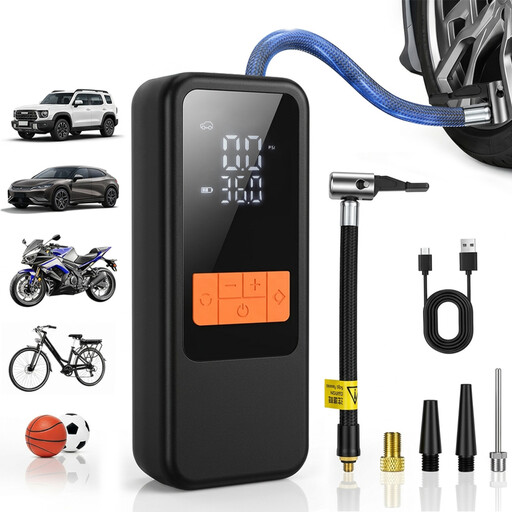
Why it suits this type of user : Its compact design is ideal for motorists, cyclists and motorcyclists who want to keep a pump close at hand, in the boot or in a bag.
Its five modes cover cars, motorbikes, bicycles and balls, with a custom setting. However, the shut-off should be monitored according to the selected mode and pressure.
A 4,000 mAh battery, a stated airflow of 26 L/min, a maximum pressure of 150 PSI and LED lighting with both a continuous mode and an SOS signal.
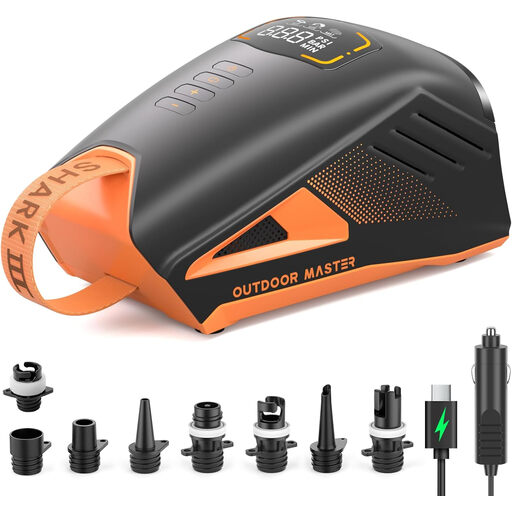
Why it suits this type of user : This pump is aimed at paddleboard and inflatable boat users looking for a dedicated electric solution for water sports.
The pressure is set using the digital display, and automatic shut-off kicks in at the selected value. However, keep the device away from water while it is in use.
A 74 Wh battery, a maximum pressure of 20 PSI, eight nozzles and a deflation function. The specification sheet states 3 min 50 s to inflate a 10.6-foot board to 15 PSI.
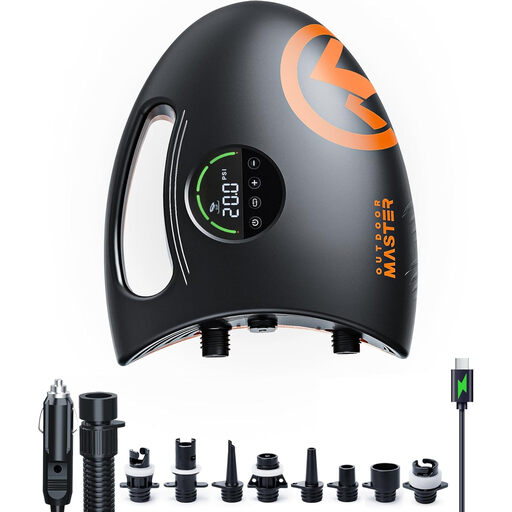
Why it suits this type of user : This model is designed for people who inflate several paddleboards or boats during the same outing and also want to deflate them quickly.
Its 88.8 Wh battery and cooling system are designed for repeated cycles. A break is still necessary if the device starts to heat up.
A maximum pressure of 20 PSI, automatic shut-off, dual Type-C and 12 V/15.8 V power supply, plus eight nozzles included.
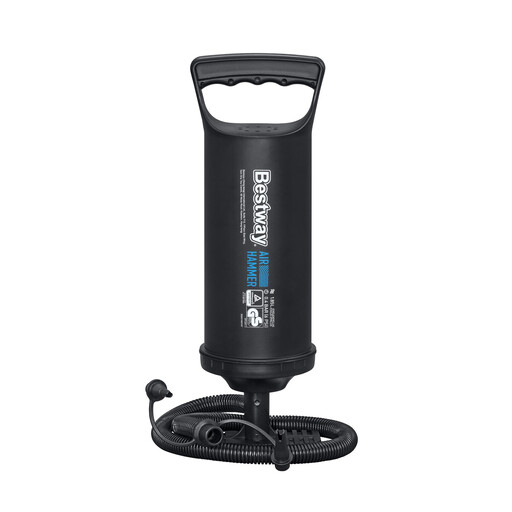
Why it suits this type of user : This manual pump is suitable for camping, mattresses, inflatable rings and inflatables, without relying on a battery or mains socket.
Its manual operation requires neither a socket nor a stated battery life. However, you must choose the correct nozzle and avoid over-inflating the equipment.
A volume per stroke of 1.85 L and bidirectional airflow, with three universal adaptors for mattresses, rafts, inflatable rings and inflatable toys.
We have selected a comprehensive range, updated in real time, of products that meet these demanding criteria and European safety standards.
To help your portable air pump last longer:
An electric pump must never be used in water or in the rain. With a manual model, regularly inspect the hose, adaptors and fittings.
Yes, some models are designed to do so. However, the time required depends on the motor’s power, the remaining pressure and the size of the tyre. For example, the Porbi Q16 specification states that it takes approximately 7 to 8 minutes to inflate an empty size 195 car tyre. For a simple top-up, the process is considerably quicker.
An air pump for a paddleboard must reach the pressure recommended for the board, generally between 12 and 20 PSI depending on the model. For regular inflation, an electric pump with a digital display, automatic shut-off, suitable nozzles and a deflation function provides welcome convenience.
The cost mainly depends on the battery capacity and the electricity required to recharge it. For occasional use, a rechargeable pump avoids the need to buy disposable batteries. Nevertheless, check the charging time, stated battery life and whether the device can be recharged via USB-C or directly in the car.