
Livraison le jour même ou le lendemain

Qualité garantie

Débloquez vos offres de bienvenue: Livraison GRATUITE | Jusqu'à -80 % | 30 jours d'essai gratuits à JoyPlus
Téléchargez l'application
The sun is shining, the water is calling… but before you can glide across the water on your board, there's the dreaded chore of inflation. The physical strain and precious minutes lost with a manual pump can quickly dampen your enthusiasm. An electric SUP pump transforms this thankless task into a mere formality and saves you valuable time on the water.
This guide is here to help you choose the perfect inflator for your needs. We'll break down the essential criteria and present our selection of the best current models, all without unnecessary marketing jargon.
Before jumping on the first model you see, let's review a few technical points that will make all the difference once you're at the water's edge.
The type of power source determines your freedom of movement and autonomy.
Most stand-up paddleboards require a pressure between 12 and 18 PSI (Pounds per Square Inch) to ensure optimal rigidity.
The weight, size, and included accessories should not be overlooked. A compact pump with a carrying handle will be much more pleasant to use. The inclusion of multiple nozzles ensures compatibility with your other gear (kayaks, towables, air mattresses...). Finally, some models offer a deflation function—a real bonus for quickly and effortlessly packing up your board.
We have selected a few models that stand out from the crowd and cater to different user profiles.
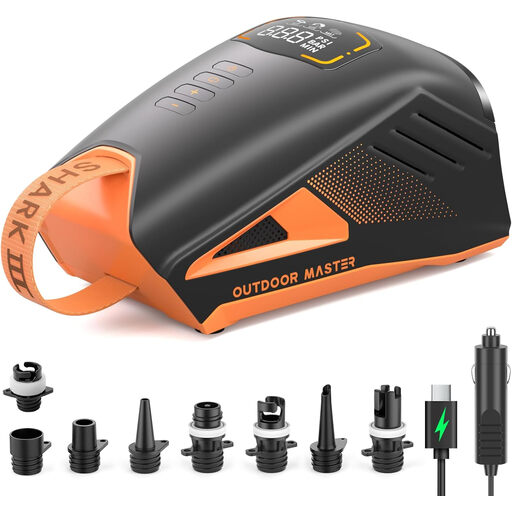
Why It Stands Out: This is the speed champion. According to the manufacturer, it can inflate a 10.6-foot board to 15 PSI in under 4 minutes—a record time for a battery-powered model.
Pros:
Who Is It For?: For those who often go out in groups or with family and want to spend less time prepping and more time on the water. Its speed and ability to handle consecutive inflations make it a formidable ally.
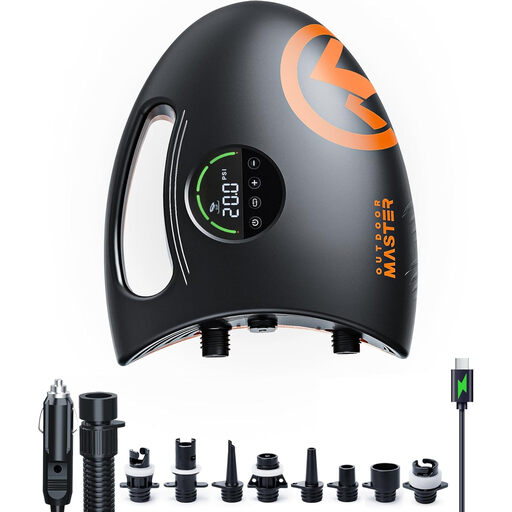
Why It Stands Out: This is the marathon runner of our selection. With its 88.8 Wh battery, this electric paddleboard inflator is an endurance beast, capable of inflating up to 6 boards on a single charge.
Pros:
Who Is It For?: Ideal for long sessions, van life weekends, or for paddle clubs and schools that need to manage a large number of boards far from any power outlet.
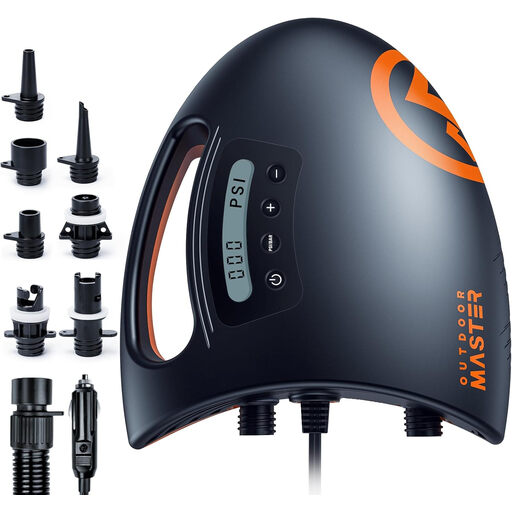
Why It Stands Out: A corded 12V model that's all about reliability and performance. Its active cooling system allows it to handle up to 3 consecutive inflations without needing a break.
Pros:
Who Is It For?: For the paddler who always drives to their spot and is looking for a simple, robust, and always-ready "plug-and-play" solution.
Our selection focuses on electric pumps, the accessory that changes the life of any inflatable paddleboard owner. If you're looking to upgrade your board or discover other gems for your aquatic adventures, feel free to explore our catalogue.
Discover our full range of paddleboards and accessories
Inflation time depends on the board's size, the target pressure, and the pump's power. On average, expect it to take between 5 and 10 minutes. The fastest models, like the Shark3, can even do it in under 5 minutes for a standard-sized board.
Bad idea. A tyre pump is designed to inject very high pressure into a small volume (a tyre). A paddleboard is the exact opposite: it needs a very large volume of air at a much lower pressure. Using a tyre compressor would be incredibly slow and would risk causing it to overheat and fail. An electric SUP pump is specifically designed for this purpose, particularly thanks to its dual-stage system.
PSI stands for Pounds per Square Inch, a unit of air pressure. A pump capable of reaching 20 PSI gives you a safety margin. It ensures you can inflate any board to its ideal pressure (usually between 15 and 18 PSI) without ever straining the motor. A properly inflated board is more rigid, more stable, and glides much better. Having this power reserve up to 20 PSI also ensures the motor isn't constantly running at full capacity, which contributes to its longevity.