
Livraison le jour même ou le lendemain

Qualité garantie

Débloquez vos offres de bienvenue: Livraison GRATUITE | Jusqu'à -80 % | 30 jours d'essai gratuits à JoyPlus
Téléchargez l'application
An inflatable paddleboard is easy to transport, fits neatly in a car boot and can be used on lakes, calm rivers or sheltered coastal waters. However, a well-presented product listing does not necessarily guarantee enjoyable outings. Insufficient width, an inaccurately assessed load or an unsuitable pump can quickly turn a peaceful trip into an endless inflating session.
Here are the key criteria to consider before buying an inflatable SUP board, along with a selection of models and accessories suited to different needs.
A long board is not necessarily stable. For a beginner paddleboard, width is the most important factor. Between 76 and 84 cm, you generally have a reassuringly broad surface on which to learn to stand and maintain your balance. By contrast, a narrower board may glide more efficiently, but it requires greater confidence and technique.
Thickness and internal construction also play an important role. A Drop Stitch or FortiFiber construction, when clearly specified, helps keep the walls close together under pressure. The result is a firmer, more enjoyable board than a basic inflatable model.
The load capacity refers to the total weight supported by the board, not just the user’s weight. You therefore need to add the rider, clothing, water, phone, dry bag and any additional accessories.
As the load approaches the limit, the board sits lower in the water and changing position becomes less comfortable. For regular outings, it is better to allow a sensible margin than to choose a paddleboard with paddle based solely on price.
A complete paddleboard kit may include a hand pump, an adjustable paddle, a fin, a safety leash, a carry bag and a repair kit. Check every item before ordering: some budget sets omit the leash or include a paddle that is awkward to adjust.
A high-pressure paddleboard pump with a pressure gauge reduces the risk of under-inflation. An electric SUP pump offers genuine convenience, particularly when several boards need inflating. It should, however, be kept a safe distance from the water and supplied with a compatible valve adapter.
For recreational use, a fairly wide all-round shape makes first outings easier and helps with minor course corrections. A 274 cm board may suit a teenager or an adult looking for relatively compact equipment. Models measuring 320 cm provide more length for touring, with the potential for a straighter, more consistent course.
Always compare:
The pressure should be stated clearly in bar or PSI. The Bestway Hydro Force Aqua Journey has a recommended pressure of 1.03 bar, or approximately 15 PSI. A pump with a pressure gauge allows you to check this value accurately, rather than relying solely on how firm the board feels.
Never exceed the pressure specified in the instructions. An electric pump capable of reaching 20 PSI may be suitable for several types of equipment, but that does not mean every board should be inflated to 20 PSI.
The inflatable paddleboards featured here generally weigh between 10 and 12 kg. A carry bag and integrated handle are particularly useful when walking to the shore or across a car park.
After every outing, rinse the board with fresh water, especially after use at sea or in chlorinated water. Dry it completely before deflating it. For storage, roll it up and keep it away from direct sunlight, persistent moisture and sharp objects.
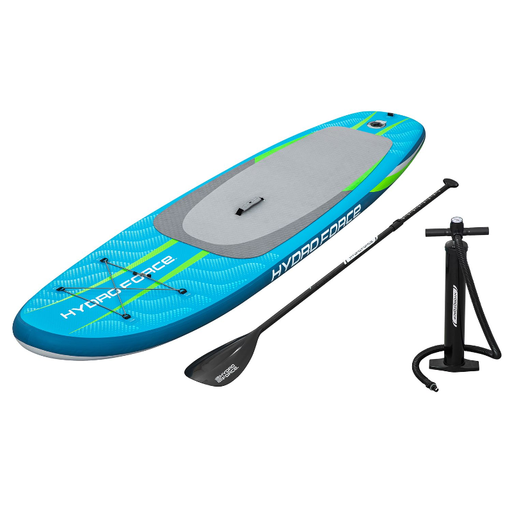
Why it suits this profile: its 274 × 76 × 12 cm dimensions and all-round shape make it suitable for first outings on lakes, calm rivers and sheltered coastal waters.
The stated maximum load is 100 kg, while the recommended pressure of 1.03 bar can be checked using the supplied pump.
The set includes an adjustable aluminium paddle, a removable fin, a leash, a carry bag and a repair kit.
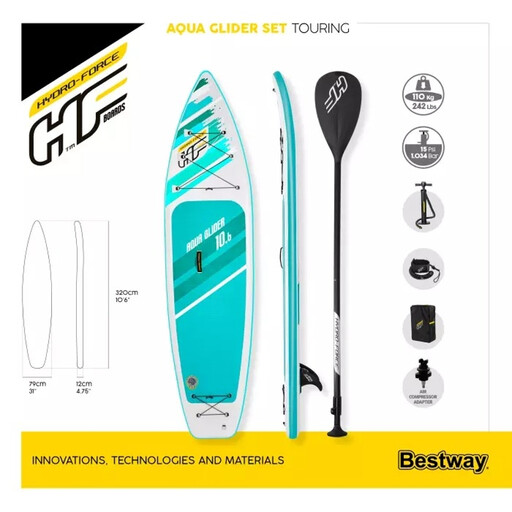
Why it suits this profile: measuring approximately 320 × 79 × 12 cm, this touring paddleboard is aimed at users who want to cover longer distances on relatively calm water.
At 79 cm wide, it offers a compelling balance between stability and directional tracking. The removable central fin also helps maintain a steady course.
The FortiFiber construction is described as rigid. The listed weight is 11.8 kg, with a recommended maximum load of 110.22 kg.
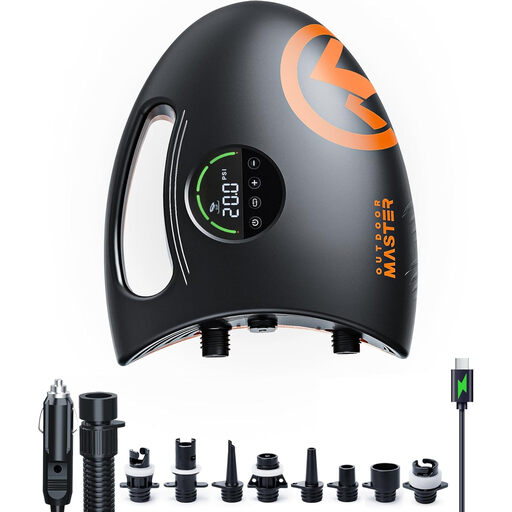
Why it suits this profile: its rechargeable 88.8 Wh battery and USB-C and 12 V ports meet the needs of users who inflate multiple pieces of equipment.
The digital display, automatic shut-off and deflation function help prevent pressure errors and make storage easier.
The product listing states a maximum pressure of 20 PSI, eight adapters and up to six SUP inflations per charge, depending on operating conditions.
We have brought together an up-to-date selection of products that meet these buying criteria and the safety requirements applicable in France.
Before every outing, check the pressure, valve, fin, paddle and leash. A high-pressure paddleboard pump must be kept away from the water while operating, particularly when connected to a 12 V socket or powered by a battery.
For users aged 14 to 17, adult supervision is recommended in accordance with the product guidance. Wear suitable buoyancy aid equipment: an inflatable board is not a lifesaving device. Stay in an area where you can remain in control, avoid strong currents, thunderstorms and large waves, and check the local navigation regulations.
With a hand pump, the time required depends on the board’s volume and the user’s physical condition. An electric pump reduces the effort and can shut off automatically once the set pressure has been reached. Times quoted by manufacturers, such as 3 minutes 50 seconds or 8 minutes 40 seconds, vary according to the model, target pressure and operating temperature.
This is possible for a short period if the board is kept in the shade, dry and protected from impacts. For longer-term storage, it is better to deflate, rinse and dry it thoroughly. Avoid direct sunlight: it can increase the internal pressure and accelerate material ageing.
Choose an all-round shape, a width between 76 and 84 cm, a load capacity suited to your total weight and a set that includes an adjustable paddle, a pump with pressure gauge, a fin, a leash and a carry bag. For frequent use or multiple boards, add an electric SUP pump compatible with the valve and recommended pressure.