
Livraison le jour même ou le lendemain

Qualité garantie

Débloquez vos offres de bienvenue: Livraison GRATUITE | Jusqu'à -80 % | 30 jours d'essai gratuits à JoyPlus
Téléchargez l'application
PFAS-free cookware is becoming increasingly popular with French households, particularly among those looking to limit their use of certain fluorinated compounds. However, marketing claims can sometimes be difficult to decipher. A frying pan advertised as “PFOA-free” is not necessarily PTFE-free, while a product described as “ceramic” may contain several layers whose composition should be checked.
Before buying a frying pan, saucepan or complete cookware set, three common pitfalls are worth bearing in mind:
To find PFOA-free cookware, you should also check the technical specifications for any PTFE and other PFAS. The statement “no intentionally added PFAS” does not necessarily mean that the product is explicitly declared to be “free from PFAS, PTFE and PFOA”.
Options to consider include:
Claims such as “free from toxic substances” should be treated with caution. They do not replace a detailed composition, usage instructions or the compliance information available on the product listing.
An induction-compatible frying pan generally has a magnetic base. However, the “all hobs” claim should still be confirmed in the product specifications: induction, gas, electric, ceramic or halogen.
Borosilicate glass deserves particular attention. Some models can be used directly on gas and electric hobs, but require an induction disc on an induction hob. You should also observe the maximum oven temperature and avoid thermal shock.
In a small kitchen, a stackable cookware set with removable handles can free up valuable cupboard space. For two people, a 20 to 26 cm frying pan is generally sufficient for everyday cooking. Families may prefer a 4-litre saucepan or a 28 to 32 cm wok.
Weight is another factor not to overlook: stainless steel and glass are durable, but can be heavier to handle. A removable handle makes it easier to move cookware from the hob to the oven, fridge or table, provided you check that it is securely locked before lifting the pan or saucepan.
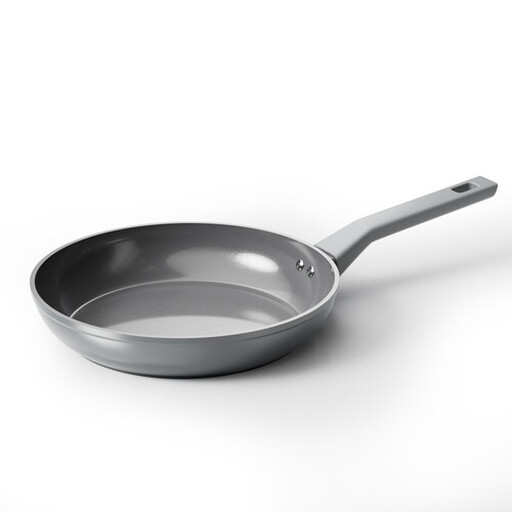
Why this choice suits this profile : With its 26 cm diameter, this frying pan is ideal for everyday meals — eggs, pancakes or vegetables — without requiring a collection of accessories.
The listing states that it is free from PFAS, PFOA and PTFE, and is compatible with induction, gas, electric, halogen and ceramic hobs.
This frying pan features a reinforced ceramic coating, an insulated handle and advertised dishwasher-safe cleaning. However, the listing recommends using non-metal utensils.
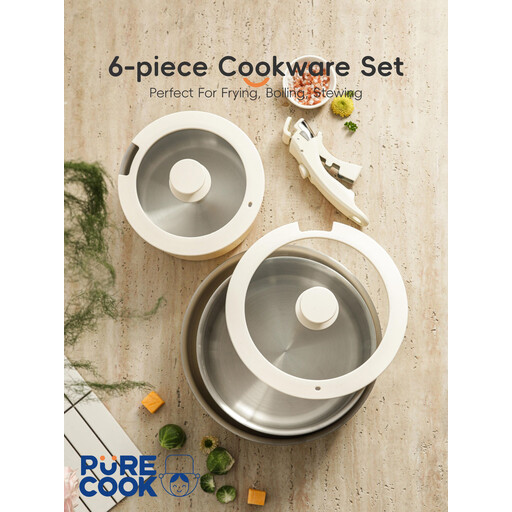
Why this choice suits this profile : This set includes a frying pan and two saucepans with a 304 stainless-steel interior, a removable handle and stackable components to keep your kitchen well organised.
The listing distinguishes the 304 stainless steel used inside from the exterior ceramic coating and states that it is free from PTFE and PFOA. This clarification helps remove ambiguity about the set’s construction.
The multi-layer construction, glass lid with silicone seal and stated compatibility with several heat sources make this a versatile set.
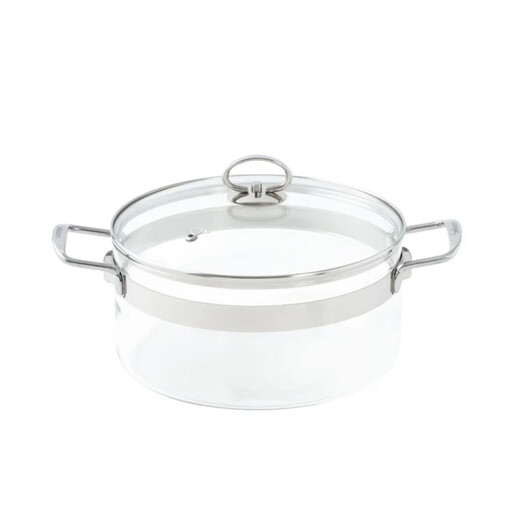
Why this choice suits this profile : Its 4.2-litre capacity is ideal for soups, pasta and vegetables prepared for several people. The glass also lets you monitor the cooking process directly.
The pan is described as having no coating and being free from PTFE and PFAS. However, the listing specifies that a disc is required on an induction hob and sets the oven’s maximum temperature at 180 °C.
Its non-porous borosilicate glass, practical transparency for everyday cooking and integrated pouring spout are its main advantages. Hand washing is recommended to preserve its clarity.
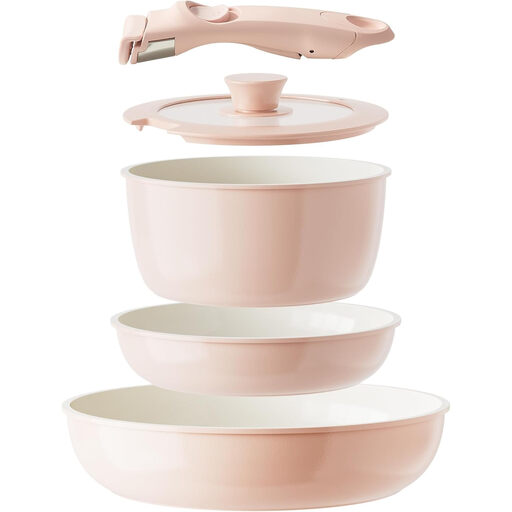
Why this choice suits this profile : This set includes a saucepan, two frying pans, a lid and a removable handle. Its design is particularly well suited to kitchens where every centimetre of space matters.
The listing states that the ceramic coating is free from PFAS, PTFE and PFOA, and is compatible with induction, gas and electric hobs.
The removable handles, stackable components and stated dishwasher compatibility make everyday cooking easier. Nevertheless, it is best to avoid metal utensils to help prevent scratches.
We have put together a complete, real-time updated selection of products that meet these demanding criteria, as well as European safety requirements.
A 304 stainless-steel wok can be perfectly suitable for regular cooking on gas, electric or induction hobs. However, you should check whether it has an interior coating. According to its product listing, the 32 cm PURECOOK model featured in this selection has a PTFE non-stick coating. It therefore does not meet the strict definition of cookware that is free from PFAS and PTFE, even though its outer structure is made from 304 stainless steel.
To cook without a coating, you will generally need to adjust the temperature, preheat the wok gradually and use enough fat to prevent food from sticking.
The lifespan of a cookware set depends less on marketing claims than on day-to-day care.
No. PFAS, PTFE and PFOA refer to different substances or families of substances. For a strict selection, look for an explicit statement covering all three and read the full technical specifications.
Not necessarily without an accessory. Some models, such as the Belissam saucepan featured here, require a compatible induction disc. Check this before buying.
It depends on how it is made, the cooking temperature and how it is cared for. Even a ceramic coating marketed as durable should be protected from scratches, thermal shock and repeated overheating.