
Livraison le jour même ou le lendemain

Qualité garantie

Débloquez vos offres de bienvenue: Livraison GRATUITE | Jusqu'à -80 % | 30 jours d'essai gratuits à JoyPlus
Téléchargez l'application
When shopping for a new pan, it's easy to get overwhelmed by complex marketing jargon. Between promises of "healthy cooking" and fancy-sounding technologies, it's hard to know what to choose. The result: disappointment is often just around the corner, with a product that doesn't live up to its promises. To ensure your purchase doesn't become a regret, here are the three main pitfalls to avoid.
This guide is designed to arm you against these pitfalls and help you identify the signs of a truly high-performing, healthy, and long-lasting PFAS-free ceramic pan.
To make an informed choice, you need to look beyond the design and focus on two technical pillars: the nature of the coating and the construction of the pan.
The term "ceramic" alone doesn't mean much. For true durability, it's better to opt for new-generation coatings. A titanium and diamond-coated pan is a prime example of this evolution: particles of diamond and titanium are integrated into the ceramic to reinforce it dramatically. This technology increases resistance to scratches and abrasion, which in turn extends the life of the non-stick effect.
Your mission: find non-toxic cookware. To do this, check that the product is explicitly guaranteed PFAS-free, PFOA-free, PTFE-free, lead-free, and cadmium-free. Only this comprehensive guarantee ensures healthier cooking, even at high temperatures.
A good pan is, first and foremost, a good conductor of heat. And it all comes down to its base. A pan compatible with all hobs, including induction, must have a thick, magnetic base. This is what guarantees rapid and uniform heat distribution, eliminating hot spots.
Versatility is another key criterion. An oven-safe pan opens up new possibilities: start cooking on the hob and finish it in the oven to brown a dish or keep it warm. To do this, make sure its handle (usually stainless steel) is designed to withstand high temperatures. The manufacturer must clearly state the maximum supported temperature (e.g., 260?°C). This is also often a sign of robustness and quality manufacturing.
Rather than an endless catalogue, we have selected three models that each meet a specific need, all while avoiding the classic pitfalls.
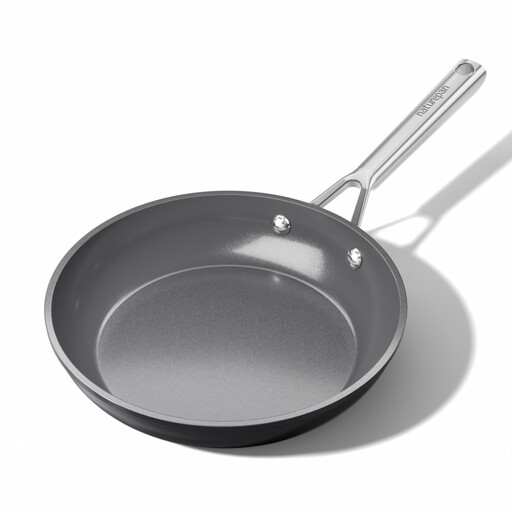
Why this model? Its 24 cm diameter is the perfect size for daily cooking, whether you're on your own or with a small group. It's versatile enough to sear meat, sauté vegetables, or whip up an omelette in a flash.
Its titanium and diamond-reinforced coating offers far better wear resistance than a basic entry-level ceramic. Its thick base ensures even heat distribution, so goodbye to the "burnt in the middle, raw on the sides" effect.
Rock-solid reliability for daily use. Compatible with all hobs (including induction) and oven-safe up to 260 °C.
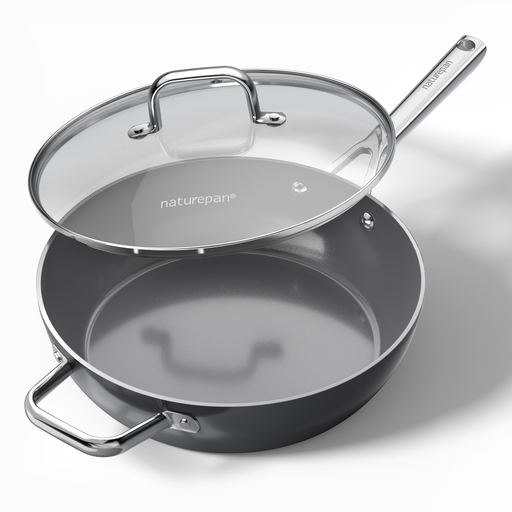
Why this model? With its large 28 cm diameter, high sides, and lid, this is the perfect sauté pan for family meals, generous sauces, or slow-cooked dishes. The go-to choice for "one-pot meals".
The explicit PFAS-free guarantee offers complete peace of mind, going far beyond a simple "PFOA-free" claim. Its sauté pan design minimises splatters and makes it much more versatile than a standard frying pan.
Its large capacity and high sides with a lid make it the perfect partner for saucy dishes and large family meals.
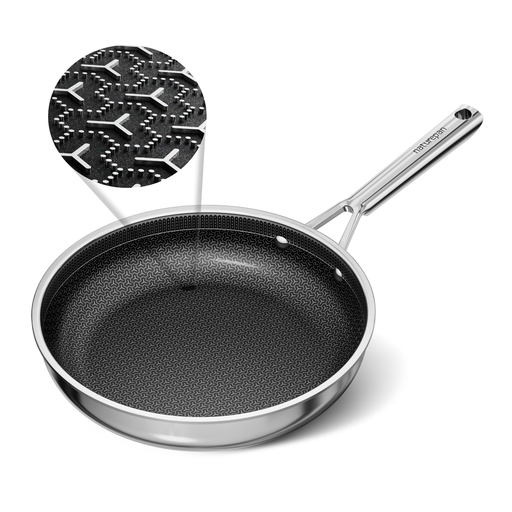
Why this model? For those who want a perfect sear on their meat without sacrificing an easy clean-up. This hybrid pan combines the best of both worlds: the performance of stainless steel and the convenience of non-stick.
Its laser-etched hexagonal pattern is ingenious: the stainless steel peaks allow you to sear food just like on a steel pan, while the non-stick coating, protected in the valleys, ensures nothing sticks. No more choosing between a perfect sear and a non-stick surface.
Its hybrid technology delivers a chef-worthy sear and enhanced durability, all with a PFAS-free guarantee.
We have curated a complete selection of products that meet our strict criteria for performance and safety.
The longevity of a durable pan depends primarily on its maintenance. A model with a reinforced coating (titanium, diamond) can last for several years if you take good care of it. To make it last, follow a few golden rules: cook on medium heat, avoid metal utensils in favour of wood or silicone, and prefer hand washing, even if the pan is dishwasher-safe.
Absolutely, provided you choose a model explicitly guaranteed to be PFAS-free, PTFE-free, PFOA-free, lead-free, and cadmium-free. The great advantage of these ceramic coatings is their perfect stability, even at high temperatures. Unlike some older coatings that could degrade and release harmful compounds if overheated, a quality ceramic is perfectly inert.
Maintenance is simple but crucial.