
Livraison le jour même ou le lendemain

Qualité garantie

Débloquez vos offres de bienvenue: Livraison GRATUITE | Jusqu'à -80 % | 30 jours d'essai gratuits à JoyPlus
Téléchargez l'application
In the search for healthier cooking, you're likely eyeing the PFOA-free ceramic pan, often touted as the ultimate healthy alternative to traditional coatings. The problem: the market is flooded with marketing promises that often lead to disappointment. As a cooking expert at Joybuy, my mission is to help you separate fact from fiction.
Before you commit, let's review the three classic traps that await the unsuspecting buyer.
To make the right choice, three technical criteria make all the difference between a short-lived gadget and a true kitchen ally.
The term "ceramic" refers to a silica-based coating (a sand derivative) applied to a metal body (usually aluminum or stainless steel). Its performance and longevity depend directly on its composition.
A good pan must heat up quickly and evenly. The quality of its base is what guarantees this.
A truly versatile pan simplifies your cooking. Check two key elements:
Rather than an endless list, here are three models that check all the boxes and meet specific needs, in line with our criteria for durability and safety.
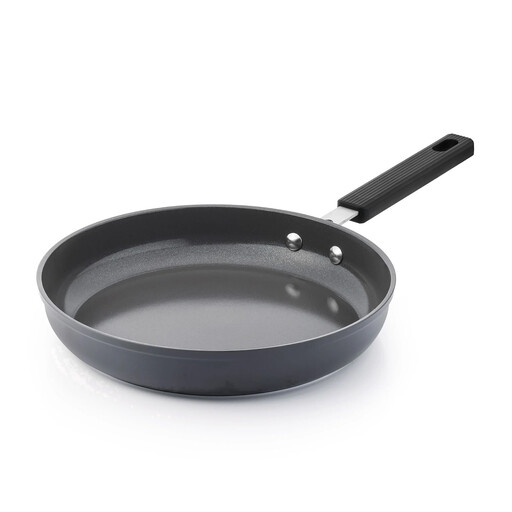
Why we chose it: Ideal for a single person or a couple, this 24 cm pan is perfect for omelets, fried eggs, or quickly cooking vegetables. Its practical size and easy maintenance meet the needs of a hassle-free daily kitchen routine.
It is explicitly guaranteed to be free of PFAS, lead, and cadmium, going far beyond the simple "PFOA-free" claim. Its base is designed for reliable performance on induction, preventing unpleasant surprises.
Ultra-easy cleanup (a simple wipe is often enough) and a stay-cool handle for safe everyday handling.
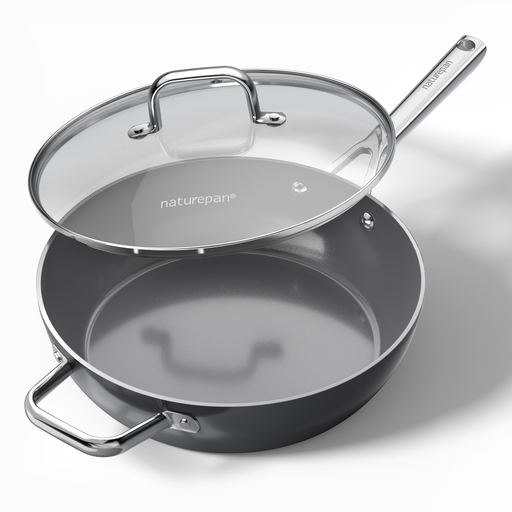
Why we chose it: With its high sides and included lid, this 28 cm sauté pan is the ultimate versatile tool for families. It allows you to sear, simmer, or prepare saucy dishes for several people without splatters.
Its coating is reinforced with titanium and diamond particles, offering far superior wear resistance compared to standard ceramic. Compatible with all stovetops, including induction, it is also oven-safe up to 260°C (500°F), ensuring rock-solid versatility.
It doubles as a Dutch oven thanks to its high sides and lid. Its stainless steel handle allows for a direct transition from stovetop to oven, a key feature for an **oven-safe pan**.
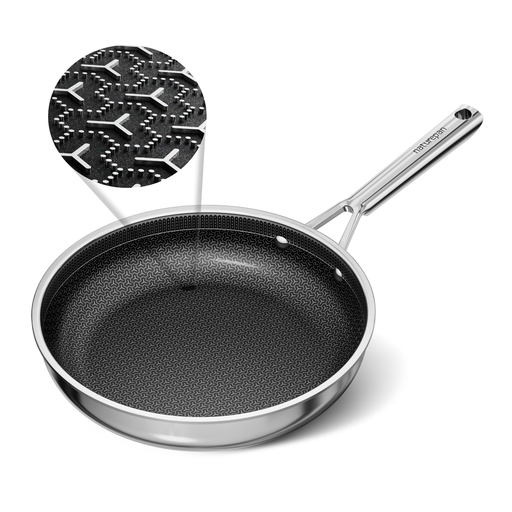
Why we chose it: Aimed at those who want the searing performance of stainless steel and the convenience of non-stick. This hybrid pan is designed for cooks who refuse to compromise between a perfect sear and foolproof non-stick performance.
The hybrid technology with a hexagonal pattern solves the dilemma between durability and non-stick. The raised stainless steel structure protects the recessed ceramic coating, preventing premature wear while ensuring pro-level searing.
5-ply construction with a hexagonal surface for superior searing and durable non-stick performance. Its promise: much better scratch resistance than 100% ceramic coatings.
We have compiled a complete selection of products that meet our strict quality and safety criteria.
The longevity of a ceramic pan varies enormously depending on the quality of its coating and its maintenance. An entry-level model can fail in less than a year. On the other hand, a titanium ceramic coating or other reinforced coating, when properly maintained, can retain its performance for several years.
To preserve your pan, follow these golden rules:
Yes, a pan with a quality ceramic coating, guaranteed PFAS-free, is considered a very healthy option. The material is stable and will not release controversial compounds into your food, even in case of accidental overheating. Another health benefit: its non-stick properties allow you to cook with very little fat, contributing to a lighter diet.