
Livraison le jour même ou le lendemain

Qualité garantie

Débloquez vos offres de bienvenue: Livraison GRATUITE | Jusqu'à -80 % | 30 jours d'essai gratuits à JoyPlus
Téléchargez l'application
Looking for healthier cooking and effortless cleanup? The non-stick ceramic pan is becoming a top choice for many. With its promise of a surface that food won't stick to, free from controversial compounds (PFOA, PFAS), it seems like the perfect solution. But be warned: not all pans are created equal, and slick marketing promises often hide real-world disappointments. Before upgrading your cookware, it's essential to know how to decode labels and avoid common pitfalls to make a truly worthwhile investment.
Navigating the jungle of options can quickly become overwhelming. Many manufacturers make appealing claims that do a poor job of hiding significant weaknesses. Here are the key points to watch out for:
To be sure of your future pan's quality and lifespan, rely on objective technical features, not advertising slogans.
For healthy cookware, the first step is to check for the absence of undesirable substances. Look for explicit labels: PFOA-free, PFAS-free, PTFE-free, lead-free, and cadmium-free.
But composition isn't everything; durability is crucial. New-generation coatings are often reinforced with mineral particles to boost their resilience:
Cooking performance depends directly on the pan's construction.
In daily use, it's the practical details that make all the difference.
To illustrate these criteria in practice, here are some products that meet specific needs while avoiding the market's classic traps.
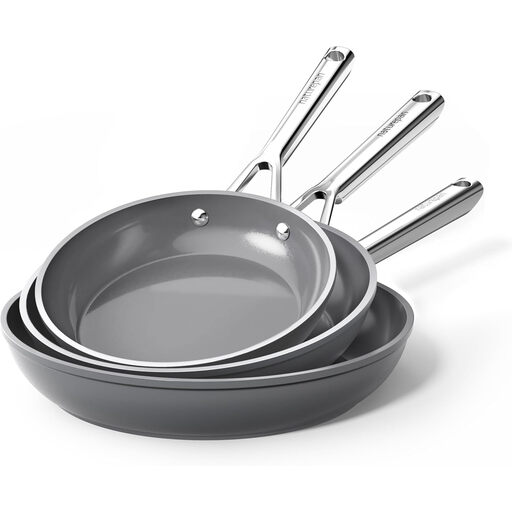
Why we chose it: From a fried egg in the morning to a family dinner, this set covers all your daily needs. Its three sizes (20, 24, and 28 cm) offer perfect flexibility to always cook the right amount.
The diamond and titanium-reinforced coating directly addresses the durability problem. All-hob compatibility, including induction, is ensured by a thick, optimised base.
A complete and robust set, guaranteed free of harmful compounds (PTFE/PFOA/PFAS) and oven-safe up to 260°C for total versatility.
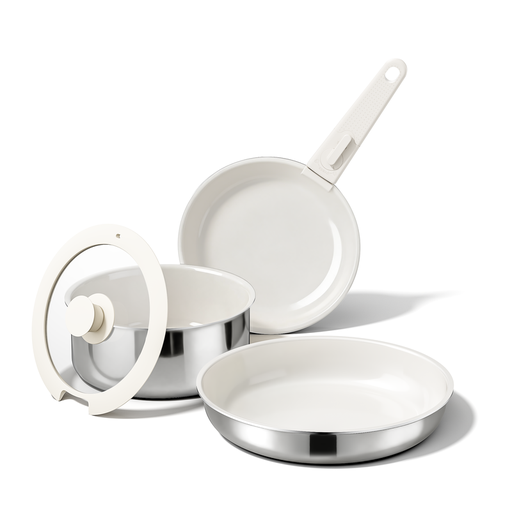
Why we chose it: The perfect solution for those short on space. The removable handle allows you to stack pans and pots for dramatic space-saving in your cupboards. It's the prime example of a well-designed **ceramic cookware set**.
This set tackles the problem of clutter head-on. Its stackable design and single handle make storage simple and efficient. The triple-layer base guarantees excellent responsiveness on induction hobs.
Phenomenal space-saving thanks to the removable handle. Ultimate versatility: the set goes from the hob to the oven, then straight to the table or into the fridge.
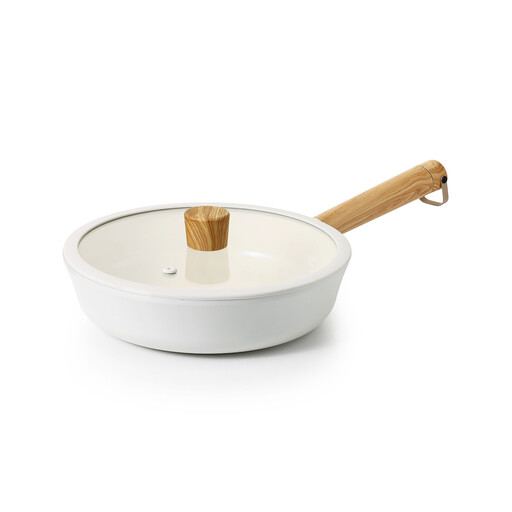
Why we chose it: With its high sides and lid, this is the perfect tool for sautéing vegetables, preparing a saucy dish, or simmering a meal without making a mess. A single, versatile piece that replaces several others.
The brand is transparent about its materials: the composition is clearly stated as free from PTFE, PFAS, lead, and cadmium. Its magnetic base is designed for optimal heat distribution on all hobs, including induction.
Its deep sauté pan design with a lid makes it ultra-versatile, able to adapt to a multitude of recipes, from a quick stir-fry to a slow-simmered dish.
We have put together a complete selection of products that meet our quality criteria and current safety standards.
What is the lifespan of a ceramic pan? It all depends on the quality of the coating and how you care for it. An entry-level model will barely last a year before it starts to stick. Conversely, a quality pan with a reinforced coating that is well-maintained (no overheating, use of proper utensils, hand washing) can perform well for 3 to 5 years, or even longer.
How do I care for my ceramic pan to make it last? To maximise its lifespan, adopt these simple habits:
Is a ceramic pan really healthier? The main health advantage of modern ceramic coatings is that they are guaranteed to be made without PFOA or PFAS. These substances, found in older Teflon-type coatings, have been flagged for their risks to health and the environment. And of course, an effective non-stick surface means less oil or butter is needed for cooking. That's always a win for lighter everyday cooking.