
Livraison le jour même ou le lendemain

Qualité garantie

Débloquez vos offres de bienvenue: Livraison GRATUITE | Jusqu'à -80 % | 30 jours d'essai gratuits à JoyPlus
Téléchargez l'application
Choosing a new frying pan often means drowning in marketing jargon: "healthy coating," "durable non-stick," "PFOA-free." The goal is admirable: to equip yourself for healthy cooking without food sticking. The problem? The market is flooded with products that make tempting promises but often disappoint in practice. Our mission as experts is to clear the path for you and help you identify the criteria that truly matter.
To avoid buyer's remorse, here are the three most common pitfalls to absolutely avoid:
To avoid these traps, simply focus on a few objective technical features. These are the real deciding factors that will determine the quality and durability of your future pan.
The term "ceramic" alone is not enough. Today's most durable coatings are reinforced to better withstand daily wear and tear. Look for terms like titanium ceramic coating or reinforced with diamond particles. These additions significantly increase the surface's hardness, its resistance to scratches (with appropriate utensils), and extend its non-stick properties. A quality coating allows for cooking with very little fat and makes cleaning incredibly easy.
The performance of a non-stick induction pan depends entirely on its base. A thick, encapsulated base (often a layer of aluminium sandwiched in stainless steel) is essential for two reasons:
Also, check if the model is an oven-safe pan. This versatility allows you to start cooking on the hob and finish it in the oven, ideal for browning a dish or keeping it warm. Pay attention to the maximum supported temperature, which often depends on the handle material.
Rather than an exhaustive list, here are options that meet specific needs, taking into account the durability and performance criteria we've discussed.
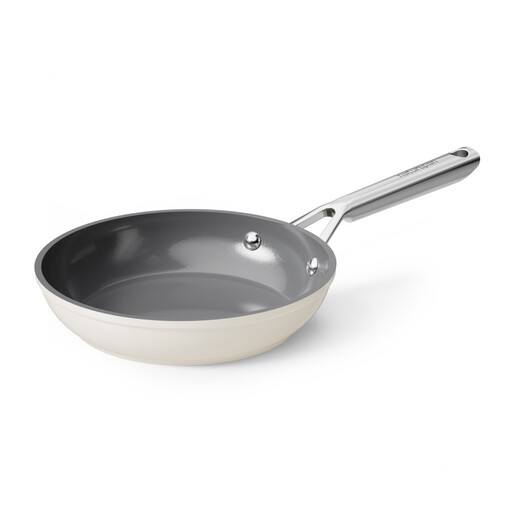
Why this model stands out: With its versatile 24 cm diameter, this pan is ideal for meals for 2 to 3 people. Compact enough for daily use, it's perfect for searing meat, sautéing vegetables, or making an omelette.
Its titanium and diamond-reinforced ceramic coating is designed for enhanced durability. Its thick base ensures even heat distribution on induction hobs, preventing cooking mishaps.
Its versatility is total: compatible with all hobs, including induction, it's also oven-safe up to 230 °C. A real bonus for browning or finishing a dish.
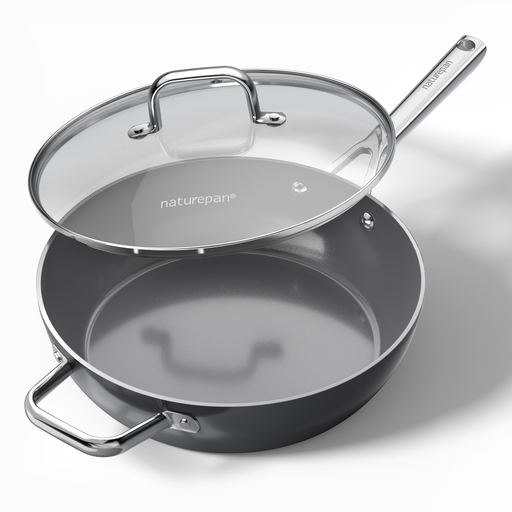
Why this model stands out: For families or fans of saucy dishes, a standard frying pan often feels cramped. This 28 cm ceramic sauté pan with its high sides and lid is perfect for stews, braised meats, or one-pot meals, all while minimising splatters.
Its design (high sides, lid) makes it a 2-in-1 tool, serving as both a sauté pan and a small Dutch oven. The reinforced coating is suitable for the longer cooking times of slow-cooked dishes.
Its large capacity and lid make it perfect for dishes with sauce. It is also oven-safe up to 260 °C, a rare and highly appreciated feature.
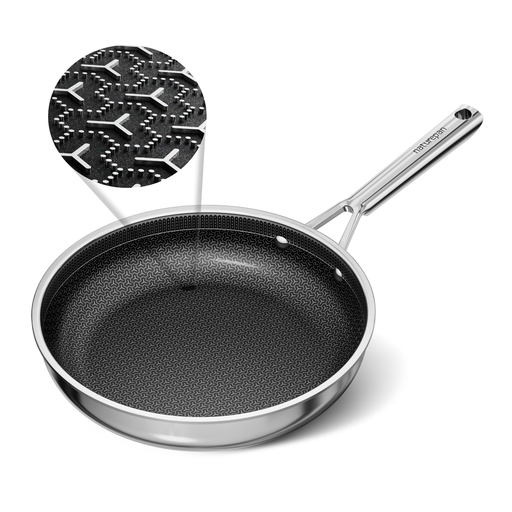
Why this model stands out: For those who love to sear a steak or fish fillet to perfection, this hybrid pan combines the best of both worlds: stainless steel ridges for perfect caramelisation (the Maillard effect!) and a ceramic base to ensure nothing sticks.
This hybrid technology ends the dilemma between a perfect sear (the domain of stainless steel) and non-stick performance (the strength of ceramic). The structure is also more resistant to metal utensils than 100% ceramic pans.
Unmatched cooking performance for searing meats and enhanced durability, thanks to its 5-ply construction and textured surface.
We have selected a full range of products that meet these quality criteria and current safety standards.
The longevity of a ceramic pan depends on two factors: the quality of its initial coating and its maintenance. A basic coating can lose its non-stick properties in less than a year. A reinforced ceramic coating (titanium, diamond), when used with care, can maintain its effectiveness for several years.
A few simple steps will extend the life of your pan:
Yes, many models are designed for it. The limitation usually comes from the handle. Stainless steel or cast iron handles allow for use in the oven at high temperatures (often over 200°C). Handles made of Bakelite or other heat-resistant plastics have a lower limit or are not compatible at all. Always check the maximum temperature indicated by the manufacturer for your oven-safe pan.