
Livraison le jour même ou le lendemain

Qualité garantie

Débloquez vos offres de bienvenue: Livraison GRATUITE | Jusqu'à -80 % | 30 jours d'essai gratuits à JoyPlus
Téléchargez l'application
Choosing your cookware can be a real headache. You want a non-stick ceramic pan for healthier everyday cooking, but between the technical jargon and marketing promises, it's hard to know what to believe. The goal is simple: to find that perfect pan that is high-performing, durable, and safe for your health. Yet, how many of us have ended up with a pan that starts sticking after just a few months?
Our editorial team's mission: to do the legwork for you. We've identified the 3 common pitfalls to avoid so you never throw your money away again.
To avoid falling into these traps, focus on objective criteria.
Before you pull out your credit card, carefully examine these three technical points. They are the fundamentals for judging the quality, durability, and safety of your future pan.
The heart of the matter for a non-stick ceramic pan is its coating. It is generally created using a "sol-gel" process, which transforms a silica derivative (quite simply, sand) into a glassy, non-porous surface.
The crucial point to check: certification as PFOA, PFAS, PTFE, lead, and cadmium-free. These intimidating acronyms refer to chemical compounds sometimes used in older coatings that are now flagged for their potential health effects. A reputable manufacturer will always display these guarantees in black and white. Some coatings are also reinforced with titanium or diamond particles to improve their abrasion resistance.
Cooking performance depends not only on the coating but also on the material that supports it.
An essential check: compatibility with your stovetop. For an induction ceramic pan, the base must include a ferromagnetic disc. This information is always indicated by a spiral-shaped pictogram.
A good pan should adapt to your recipes. The ability to move it from the stovetop to the oven is a real bonus for finishing a dish with a gratin or keeping it warm. Check the maximum temperature supported by the pan and its handle. An oven-safe pan will open up new culinary horizons.
Finally, durability also comes down to maintenance. Although many models claim to be dishwasher-safe, washing by hand with a soft sponge remains the best way to extend the life of the non-stick coating.
To move from theory to practice, here is our selection of models that tick all the boxes, for different uses and budgets.
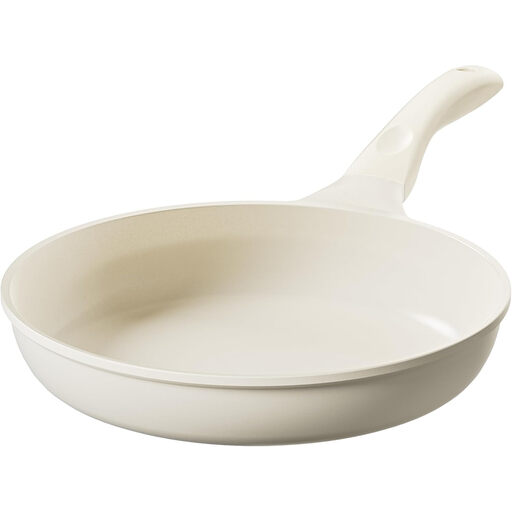
The editor's verdict: Perfect for daily use, this 28 cm pan is ideal for cooking eggs, searing a steak, or sautéing vegetables for two to three people. Its light weight and cool-touch Bakelite handle make it very easy to manage.
It tackles the vague "health" claim head-on by being transparent: a ceramic coating guaranteed free of PTFE/PFOA/PFAS, for total peace of mind in the kitchen.
Its thick base ensures fast, even heating on all stovetops, including induction. As for cleaning, it's a breeze: a simple wipe with a sponge is all it takes.
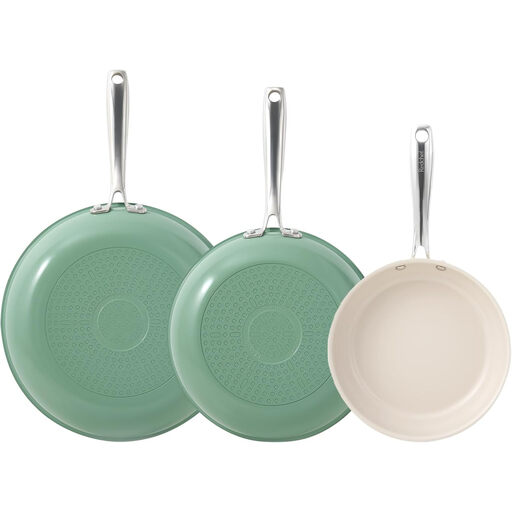
The editor's verdict: This ceramic pan set (20, 24, and 28 cm) is the perfect solution for families or anyone who loves to juggle multiple preparations. It covers every need, from a small omelette to a simmering stew.
This set debunks the myth of the fragile pan. Its secret weapon? It's oven-safe up to 450°C, a rare feature that lets you go from stovetop to oven without switching dishes.
The forged aluminium body ensures rapid and even heat distribution across all sizes, eliminating hot spots for perfectly controlled cooking every time.
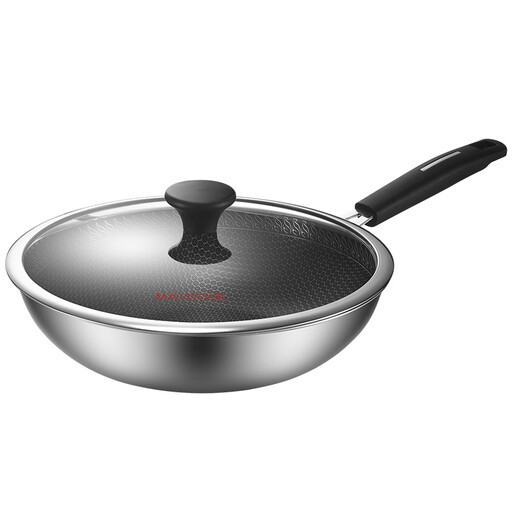
The editor's verdict: This ceramic wok is built for those who demand robustness and performance. Its 3-ply stainless steel structure is made to last and handle high-heat cooking, like Asian stir-fries.
It addresses the main weakness of coatings: scratches. Its defence? A honeycomb interior texture that protects the ceramic surface from direct contact with utensils, significantly increasing its longevity.
The combination of stainless steel and protected ceramic offers the best of both worlds: the durability and responsiveness of steel with the healthy, non-stick properties of ceramic.
Discover our full selection of products that meet our demanding specifications for performance and safety.
It all depends on how you use and care for it. On average, a good quality ceramic coating, used with care (no metal utensils, no overheating while empty, hand washing preferred), will retain its non-stick properties for 2 to 3 years. Models with reinforced coatings or protective structures can last much longer.
This should be strictly avoided. Metal utensils (forks, knives, stainless steel spatulas) can scratch and damage the coating, destroying its non-stick properties. Always opt for utensils made of wood, silicone, or nylon. The only exception is certain models with a honeycomb structure specifically designed to protect the coating.
To maximise the life of your pan: