Households that make their own mix
You regularly use a cereal base and prefer to choose what you add yourself. Plain porridge oats need to be prepared this way, unlike muesli, which is already mixed.


When shopping with diabetes in mind, choose between ready-to-serve muesli and porridge oats based on the recipe, your usual portion and how much time you have to prepare it, rather than pack size alone. Compare the carbohydrate and sugar content per 100 g, then check the amount you actually eat: ‘no added sugar’ does not mean there are no naturally occurring sugars in dried fruit.
You regularly use a cereal base and prefer to choose what you add yourself. Plain porridge oats need to be prepared this way, unlike muesli, which is already mixed.
You want a mix of cereals and dried fruit without any extra preparation. ‘No added sugar’ doesn’t mean you can skip checking the carbohydrate and sugar information on the label.
Check the recipe on the pack you’re buying, including which cereals it contains and any ‘may contain’ warnings. Another product or recipe from the same brand may have different information.
For food shopping when managing diabetes, Assurance Maladie advises checking the nutrition information per 100 g against the amount you actually eat. This applies to ready-to-serve muesli just as much as it does to porridge oats.
| What to check | Look for | Who is this useful for? |
|---|---|---|
| Carbohydrates and sugars | Compare the ‘carbohydrates’ and ‘of which sugars’ figures per 100 g, then check them against your portion. Read the ingredients list too. | If I choose a dried-fruit muesli, I want to know how much sugar is in the amount I’ll serve, even if it has no added sugar; around 42% of shoppers make this a priority. |
| Pack size and preparation | Check the net weight, the storage space you’ll need and whether you’ll use the pack up after opening. | In a household that eats cereal regularly, I prefer a pack that suits our routine, even if I have to make the mix myself; around 33% of shoppers prioritise this when choosing a format. |
| Recipe and allergens | Read the ingredients and allergen information on the pack of the product you’re considering. | If certain ingredients are a problem for someone in my household, the recipe’s suitability matters more than the packaging; this is the main concern for around 25% of shoppers. |
As Anses points out, this claim doesn’t mean the product contains no sugar at all. Auchan’s product listing for BJORG raisin, fig, date and apricot muesli gives a sugar content of 14 g per 100 g.
Read the ingredients list and the ‘of which sugars’ figure, then check how it compares with your portion.
A pack of porridge oats and a dried-fruit muesli aren’t equivalent recipes: the oats need additions, while the muesli is already mixed.
Check the ingredients and storage instructions before buying several packs.
Making your own mix also means planning which ingredients to add and allowing time to prepare it.
Manger Bouger describes Nutri-Score as a way to compare products in the same aisle. It doesn’t replace checking the carbohydrates, sugars, ingredients and portion you eat.
Use it to compare like-for-like products, then read the nutrition information for each one.
Auchan’s product listing for BJORG dried-fruit muesli flags cereals containing gluten and possible traces of other allergens, including milk, nuts, sesame and soya.
Check the information on the pack you’re actually buying, even if you’re already familiar with the brand.
The range includes organic dried-fruit mueslis, including a raisin, fig, date and apricot variety sold in a 750 g pack on Auchan’s website.
Carrefour offers a 375 g pack of organic fruit muesli with no added sugar.
The 1 kg product listed by E.Leclerc contains porridge oats, which you can use as the base for a mix made at home.
E.Leclerc offers a 500 g pack of organic flaked muesli with dried fruit.
These products cover two different ways to enjoy cereal: serving ready-made muesli or making your own mix from porridge oats. Pack weight alone won’t tell you which option is right for you.
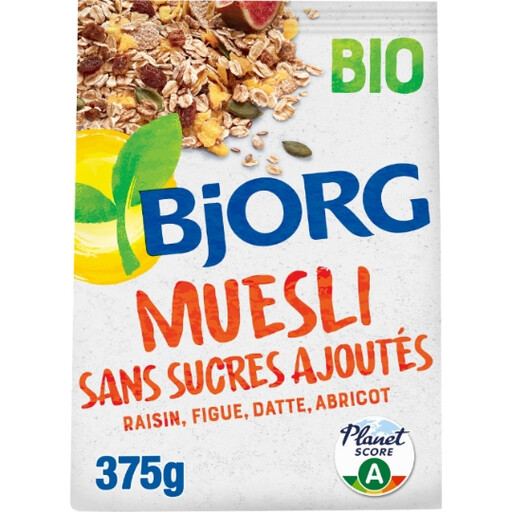 Image unavailable
A ready-made muesli for anyone who’d rather not prepare their own mix. For this 375 g variety, Joybuy lists 14 g sugars per 100 g. Check the pack for the full nutrition information and ingredients before choosing your portion.
 Image unavailable
A base to add to if you prefer choosing the ingredients in your mix. This pack contains 500 g of organic porridge oats. Check the label to compare nutrition information and look for allergen warnings.
 Image unavailable
Porridge oats to prepare or add to, rather than ready-to-serve fruit muesli. This is a 500 g pack; check the ingredients and nutrition information per 100 g on the label before comparing it with another oat base.
 Image unavailable
An instant oat base for making your own mix, in a 700 g bag. Before comparing it with other products, check the packaging for the ingredients and the ‘carbohydrates’ and ‘of which sugars’ figures per 100 g.
No. Anses explains that this claim doesn’t rule out sugars naturally present in the ingredients. For dried-fruit muesli, check the ‘of which sugars’ figure per 100 g and compare it with the portion you eat.
No. Manger Bouger describes it as a tool for comparing products in the same aisle. When shopping with diabetes in mind, check the carbohydrates, sugars, ingredients and the amount you plan to serve too.
There isn’t one portion size that suits everyone. Assurance Maladie says quantities should be tailored to individual needs. Compare the figures per 100 g with your usual portion, and talk to your healthcare professional about making a personal adjustment.
DGCCRF says that the labelling on pre-packed foods includes information such as the ingredients list, nutrition declaration and net quantity. This information helps you check the recipe and compare products used in the same way.
Follow the instructions on the packaging. For the BJORG dried-fruit muesli listed by Auchan, the retailer advises resealing the pack tightly and keeping it somewhere dry.