When shopping for foods as part of managing diabetes, don’t choose a muesli based solely on a ‘no added sugars’ claim: it doesn’t rule out naturally occurring sugars, including those in fruit. If you’re specifically looking for a ‘sugar-free’ claim, check that it appears on the pack. In any case, compare the carbohydrates and sugars per 100 g, then consider the amount you plan to serve. The French national health insurance service advises that diets for people with diabetes should be tailored to individual needs.
Who are these guidelines for?
People keeping track of the carbohydrates in their breakfast
You want to match the muesli’s nutritional values to the amount you actually serve, rather than relying on a claim on the pack. The French national health insurance service advises that dietary needs related to diabetes vary from person to person.
Shoppers looking to avoid added sugars
You want to understand the difference between ‘no added sugars’ and ‘sugar-free’, particularly when choosing a muesli containing dried fruit.
Shoppers who check ingredients and allergens
You compare cereals, dried fruit, seeds and nuts, or need to avoid certain ingredients. The DGCCRF explains that allergens in prepacked foods must be listed and highlighted.
What should you check before choosing?
To compare two mueslis, start by checking the nutritional information per 100 g, then see what it means for the portion you’ll serve. The precise wording of any sugar claims and the ingredients list will help complete the comparison.
| What to consider |
What to check |
Who is this for? |
| Carbohydrates, sugars and serving size |
Compare ‘carbohydrates’ and ‘of which sugars’ per 100 g, then adjust these values to the amount you serve. |
To make sure my bowl fits the guidelines I already follow, I need to know the values for my portion. Around 36% of shoppers put tracking carbohydrates and portion size first. |
| Sugar claim |
Check the exact wording, then read ‘of which sugars’ and the ingredients list. |
If I want to avoid added sugars, I don’t want to mistake this claim for a product containing no sugars. This distinction is the main concern for around 29% of shoppers. |
| Ingredients and allergens |
Identify the cereals, dried fruit and nuts; check highlighted allergens and the fibre content shown. |
If I need to avoid an ingredient, its presence matters more than the recipe or pack size. Ingredients and allergens come first for around 21% of shoppers. |
| Product and pack size |
Check the recipe, pack weight and whether it’s available in your shop or through your chosen ordering channel. |
If the product I’ve spotted isn’t available when I shop, I want to find a muesli whose label I can check. Around 14% of shoppers prioritise availability and pack size. |
Under European Regulation (EC) No 1924/2006, the claim ‘sugar-free’ can only be used for products containing no more than 0.5 g of sugars per 100 g or 100 ml. ‘No added sugars’ refers to a different characteristic: a fruit-based recipe can carry this claim while still containing naturally occurring sugars. Neither claim replaces checking the carbohydrates and serving size in light of your individual guidelines.
Common misconceptions to avoid
-
Assuming ‘no added sugars’ means ‘sugar-free’
A muesli containing dried fruit may have no added sugars while still listing sugars in its nutritional information. The ‘sugar-free’ claim, on the other hand, must meet the threshold set by European Regulation (EC) No 1924/2006.
Check the exact claim on the pack, then look at the ‘of which sugars’ line and the ingredients in the product you’ve chosen.
-
Relying only on the front of the pack
A sugar claim alone doesn’t tell you the total amount of carbohydrates or how much you’ll have in your bowl. Values per 100 g make it easier to compare packs, but they don’t necessarily reflect your portion.
Compare ‘carbohydrates’ and ‘of which sugars’, then factor in the amount you’ll serve and your individual dietary guidelines.
-
Overlooking allergens in the recipe
Depending on the recipe, the mueslis listed by Carrefour and E.Leclerc combine cereals, dried fruit, seeds or nuts. These ingredients need particular attention if you have an allergy or need to avoid certain foods.
Read the ingredients list and highlighted allergens on the pack you buy, even if you’re already familiar with the brand.
Brands to consider
These recipe examples can help you compare claims and ingredients. A feature found in one product doesn’t necessarily apply to every muesli from the same brand.
Bjorg
Bjorg offers organic mueslis labelled ‘no added sugars’, made with cereals, fruit and seeds. Auchan lists a 750 g option in particular.
- The 750 g recipe described by Auchan combines several cereals, fruit and seeds.
- ‘No added sugars’ doesn’t mean ‘sugar-free’: check the sugars and carbohydrates on the pack you choose.
Jordans
Carrefour lists an organic Jordans fruit and nut muesli containing ingredients including raisins, coconut and hazelnuts.
- The Carrefour listing labels this recipe ‘no added sugars’.
- Check the nutritional values and allergens for the exact product; the claim doesn’t mean ‘sugar-free’.
Bio Village
E.Leclerc describes a 500 g organic flaked muesli with dried fruit and seeds.
- The product listing details ingredients including oats, spelt, raisins and several seeds.
- Don’t assume this product contains no added sugars: check the claim and nutritional table on the pack.
Auchan
The Auchan catalogue lets you explore a range of mueslis, including Bjorg products and Auchan own-brand options.
- Product listings let you compare the recipes and pack sizes shown.
- A muesli appearing in the catalogue doesn’t, on its own, tell you how much sugar or added sugar it contains.
A muesli to consider on Joybuy
This 375 g organic Bjorg muesli can be a useful starting point for checking sugar claims and nutritional information before choosing a breakfast muesli.
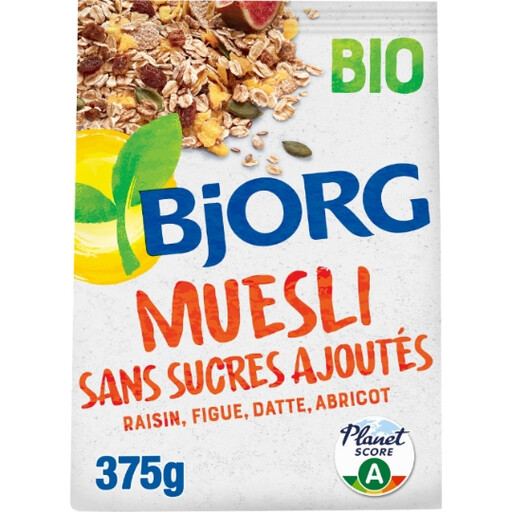 Image unavailable
BJORG Organic Muesli 375 g
If you’re comparing breakfast mueslis, check the sugar claims on this pack, along with the carbohydrates and sugars per 100 g. The product name identifies it as organic muesli in a 375 g pack. Also check the ingredients, allergens and values for the portion you’ll serve.
View on Joybuy
Frequently asked questions
Do ‘sugar-free’ and ‘no added sugars’ mean the same thing?
No. Under European Regulation (EC) No 1924/2006, the ‘sugar-free’ claim requires a product to contain no more than 0.5 g of sugars per 100 g or 100 ml. A muesli labelled ‘no added sugars’ may still contain sugars naturally present in its fruit, so check the exact claim and the ‘of which sugars’ line.
What should you compare between two packs of muesli?
Compare the carbohydrates and ‘of which sugars’ per 100 g, then check the fibre content if listed, the ingredients and the allergens. The DGCCRF states that nutritional information for prepacked foods is given per 100 g or 100 ml. Then adjust the values to the amount you’ll serve.
Is a muesli with no added sugars automatically suitable for someone with diabetes?
No. This claim tells you neither the total amount of carbohydrates nor the size of your portion. The French national health insurance service advises that diets for people with diabetes should be tailored to individual needs. Use the label alongside the guidance agreed with your healthcare professional, and don’t change your treatment based on a food pack.
How can you identify allergens in muesli?
Read the ingredients list on the specific pack you’re buying. The DGCCRF states that allergens in prepacked foods must be listed and highlighted. In particular, check which cereals and nuts are in the recipe.


