
Livraison le jour même ou le lendemain

Qualité garantie

Débloquez vos offres de bienvenue: Livraison GRATUITE | Jusqu'à -80 % | 30 jours d'essai gratuits à JoyPlus
Téléchargez l'application
A Marseille soap liquid laundry detergent often brings to mind a clean scent, a gentle formula and traditional expertise. However, the simple mention of “Marseille” is not enough to assess its ingredients, effectiveness or suitability for sensitive skin. Between claims of natural origin, pleasant fragrances and large family-sized formats, a few checks are essential before you buy.
The presence of soap does not automatically mean that the detergent is hypoallergenic. It may also contain fragrance, enzymes, preservatives or optical brighteners. If you are looking for a liquid laundry detergent for sensitive skin, take the time to check the ingredients list and the information on the label.
The term “dermatologically tested” is not a medical guarantee that applies to everyone. It means that the product has been assessed according to the manufacturer’s protocol; however, every skin type can react differently.
A large bottle is not necessarily the most economical option. To compare prices, look instead at the stated number of washes, the total volume and the recommended dosage. A highly concentrated detergent may require a smaller dose than a product sold in a larger bottle.
The amount of laundry, how dirty it is and the hardness of your water also affect consumption. Using too much detergent leaves more residue on fabrics without necessarily improving the washing results.
An effective low-temperature laundry detergent can help reduce energy consumption, particularly during 20 or 30 °C cycles. However, the result depends on the fabric, the stain and the programme selected. Greasy or old stains may require pre-treatment, while certain garments must always be washed according to the instructions on their care label.
For a detergent intended for the whole family, check for anionic and non-ionic surfactants, soap, enzymes, fragrance and preservatives. Some products designed for sensitive skin highlight a supposedly hypoallergenic fragrance or the absence of certain preservatives. This does not mean you can skip reading the label carefully.
Laundry detergent remains a chemical cleaning product. It can cause eye irritation and must be kept out of children’s reach. Follow the safety pictograms, avoid contact with the eyes and follow the manufacturer’s recommendations.
A formula advertised as active from 20 °C may be suitable for lightly or moderately soiled laundry, depending on the programme and fabric type. Other detergents state that they should be used from 30 °C. This difference matters if you regularly use short or cold cycles.
To reduce your energy consumption, load the drum properly, select the lowest temperature suitable for the laundry and pre-treat stubborn stains. This will help you avoid having to run another cycle.
Bottles, refills and the proportion of recycled plastic should be compared separately. Recyclable packaging does not mean that the entire production chain has an equivalent environmental impact. Claims such as EU Ecolabel, plant-based formula, no microplastics or reduced plastic use should be checked on the packaging and product page.
A refill can reduce the amount of plastic used, provided it is stored and handled correctly to prevent leaks.
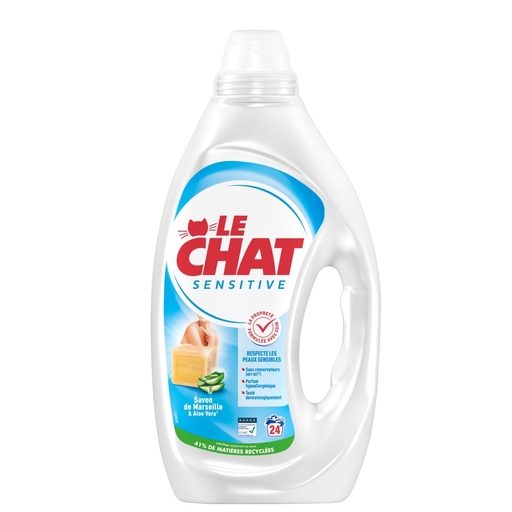
Why this choice suits this profile : With its 1.08 L bottle advertised for 24 washes, this detergent lets you try a Marseille soap and aloe vera formula without investing in a large multipack.
The product page mentions a hypoallergenic fragrance, no MIT/BIT preservatives and use from 20 °C. Nevertheless, check the ingredients and dosage before first use.
24 washes, a formula advertised as dermatologically tested and a bottle made from at least 41 % recycled materials.
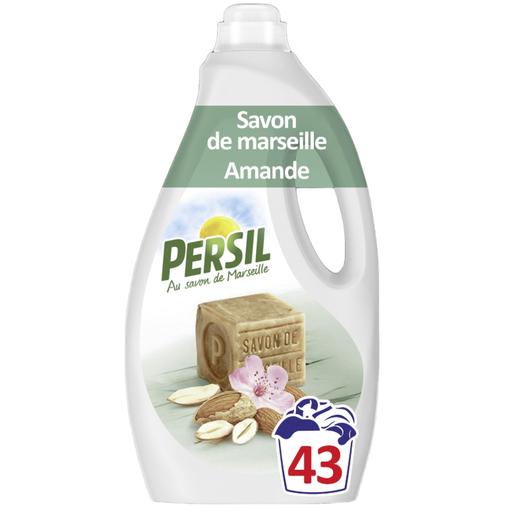
Why this choice suits this profile : Households that enjoy gentle fragrances may prefer this formula with Marseille soap and a sweet almond fragrance.
The formula is advertised as dermatologically tested and suitable for use from 30 °C. However, the presence of fragrance and certain preservatives means that people with reactive skin should examine the ingredients carefully.
Advertised for 43 washes, a fully recyclable bottle according to the product page and a sweet almond fragrance enriched with natural vanilla extract.
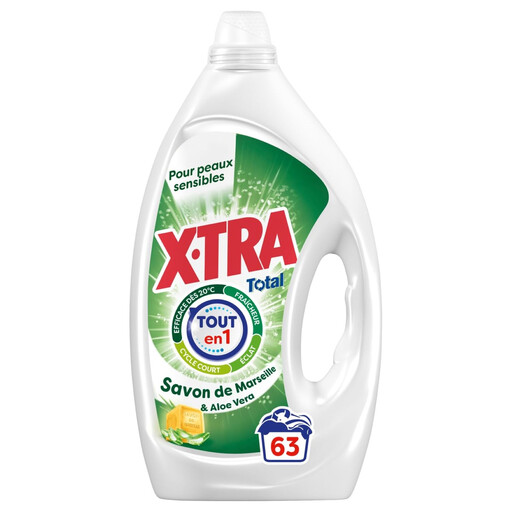
Why this choice suits this profile : Its 2.835 L format is made for families and households that run frequent washes, with use advertised from 20 °C.
The recommended dosage is 45 ml for a normally soiled load and soft to moderately hard water. This is a useful indication for avoiding overdosing.
Advertised for 63 washes, with Marseille soap and aloe vera, suitable for different fabrics and a bottle made from 65 % recycled plastic.
We have selected the products that best meet these demanding selection criteria and European safety standards in a complete list updated in real time.
An eco-friendly laundry detergent may combine plant-based surfactants, refillable packaging and environmental certification. For example, Rainett Marseille soap laundry detergent claims to have the EU Ecolabel, a formula with no added MIT, BIT or CMIT, and a 1.6 L refill designed for 32 washes.
These details describe the product’s features, but do not guarantee zero environmental impact. For a meaningful comparison, examine the dose required per cycle, the type of packaging, recycling instructions and any environmental warnings. Choosing the right programme and fully loading the drum remain just as important.
Some products are presented as hypoallergenic or dermatologically tested, but these claims do not replace checking the ingredients. Fragrances, enzymes and preservatives can still cause problems for people with reactive skin. If you experience discomfort, stop using the product and seek advice from a healthcare professional.
Yes, if the product page and label state that it is effective from 20 °C. Pre-treat visible stains, select a suitable programme and avoid overloading the drum. For very dirty laundry, a higher temperature may be necessary, in line with the manufacturer’s recommendations.
No. Marseille liquid soap is intended for the skin or for hand washing, depending on the instructions on its label. Laundry detergent, on the other hand, is formulated for fabrics and washing machines. A shower gel with almond milk or liquid hand soap should therefore never be poured into the washing machine.