
Livraison le jour même ou le lendemain

Qualité garantie

Débloquez vos offres de bienvenue: Livraison GRATUITE | Jusqu'à -80 % | 30 jours d'essai gratuits à JoyPlus
Téléchargez l'application
Choosing a liquid laundry detergent for sensitive skin isn’t just about spotting the word “gentle” on the label. Between so-called hypoallergenic fragrances, formulas marketed as natural, and promises of effectiveness at low temperatures, some important details can easily slip under the radar.
For families, parents of young children, or anyone prone to skin reactions, three common pitfalls keep cropping up:
When choosing a liquid laundry detergent for sensitive skin, look at the information about preservatives, dyes, optical brighteners, and fragrances. If you want to avoid certain ingredients, you can look for a liquid laundry detergent without MIT or BIT, while also checking the full composition on the packaging.
Claims like “free from listed skin allergens” or “free from dyes” are more precise than a simple promise of gentleness. That doesn’t mean the product will suit every sensitivity, though. If you have a reaction after washing, stop using it and seek advice from a healthcare professional.
A detergent that works at low temperatures can be suitable for everyday washes at 20 or 30 °C, as long as you follow the dosage and the manufacturer’s recommendations. Products containing enzymes are generally formulated to tackle different stains, but the result also depends on the fabric, the cycle length, and how dirty the items are.
For stains from milk, food, or mud, a local pre-treatment may be necessary. Also check the garment labels: the maximum allowed temperature always takes priority.
Compare the price per wash, rather than just the price of the bottle. A detergent refill can reduce the amount of plastic used, but only if it fits the intended bottle and the dosage is still easy to measure.
An ecolabel detergent carries an official environmental mark, such as the EU Ecolabel, which is based on criteria relating to formulation and packaging. This certification doesn’t replace checking that the product is compatible with your laundry or reading the usage instructions.
Finally, a Marseille soap detergent may appeal to those who prefer certain traditional ingredients. However, the name “Marseille soap” alone isn’t enough to determine skin tolerance: always check the composition.
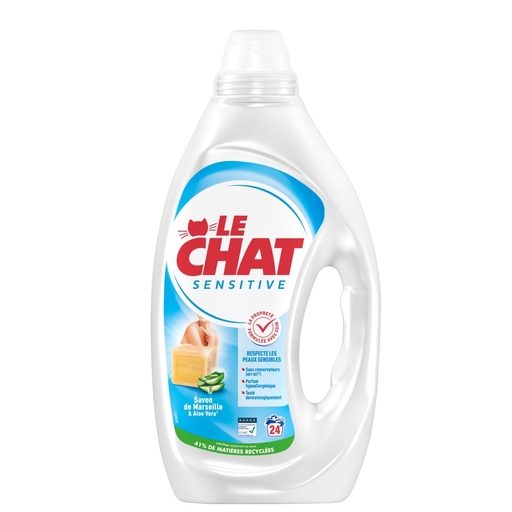
Why this choice suits this profile: Its 24-wash format lets you try a detergent for sensitive skin without stocking up on a large volume. The formula is described as hypoallergenic, dermatologically tested, and ECARF certified.
The product page specifies that it contains no MIT or BIT preservatives and states effectiveness from 20 °C. It’s still essential to follow the dosage on the packaging.
Marseille soap, aloe vera, fragrance described as hypoallergenic, and use from 20 °C.
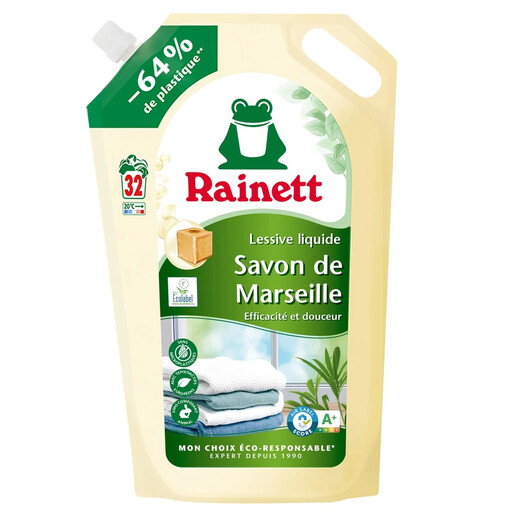
Why this choice suits this profile: This option combines Marseille soap, plant-based surfactants, and an eco-refill format. It’s aimed at households that care about environmental certification and washing at 20 °C.
The format claims to use less plastic than an equivalent bottle, and the label states that no MIT, BIT, or CMIT has been added.
EU Ecolabel, 32 washes, recommended dosage of 50 ml, and formula described as free from animal-derived ingredients.
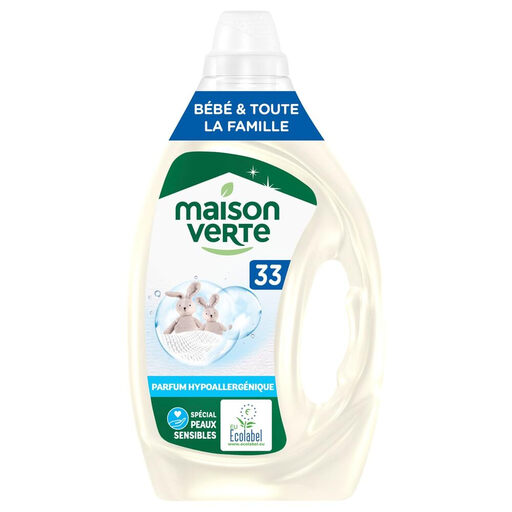
Why this choice suits this profile: Designed for the family and baby laundry, it suits households that are constantly doing washes. The product page mentions five naturally derived enzymes and use from 20 °C.
The product page details the categories of ingredients excluded, including dyes, microplastics, and added MIT/BIT preservatives.
EU Ecolabel, fragrance described as hypoallergenic, and 33 washes. According to the product page, do not use on wool or silk.
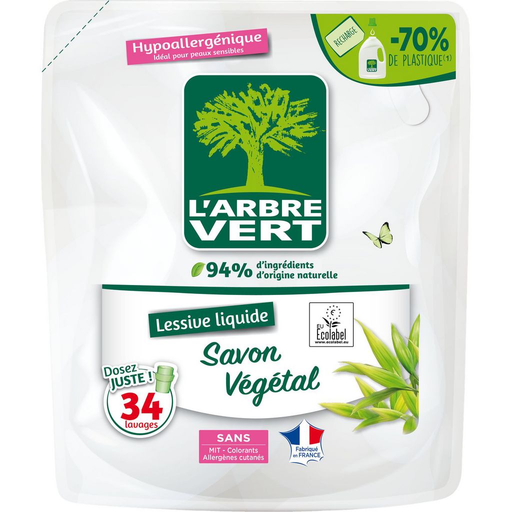
Why this choice suits this profile: This 34-wash refill is ideal for households that already have the matching bottle and want to cut down on rigid packaging.
The product states it contains no optical brighteners, phosphonates, dyes, or MIT. The refill is said to use 70% less plastic than the bottle.
93% naturally derived ingredients claimed, EU Ecolabel certification, and 34 washes per pouch.
We’ve put together a comprehensive, real-time updated list of products that meet these strict selection criteria as well as European safety regulations.
A baby laundry detergent may claim a formula without certain preservatives, a hypoallergenic fragrance, or a specific certification. These claims describe how the product is designed, but they don’t guarantee that every child won’t react. For the first few washes, choose a clearly documented formula and keep an eye on how your baby’s clothes are tolerated.
Not necessarily. “Hypoallergenic” generally means the formula has been designed to reduce the risk of an allergic reaction. Some products contain a fragrance that is described as hypoallergenic. If you want to avoid fragrances, check the ingredients list and the information on the packaging.
To compare two products, divide the price by the number of washes stated, then take the recommended dosage into account. A refill can be good value if it’s compatible with your bottle and the dosage is still accurate. The real cost also depends on how often you wash and how much laundry you put in each load.