
Livraison le jour même ou le lendemain

Qualité garantie

Débloquez vos offres de bienvenue: Livraison GRATUITE | Jusqu'à -80 % | 30 jours d'essai gratuits à JoyPlus
Téléchargez l'application
A lightweight, breathable summer duvet should see you through warm nights without making you feel like you’re suffocating. Yet product listings often muddle together weight, thickness, material and promises of coolness. In a bedroom at 20 °C or above, the right choice really comes down to air circulation, ease of care and a size that fits your bed.
A very thin duvet isn’t necessarily comfortable when temperatures rise. Its outer fabric can trap moisture, while a filling that’s too compact restricts airflow. So it’s better to check the cover material, the type of fibres and the weight rather than relying solely on the picture.
A cooling duvet may have a fabric that feels cool against the skin. That doesn’t mean it regulates the room temperature or that it will suit everyone who sweats at night. Its design, your bedroom ventilation and the bedding you use all play a part too.
A bulky duvet can exceed the capacity of a household washing machine. Some models need a large-capacity machine or even professional cleaning. Before you order, check the wash temperature, any restrictions on bleach or tumble drying, and the recommended drum capacity.
For a lightweight duvet for warm nights, the weight is a more reliable indicator than thickness alone. Models with hollow fibres around 250 g/m² are designed to provide moderate coverage in a room heated to 20 °C or more. Down and feather models may have a lower weight while still retaining a particular loft.
However, the level of warmth is very personal. Someone who sweats at night will generally want a breathable cover and a filling that isn’t too dense. A four-season duvet can be useful if your bedroom temperature varies a lot, but it may be too warm with all its layers during summer.
For an anti-allergy duvet, carefully examine the wording on the listing, the composition and any available certifications. The mention STANDARD 100 by OEKO-TEX relates to the testing of harmful substances according to the criteria set by the certification body. It doesn’t turn the duvet into a medical device and doesn’t guarantee the absence of an individual reaction.
The mattress size alone isn’t always enough to choose a duvet. For a single person, a summer duvet 140x200 generally suits a bed of the same width. For a double bed, a summer duvet 200x200 offers limited overhang, while a summer duvet 220x240 gives more room on a wider bed.
Also measure the height of your mattress and consider your sleeping habits as a couple. A duvet that’s too narrow may shift during the night; one that’s too large can be harder to wash and dry.
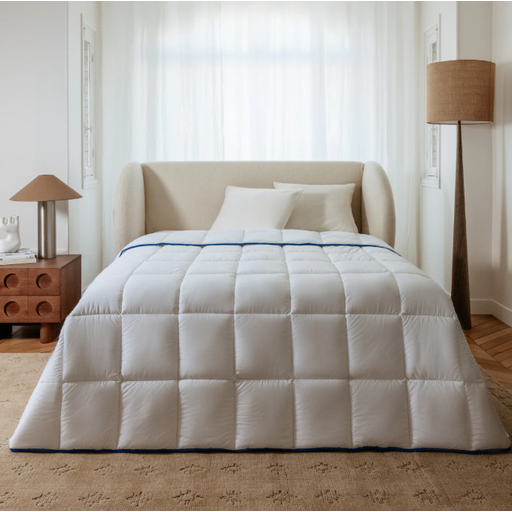
Why this choice suits this profile: Its 140 x 200 cm size is ideal for a single bed, and it’s designed for rooms from 20 °C.
The listing specifies the siliconised hollow fibre filling, the 250 g/m² weight and the 3 cm thickness, rather than just a vague promise of lightness.
100% cotton percale cover, STANDARD 100 by OEKO-TEX, CertiPUR, Sanitized and ISO 9001 certifications listed, machine washable at 40 °C.
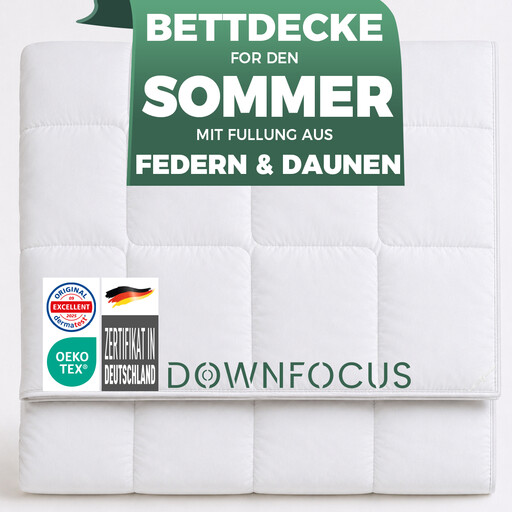
Why this choice suits this profile: This model is aimed at those looking for a natural down and feather filling for a double bed.
The listing states a weight of 200 g/m² and a composition of 90% feathers and 10% down: data to compare before buying.
OEKO-TEX certification listed, with RDS and Downpass references mentioned on the product page.
Why this choice suits this profile: Its large size is ideal for couples who want a more generous overhang on a double bed.
The listing details the size, thickness, weight and recommended wash capacity: all useful information for planning care.
Cotton percale, 250 g/m² hollow polyester fibres, certifications listed and machine washable at 40 °C.
We’ve put together a comprehensive list, updated in real time, of products that fully meet these demanding selection criteria and European safety regulations.
When it arrives, a compressed duvet may need 48 to 72 hours to regain its volume. Air it in a dry room and avoid storing it until it’s completely dry. For a machine-washable duvet, follow the stated temperature and use a machine that’s large enough. A duvet measuring 220 x 240 cm or 240 x 260 cm may need a drum of at least 12 kg, depending on the manufacturer’s recommendations.
Regularly shake the filling, protect the duvet with a suitable cover and follow the care instructions. For down and feather models, pay particular attention to drying to limit residual moisture and the formation of filling clumps.
Go for a moderate weight, a breathable cover and easy care. A cotton percale and polyester duvet, or a model with a cool-touch side, could work depending on your preferences. Ventilating the bedroom also makes a big difference.
Yes, in a temperate room or with suitable pyjamas. If temperatures vary a lot, a four-season duvet offers more flexibility. However, check the warmth level of each layer.
Look for the exact wording STANDARD 100 by OEKO-TEX on the listing, label or product documents. A simple phrase like ‘free from harmful substances’ doesn’t replace a reference to a verifiable certification.