
Livraison le jour même ou le lendemain

Qualité garantie

Débloquez vos offres de bienvenue: Livraison GRATUITE | Jusqu'à -80 % | 30 jours d'essai gratuits à JoyPlus
Téléchargez l'application
Buying a new induction pan set can quickly become a headache. Faced with a jungle of marketing claims and promises of durability, it's hard to separate the truly high-performing products from those that will let you down after just a few months. To make the right choice, it's best to know the most common pitfalls.
The first trap to avoid is the famous "compatible with all hobs" claim. While technically accurate, this often hides mediocre performance on induction. A pan with a base that isn't optimised will heat up slowly, unevenly, and may even emit an unpleasant buzzing sound.
Another point to watch out for is the non-stick coating. Too many pans lose their non-stick properties in record time, get scratched at the slightest opportunity, or worse, are made with materials of questionable composition. Finally, a poorly thought-out design with bulky handles can turn storage into an obstacle course, especially in small kitchens.
This guide is here to help you see things more clearly and identify the criteria that truly make a difference.
To avoid disappointment, focus on a few fundamental technical characteristics. These are the true guarantees of the quality and longevity of your future induction cookware set.
Induction compatibility doesn't depend on the entire pan, but solely on its base. For maximum efficiency, its bottom must be ferromagnetic.
This is what allows you to cook with little to no fat and makes cleaning easier. However, not all coatings are created equal.
Beyond cooking performance, ergonomics and versatility are key factors.
To illustrate these criteria in a concrete way, here are a few models that meet specific needs.
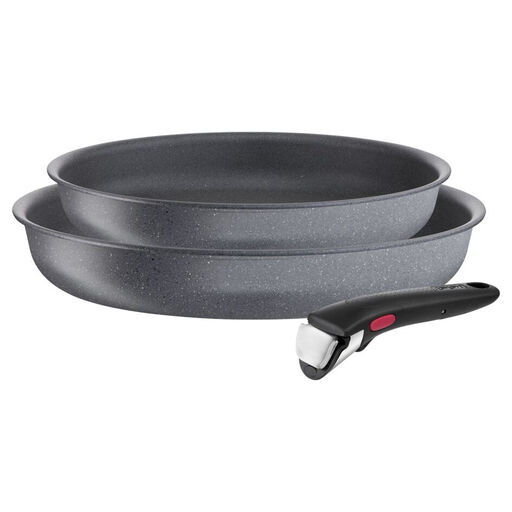
Why we chose it: Ideal for apartment dwellers or anyone looking to declutter their cupboards. The removable handle system is a proven solution for ultra-compact storage and great versatility.
This set directly solves the problem of bulky handles. The single, detachable handle allows the pans to be stacked, freeing up valuable space.
The Thermo-Fusion base ensures good heat distribution on induction. The coating is guaranteed PFOA, lead, and cadmium-free.
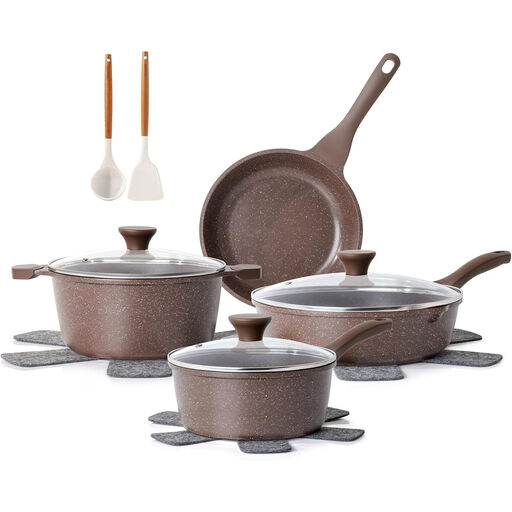
Why we chose it: For families who cook daily and are looking for a complete, healthy solution. This set covers all needs, from frying pans to saucepans, with a coating free from controversial substances.
It directly addresses concerns about material safety. The granite-effect coating is formulated to be PFOA, PFOS, lead, and cadmium-free, offering peace of mind for everyday cooking.
This is a complete cookware set that includes utensils and protective separators. Its compatibility with all hobs, including induction, makes it a particularly versatile all-in-one solution for getting equipped.
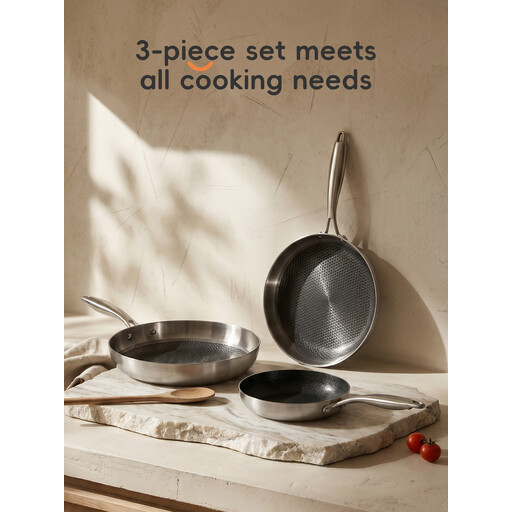
Why we chose it: For those who prioritise robustness and longevity above all else. Stainless steel is a virtually indestructible material that is resistant to both scratches and high temperatures.
It bypasses the problem of non-stick coating lifespan by simply doing without one. This is a long-term investment, without the fear of the coating degrading.
The 304 stainless steel construction and multi-layer composite base guarantee excellent heat retention and great durability. The three sizes (20, 26, 30 cm) cover most uses.
We have compiled a complete and up-to-date list of products that meet our strict selection criteria and current standards.
The lifespan heavily depends on the quality of the coating and its maintenance. A good quality non-stick pan set, used and cared for properly (hand washing, wooden or silicone utensils), can last between 3 and 5 years. Entry-level models, on the other hand, can wear out within the first year.
The easiest trick is the magnet test. Take a magnet and place it on the bottom of your pan. If it sticks firmly, your cookware is ferromagnetic and will work on an induction hob. You can also look for the induction symbol (a coil-shaped icon) engraved on the bottom of the pan.
Both types of coatings are safe for food use, provided you follow the usage recommendations. Modern PTFE coatings are made PFOA-free, which was the main source of concern in the past. Ceramic coatings, derived from minerals, are naturally free of fluorinated compounds. The choice is therefore primarily a matter of personal preference and sensitivity to materials.