
Livraison le jour même ou le lendemain

Qualité garantie

Débloquez vos offres de bienvenue: Livraison GRATUITE | Jusqu'à -80 % | 30 jours d'essai gratuits à JoyPlus
Téléchargez l'application
A non-stick frying pan can make everyday meals much easier. However, you need to choose a model suited to your cooking habits. A small frying pan is ideal for cooking eggs or a single portion, while a 28 cm model is better suited to family meals. The material, coating and compatibility with your hob also play a key role in the pan’s lifespan and ease of care.
Before you buy, it is therefore worth looking beyond claims such as “non-stick”, “suitable for all hobs” or “ultra-resistant”. Marketing language cannot replace checking the actual specifications.
A pan suitable for induction hobs must have a suitable magnetic base. The simple claim “suitable for all hobs” should be confirmed in the technical specifications, particularly if you cook on an induction, ceramic or halogen hob.
Remember to check the actual diameter of the base, which is often smaller than the stated size. A 24 cm frying pan will not necessarily cover an entire cooking zone of the same size.
The PFOA-free pan claim relates to one specific substance and, on its own, does not indicate how durable the coating is. Some product descriptions also state that the pan is free from PTFE, PFAS, lead or cadmium. These statements should be understood as declarations made by the manufacturer or seller, rather than as a medical guarantee.
Lifespan also depends on the thickness of the coating, the quality of the base, cooking temperature and the utensils used.
An easy-to-clean frying pan is not necessarily designed to withstand every type of treatment. Dishwashers, abrasive sponges, metal utensils and heating an empty pan can all accelerate wear on a non-stick coating.
Even when a model is advertised as dishwasher-safe, washing it by hand with a soft sponge will generally help preserve its surface for longer.
A larger diameter can mean a potentially heavier and less manoeuvrable frying pan. On an induction hob, check that the base properly covers the active cooking zone.
A fixed handle is simple and ready to use straight away. A removable handle, on the other hand, makes storage easier and allows you to move the pan from the hob to the oven. In this case, check whether the handle is included or sold separately, then follow the stated maximum temperature.
The handle may remain cooler on the hob, but it should always be handled with care. The body of the frying pan will inevitably become hot during cooking.
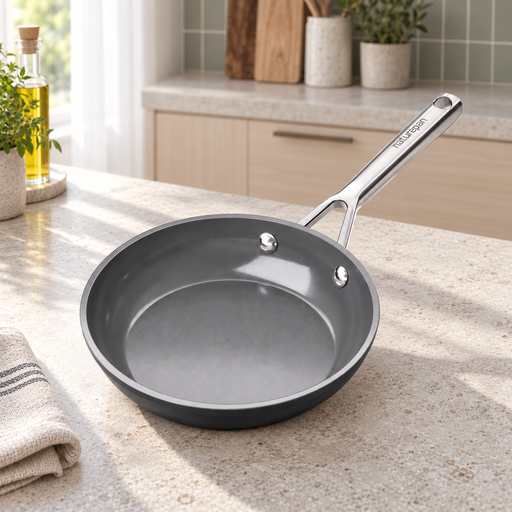
Why this choice suits this profile: Its 20 cm size is easy to handle for eggs, omelettes and small portions. The product description states that it is compatible with induction, gas, electric and ceramic hobs.
The product description mentions a reinforced ceramic coating and states that it is free from PTFE, PFAS and PFOA. However, use low to medium heat and non-metal utensils.
Ceramic coating, oven-safe up to 260 °C according to the product description, and stated to be dishwasher-safe.
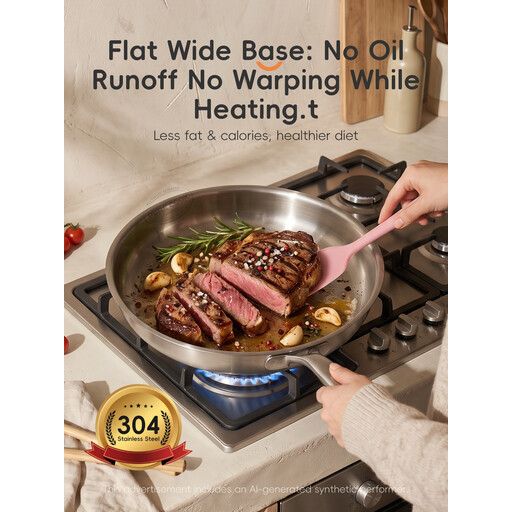
Why this choice suits this profile: Its 28 cm diameter and three-layer construction are ideal for family cooking, searing and dishes that require a large cooking surface.
It does not rely on a non-stick coating that needs protecting. The stated construction combines 304 stainless steel with an aluminium core, and is suitable for all hobs.
Stainless steel stated to be scratch-resistant, dishwasher-safe and compatible with induction, gas, ceramic and halogen hobs.
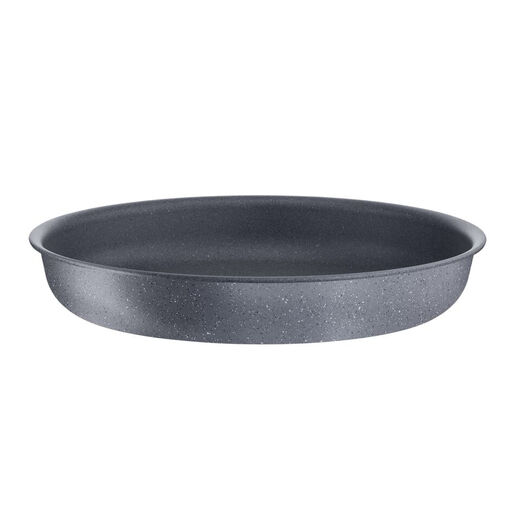
Why this choice suits this profile: Its 26 cm size is suitable for most everyday meals. The removable handle, sold separately, makes storage and transferring the pan to the oven easier.
The product description details the induction-compatible base, the Thermo‑Signal indicator and the Mineralia coating, stated to be free from PFOA, lead and cadmium. The handle must be purchased separately.
Suitable for all hobs, stackable with other items in the Ingenio range and made in France, according to the information provided.
To help your non-stick frying pan last longer, a few simple habits can make all the difference:
For cooking with little oil, a non-stick coating is particularly practical for eggs, fish, pancakes and vegetables. However, you should still follow the manufacturer’s instructions.
We have put together a complete, real-time updated list of products that meet these strict selection criteria as well as European safety regulations.
The 24 cm size is suitable for one or two portions. A 26 cm frying pan offers greater versatility for a couple or small family. The 28 cm diameter lets you cook more food at once, but requires a sufficiently large hob and a frying pan that you can handle comfortably.
Yes, provided its base contains a magnetic material and the product description explicitly states that it is compatible. A ceramic frying pan is not automatically suitable for induction: always check which types of hob it can be used on.
There is no universal lifespan. Frequency of use, temperature, washing and the utensils used all directly affect its durability. If the coating starts to flake, becomes distorted or sticks much more than it did originally, check the manufacturer’s recommendations and consider replacing the frying pan.