
Livraison le jour même ou le lendemain

Qualité garantie

Débloquez vos offres de bienvenue: Livraison GRATUITE | Jusqu'à -80 % | 30 jours d'essai gratuits à JoyPlus
Téléchargez l'application
Choosing a new non-stick induction cookware set can quickly become a headache. Between promises of perfect glide and technical logos, it's easy to get lost and regret your purchase. A coating that's scratched in a few weeks, weak induction performance, scalding handles… these disappointments are unfortunately all too common.
Our mission? To help you see things more clearly. Let's forget the marketing jargon and focus on the criteria that truly matter for making an informed choice that suits your kitchen and your budget. This guide breaks down the 3 most common pitfalls and gives you the keys to outsmart them.
Investing in a good set of pots and pans is essential, but some sales pitches are designed to mislead you. Here are the red flags to keep in mind.
The promise of an egg sliding off the pan without a drop of oil is tempting. However, don't be fooled by flashy brand names: the durability of a non-stick coating primarily depends on its composition and thickness. A low-quality coating that is too thin or poorly applied will lose its properties in record time, especially if exposed to excessive heat or unsuitable utensils.
Warning: "induction compatible" does not mean "high-performance on induction." If the base of the cookware isn't sufficiently thick and ferromagnetic, heating will be sluggish, heat distribution will be poor, and your electricity bill will take a hit. The simple "induction" logo is no guarantee of optimal performance.
The "PFOA-free" claim is standard today, simply because the substance is regulated in Europe. But PFOA is often just the tip of the iceberg: the large family of PFAS (the infamous "forever chemicals"). For true peace of mind, it's worth checking for the complete absence of PFAS or turning to alternative materials like ceramic.
To avoid making a mistake, focus on these three technical characteristics. This is where the true quality and practicality of your future equipment lie.
There are two main families of coatings:
For an induction pan worthy of the name, the base is the crucial element. Look for a thick, warp-resistant base, often called a "sandwich base." It is typically composed of a layer of aluminium (for excellent heat diffusion) encapsulated in ferromagnetic stainless steel (for induction compatibility). The result: fast, even heating and perfect stability on the cooktop.
In a modern kitchen, every centimetre counts. A space-saving cookware set is therefore a particularly smart solution. Systems with a removable handle allow you to easily stack pots and pans, put them in the oven (without the handle), and use them as serving dishes. A decisive advantage for small kitchens, studios, and even for equipping a van or camper.
Rather than an endless catalogue, here are concrete solutions for specific needs, selected according to the quality and practicality criteria we've just discussed.
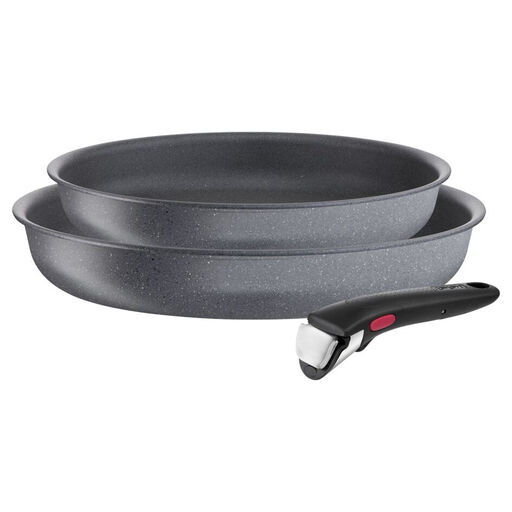
Editor's Verdict: Perfect for a first home or for optimising a small space. This two-pan set with a single handle covers the essentials while being incredibly easy to store.
Its removable handle system is the unbeatable answer to a lack of space. The Thermo-Signal indicator prevents overheating that degrades the coating, thus preserving its lifespan.
Modularity and space-saving: the pans stack perfectly. Thermo-Fusion base: ensures even heat distribution on all hobs, including induction.
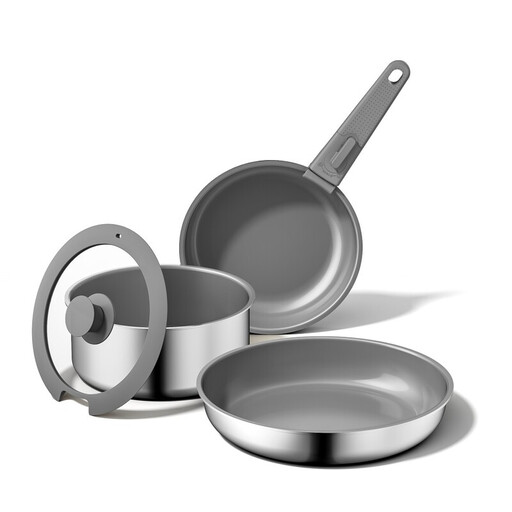
Editor's Verdict: For those who place material composition at the heart of their concerns. This set combines a ceramic coating with the practicality of a removable handle.
This set directly addresses the materials issue by offering a ceramic coating, explicitly formulated without PFAS or PFOA. This provides peace of mind that goes beyond the legal standard.
PFAS-free ceramic coating: an excellent alternative for those who want to avoid fluorinated compounds. Total versatility: compatible with all hobs, oven-safe (up to 250 °C), and features a removable handle.
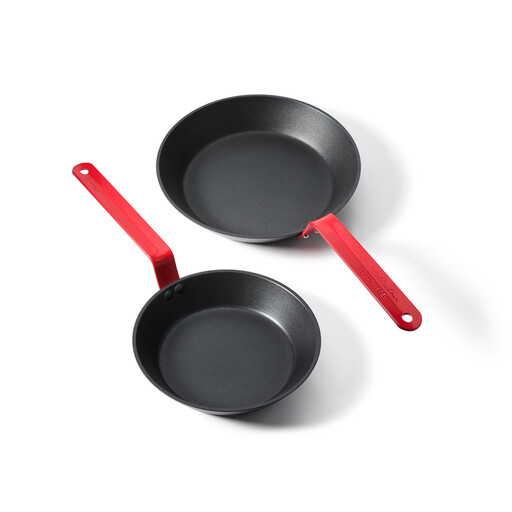
Editor's Verdict: For enthusiasts who cook daily and demand durability and versatility. Their oven-safe design opens up a world of culinary possibilities.
It sidesteps the trap of premature wear with its Swiss ILAG coating, renowned for its high resistance. Its oven-safe capability up to 230 °C is a mark of robustness that elevates it above a simple frying pan.
Durability and oven-safe: a coating built to last and the ability to finish a dish in the oven, just like the pros. Thick base: ensures optimal performance on induction.
Explore our full collection of products that meet our strict selection criteria and European safety standards.
With proper care, a quality coating can last between 2 and 5 years. The golden rules to preserve it: no thermal shock (never put a hot pan under cold water!), no high heat, use only wooden or silicone utensils, and wash by hand with a non-abrasive sponge.
That's a definite no-go. Even coatings advertised as "scratch-resistant" will eventually give way under repeated attacks from metal, losing all their effectiveness. Always opt for spatulas and spoons made of wood, silicone, or nylon.
The magnet test is foolproof. Take a magnet (a simple fridge magnet will do) and hold it to the bottom of your pot. If it sticks firmly, you're in business: it's induction-compatible. Also, look for the induction symbol (a kind of horizontal coil) engraved on the underside of the cookware.