
Livraison le jour même ou le lendemain

Qualité garantie

Débloquez vos offres de bienvenue: Livraison GRATUITE | Jusqu'à -80 % | 30 jours d'essai gratuits à JoyPlus
Téléchargez l'application
An induction-compatible frying pan must meet several requirements: a magnetic base, good heat distribution, a diameter suited to the cooking zone and care requirements that match its material. However, product descriptions can sometimes make the choice more difficult, particularly when terms such as ‘all hobs’, ‘non-stick’ or ‘chemical-free’ remain too vague.
Before you buy, here are the main pitfalls to avoid and the criteria that will help you objectively compare a non-stick frying pan, a stainless steel frying pan, a ceramic model or a wok.
A frying pan designed for induction must have a base containing a ferromagnetic material. Simply being compatible with gas or electric hobs is not enough. Always look for ‘induction’ in the technical specifications, rather than relying on a general phrase such as ‘all cookers’.
Frying pans with a magnetic stainless steel base, such as some multi-layer models, are generally designed to work on an induction hob. By contrast, an older aluminium or copper frying pan may require a specific adapter.
A non-stick frying pan remains sensitive to overheating when empty, metal utensils and abrasive sponges. Even a reinforced surface should be used according to the manufacturer’s recommendations. A ceramic frying pan or a PFAS-free frying pan is therefore not exempt from these precautions.
Check the instructions for washing, oven use, dishwasher compatibility and approved utensils. These details have a direct impact on the frying pan’s lifespan.
A 28 cm induction frying pan is suitable for preparing family-sized portions, but its actual base may be smaller than the stated diameter. If the base does not cover enough of the magnetic cooking zone, heating may be less even. Conversely, a 20 cm model is easier to handle in a small kitchen, but provides less surface area for searing several ingredients.
A magnetic base is essential. Multi-layer constructions combining stainless steel and aluminium aim to provide both induction compatibility and even heat distribution. The 28 cm PURECOOK Tri-Ply 304 model uses a stainless steel, aluminium and stainless steel structure, while the 28 cm Maxcook wok states that it has a composite base compatible with induction, gas, electric and ceramic hobs.
For non-stick models, also check the maximum oven temperature they can withstand. Some products, such as SMEG frying pans, state that they can be used at temperatures of up to 250 °C, while Naturepan specifies a limit of 230 °C without the lid.
A frying pan with a lid is suitable for slow cooking, vegetables and dishes that need to retain their moisture. A deep sauté pan can also partly replace a non-stick wok in a kitchen with limited equipment.
For a studio flat or small kitchen, a set with removable handles can reduce clutter. For a family, a cookware set or a 28 to 30 cm frying pan provides more cooking surface, at the cost of greater weight and storage space.
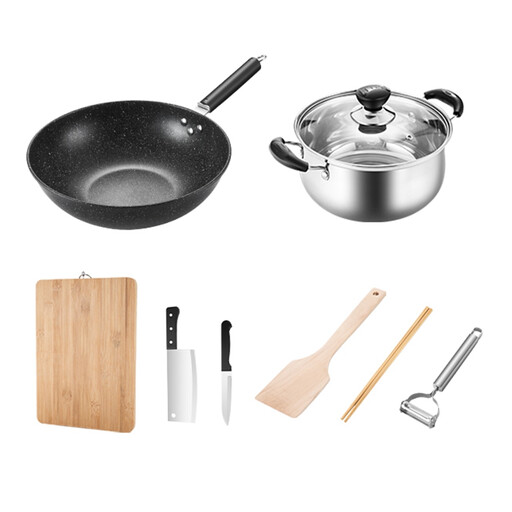
Why this choice suits this profile: An ideal starter set, including a frying pan, a saucepan and several kitchen accessories for everyday meals.
Induction compatibility is clearly stated for the frying pan. The limitation concerning the saucepan is also specified: use it at medium or low power.
A thin iron frying pan, a stainless steel saucepan and several accessories combined in one set.
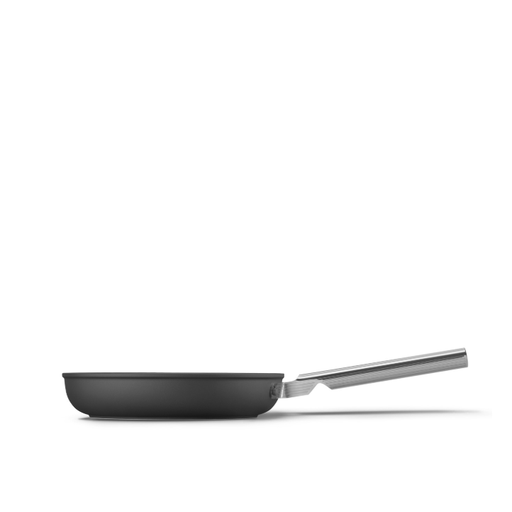
Why this choice suits this profile: A ceramic frying pan with a distinctive style, suitable for everyday cooking and for those who pay close attention to the coating’s composition.
The product specifications state that it has a PFAS-free ceramic coating and is compatible with induction, gas, electric hobs and ovens up to 250 °C.
A base designed to distribute heat evenly, with three diameters available: 20, 24 and 28 cm.
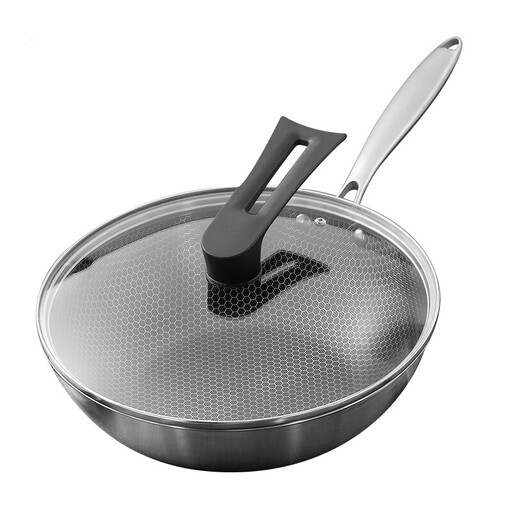
Why this choice suits this profile: Its 30 cm size and stated 4.7 l capacity make it suitable for families and preparing large quantities.
The product specifications detail the materials, the tempered glass lid and compatibility with induction, gas, electric hobs and ceramic hobs.
A versatile non-stick wok for frying, stir-frying, steaming or slow cooking, with a silicone-coated handle.
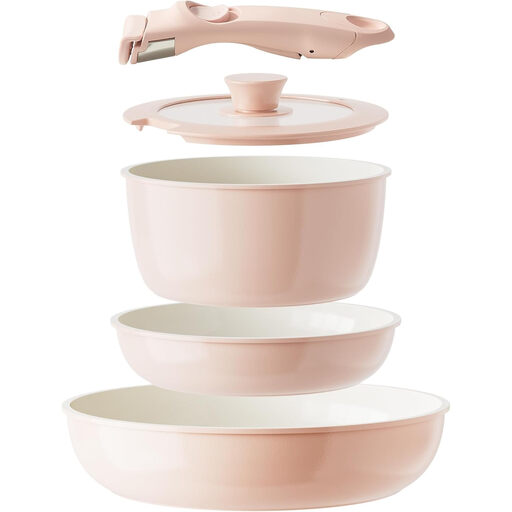
Why this choice suits this profile: The removable handles and stackable components are especially practical when every centimetre of storage space matters.
The product specifications mention induction compatibility and a coating advertised as free from PFAS, PTFE and PFOA. Nevertheless, check the temperature instructions before using it in the oven.
A five-piece set comprising a saucepan, a lid, two frying pans and a removable handle.
We have put together a comprehensive, real-time updated selection of products that meet these strict criteria and the requirements of European safety regulations.
To extend the lifespan of your cookware, adopt a few simple habits:
A PFAS-free or uncoated frying pan will not necessarily be non-stick in every situation. Stainless steel requires controlled heating, while a ceramic surface needs extra care to prevent scratches.
Place a magnet underneath its base: if it sticks firmly, this indicates the presence of a ferromagnetic material. However, this check is only indicative; the manufacturer’s product specifications must confirm compatibility with induction hobs.
A diameter of 24 to 28 cm is generally suitable for meals for two to four people. For larger portions or wok cooking, a 30 cm model provides more space. Simply make sure that the induction zone is wide enough.
Stainless steel does not have a non-stick coating that can wear out, but food may stick more readily if the temperature is not properly controlled. A non-stick frying pan makes certain cooking tasks and cleaning easier, provided you follow the recommended utensil and temperature guidelines. The right choice therefore depends on your recipes, cooking style and maintenance priorities.