
Livraison le jour même ou le lendemain

Qualité garantie

Débloquez vos offres de bienvenue: Livraison GRATUITE | Jusqu'à -80 % | 30 jours d'essai gratuits à JoyPlus
Téléchargez l'application
An induction cooktop can be a perfect fit for a family kitchen, studio apartment, motorhome or secondary kitchenette. The challenge is that product descriptions often focus on maximum power, automatic programmes and fast-cooking claims without clearly explaining the practical considerations: cookware compatibility, electrical connection, installation dimensions and residual heat.
Before placing your order, it is therefore worth understanding the difference between a portable induction cooktop, a built-in induction hob, a ceramic glass cooktop and a standard electric hot plate. Here are the key criteria to check, along with a selection of models available on Joybuy.
A 2,000 W induction cooktop can heat a saucepan quickly. However, this figure usually refers to the maximum power of a single cooking zone. On a 4-zone induction hob, total power may reach 6,000 to 7,200 W, with power distributed between the zones when several pans are used at the same time.
For everyday use, check in particular:
A high power rating does not mean that the cooktop will consume that amount continuously. It primarily indicates the maximum heating capacity available. Consumption also depends on cooking time, the cookware used and the selected power level.
Induction cooking relies on a magnetic field. Frying pans and saucepans must therefore have a ferromagnetic base. To check, simply hold a magnet against the underside of the cookware: if it adheres firmly, the utensil is generally compatible.
Aluminium, copper, glass or ceramic cookware without a magnetic base will not work on an induction cooktop. A ceramic glass cooktop, on the other hand, heats through radiant heat and accommodates a wider range of materials, provided the base is flat and designed to withstand heat.
A built-in induction hob cannot be connected in the same way as a small portable electric cooker. Several models rated at 6,000 W or more are supplied without a plug and require a fixed connection. Installation should be carried out by a qualified electrician, taking into account the property’s electrical configuration and the instructions provided in the manual.
You should also check:
For a student room, home office, compact kitchen or motorhome, a 2,000 W portable induction cooktop takes up very little space and can be stored away after use. Even so, measure the available space and make sure the appliance sits on a stable, dry and heat-resistant surface.
In a fully equipped kitchen, a 4-zone induction hob offers greater flexibility. External dimensions are generally around 59 × 52 cm, with a cut-out of approximately 56 × 49 cm. Every model has its own specifications, so always check them carefully before purchasing.
A touch-control cooktop is easy to clean because it has no raised buttons. Rotary controls may nevertheless feel more intuitive, particularly for occasional use or for people who prefer a physical adjustment mechanism.
An induction cooktop with a timer can switch off a cooking zone automatically once the programmed time has elapsed. The child lock, meanwhile, locks the controls to prevent accidental operation. These features do not replace supervision, especially when cooking with oil or using very hot cookware.
The following features are worth prioritising:
Even with induction cooking, the surface can become hot through heat transfer from the cookware. Wait until the residual-heat indicator has gone out before cleaning the cooktop.
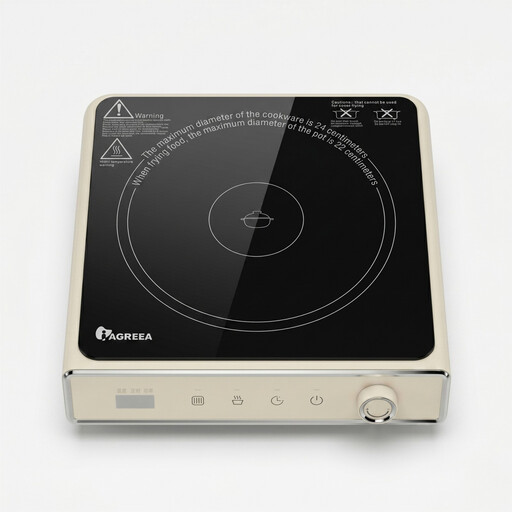
Why this model may suit you: This portable electric cooktop is well suited to a kitchenette, student accommodation or occasional use. Its ceramic glass technology accommodates steel, cast iron, aluminium, glass and ceramic cookware, in line with the product listing.
There is no need to replace your entire cookware collection. The cooktop is also advertised as featuring automatic shut-off after one hour without any user input.
2,000 W, 8 temperature levels, 8 power levels and a timer of up to 180 minutes, according to the product description.
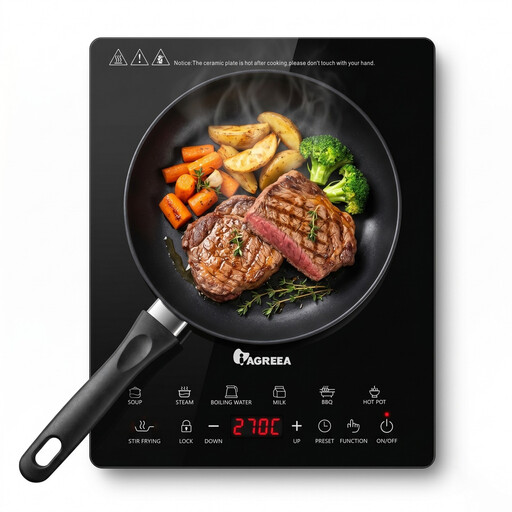
Why this model may suit you: Its portable format and advertised 44.5 mm thickness make it easy to store in a studio apartment, motorhome or secondary kitchen. It accommodates flat-bottomed magnetic cookware measuring 12 to 26 cm.
Compatibility with different cookware diameters is clearly specified, helping you avoid unpleasant surprises with a pan that is too small or too large.
Power adjustment from 100 to 2,000 W, temperature range from 60 to 270 °C, 7 programmes, timer of up to 3 hours and advertised child lock.

Why this model may suit you: This built-in induction hob features four cooking zones and an advertised maximum power of 7,200 W, making it suitable for preparing several dishes in a fully equipped kitchen.
The cut-out dimensions, plug-free connection and need to use an electrician are clearly highlighted before purchase.
4 zones, 9 power levels, Boost function, 1- to 99-minute timer, cookware detection, child lock and residual-heat indicator.
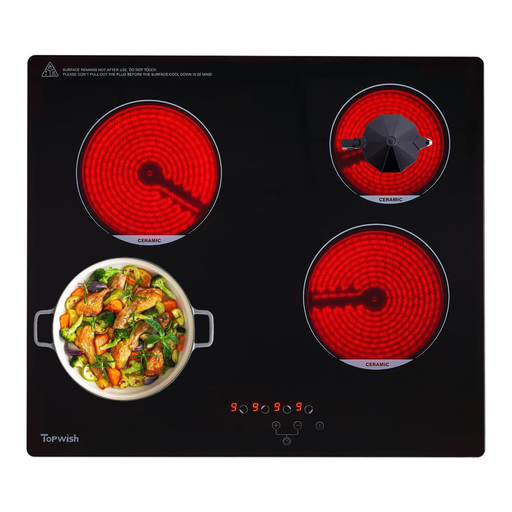
Why this model may suit you: This built-in ceramic glass cooktop works with various types of cookware, including aluminium and copper, provided the bases are clean, flat and suitable for cooking.
It avoids the ferromagnetic cookware requirement associated with induction while retaining a 60 cm built-in format.
4 cooking zones, advertised power of 6,600 W, 9 settings, timer of up to 99 minutes, child lock and “H” indicator.
Browse our updated selection of electric cooktops and compare the available formats, power ratings and features.
It depends on the power being used and the cooking time. A 2,000 W cooktop can operate at a lower setting to simmer a dish, while a 7,200 W hob will not necessarily use its full power continuously. To estimate the cost, multiply the actual power used, in kilowatts, by the duration in hours and by your electricity tariff.
It depends on the quality of the components, installation, ventilation and maintenance. Avoid impacts to the glass surface, do not block the vents and only clean the cooktop once it has cooled down. For a built-in model, installation in accordance with the instructions also helps reduce the risk of electrical faults or overheating.
Not always. Low-power portable models are generally designed for use with a suitable, properly earthed socket. More powerful built-in hobs often require a fixed connection and may be supplied without a plug. Consult the manual and have the installation checked by a professional before commissioning.