
Livraison le jour même ou le lendemain

Qualité garantie

Débloquez vos offres de bienvenue: Livraison GRATUITE | Jusqu'à -80 % | 30 jours d'essai gratuits à JoyPlus
Téléchargez l'application
A graphite pencil set for drawing lets you move from a light sketch to deep shadows without having to buy individual pencils every time. But not all sets are created equal, and not every one suits the same purpose. The number of pencils, the range of grades on offer, or even the presentation in a box can give an impression of quality without necessarily guaranteeing a pleasant everyday experience.
For beginner artists, art students, illustrators, architects and technical draughtsmen, three common pitfalls keep cropping up.
The grade corresponds to the relative proportion of graphite and clay. H pencils are harder and produce fine, light lines, while B pencils are softer and better suited to shading. HB is a very common all-rounder, while F offers a point that holds its precision relatively well.
For a versatile set, look for a progression that covers at least the following uses:
Pencils of different hardnesses are therefore generally more useful than a large number of pencils concentrated on just one part of the grade scale.
A quality graphite lead should deposit material evenly, without excessive snagging or unpredictable variations. Break-resistant graphite pencils can be particularly useful for frequent drawing sessions, but the result also depends on the pressure you apply and the sharpening angle.
To preserve the point:
A metal drawing pencil tin is well suited to travel and protects the pencils better than a soft case. For studio use, a pencil case can be enough, as long as you separate the pencils by hardness.
Ranges such as STAEDTLER Mars Lumograph pencils, Faber-Castell graphite pencils or Pitt Graphite Matt pencils stand out above all for their grade selection, their finish and their packaging. Your choice should therefore be based on your technique, rather than just the prestige of the brand.
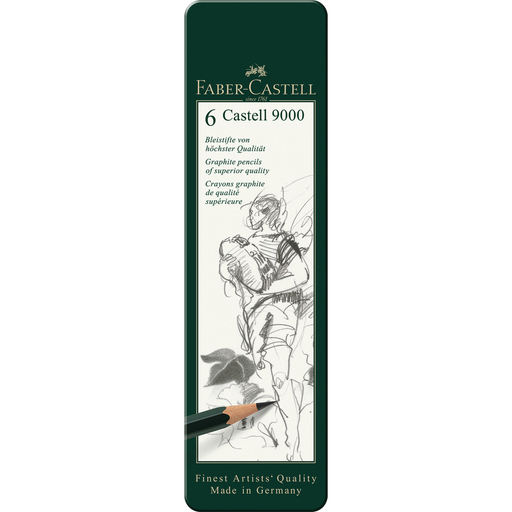
Why this choice suits this profile: A set of six pencils is ideal for starting out in drawing, for school studies or occasional sketching, without having to invest in a large box straight away.
The compact set stops you paying for grades you rarely use when you're a beginner. The leads are said to be break-resistant and suitable for sketching, shading and detailed drawing alike.
Six pencils, a hexagonal barrel and a practical box for carrying around.
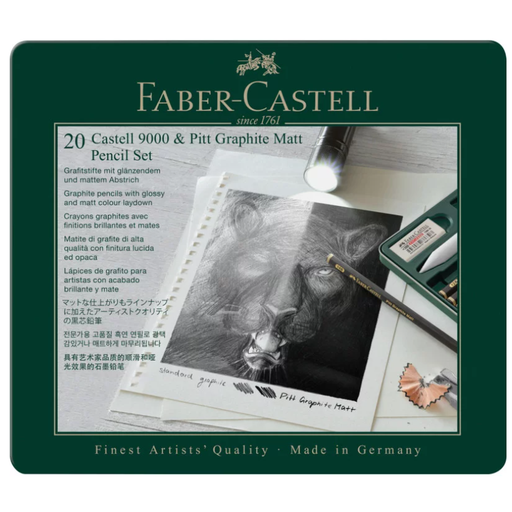
Why this choice suits this profile: This set combines a wide selection of grades with two types of graphite. It's aimed at illustrators and artists who switch between precision, modelling and strong values.
With its 20 pieces, the range stops you being limited to just a few hardnesses. The inclusion of matt graphite also partly solves the problem of reflections on heavily worked areas.
The combination of the Castell 9000 and Pitt Graphite Matt ranges, a metal tin and leads said to be break-resistant.
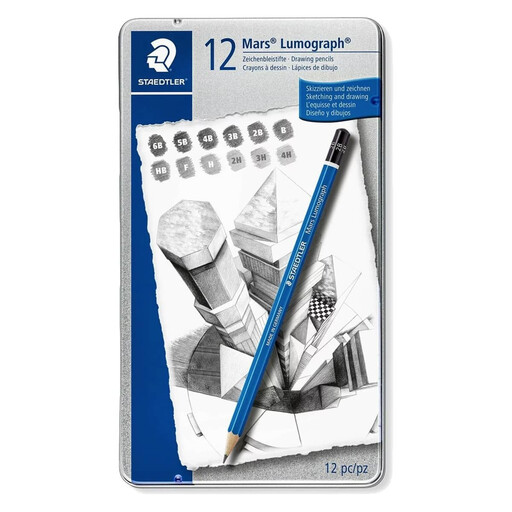
Why this choice suits this profile: Architecture students, technical draughtsmen and regular users benefit from a clear progression from 6B to 4H, allowing you to move from fine lines to dense shading.
The range of 12 hardnesses reduces the compromises between sketching, dimensioning, detail and shading. The metal tin also protects the pencils during travel.
12 grades, from 6B to 4H, a graphite-clay lead said to be break-resistant and a sturdy metal tin.
We've put together a complete selection, updated in real time, of products that meet these demanding criteria as well as European safety standards.
A set of six pencils covering a few common hardnesses can be enough to learn the basics. If you regularly do portraits, sketching and shading, a box offering at least the grades H, HB, B, 2B, 4B and 6B will give you more possibilities.
It all depends on how often you use them, the pressure you apply and how much you sharpen them. Storing them in a dry place, sharpening gradually and using a break-resistant lead all help to reduce waste. A metal tin also helps protect the pencils from knocks.
Pitt Graphite Matt pencils are designed to reduce light reflections on the paper. They can be a good choice if you often scan or photograph your work. For writing, plans or everyday sketches, a classic graphite pencil will work perfectly well without this particular feature.