
Livraison le jour même ou le lendemain

Qualité garantie

Débloquez vos offres de bienvenue: Livraison GRATUITE | Jusqu'à -80 % | 30 jours d'essai gratuits à JoyPlus
Téléchargez l'application
Navigating the vast world of drawing pencils can quickly become overwhelming. Between marketing promises and a myriad of options, it's easy to make the wrong choice. As the Head of Product Curation at Joybuy, my mission is to bring you some clarity. Let's cut through the advertising jargon: here, we'll focus on the practical details to help you find the supplies that truly suit your projects, whether you're a seasoned artist, an art student, or simply a creative hobbyist.
But before we get to our selection, let's debunk a few common traps together:
To avoid these pitfalls, focus on three essential technical characteristics.
The lead dictates the technique, the finish, and the feel beneath your fingers. There are three main families:
Also known as permanence, this measures the pigments' ability to resist UV rays without fading. For fine art supplies, this is a non-negotiable criterion if you want your creations to retain their vibrant colours over the years. Major brands, like Faber-Castell, indicate this resistance level (often with a star system) directly on the pencil's barrel. It's a true hallmark of professional quality.
How you store your pencils has a direct impact on their lifespan.
Rather than an endless list, here are our targeted suggestions, based on the criteria we've just discussed.
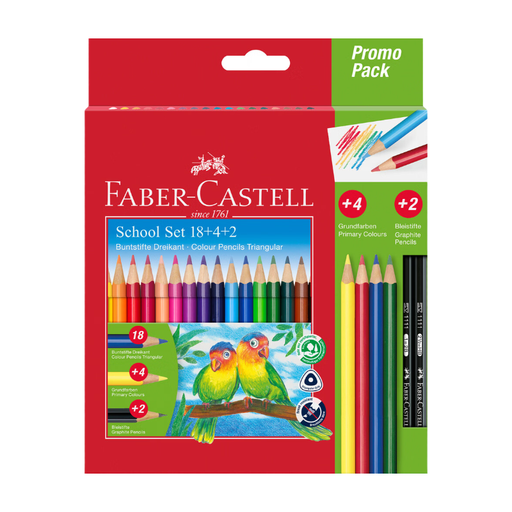
Why we recommend it: Perfect for getting started or for various creative projects, this pack offers very respectable quality without breaking the bank. The mix of standard, neon, and metallic colours makes it highly versatile for drawing, colouring, or bullet journaling.
This set focuses on quality and versatility, not quantity. It's from a reputable brand that guarantees a solid lead and decent pigmentation, light-years away from low-end "mega-sets."
The ergonomic triangular barrel provides a very comfortable grip that reduces fatigue. Most importantly, the break-resistant bonded lead (SV process) is a real plus for beginners and younger users.
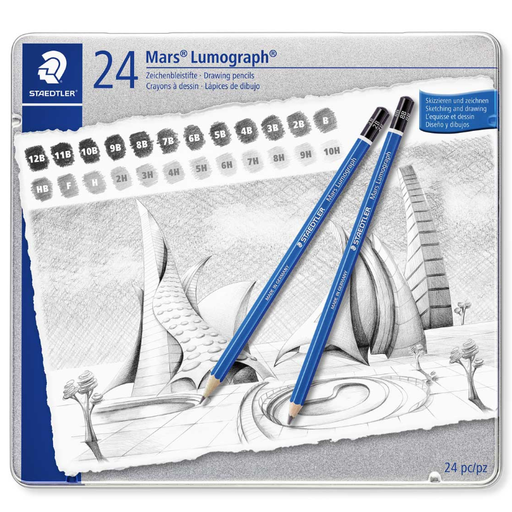
Why we recommend it: This is THE benchmark for architects, designers, and artists working with graphite. This set covers an exceptional range of hardness grades, allowing you to go from ultra-fine construction lines to deep, expressive shading without switching product lines.
It meets a specific need with the perfect tool. Rather than collecting individual pencils, this set provides the entire range of hardness grades essential for masterful graphite work in one go. No compromises.
The ultra-comprehensive range of 24 hardness grades (from 12B to 10H) is its masterstroke. The special lead formulation ensures a uniform laydown and excellent break-resistance, even during sharpening.
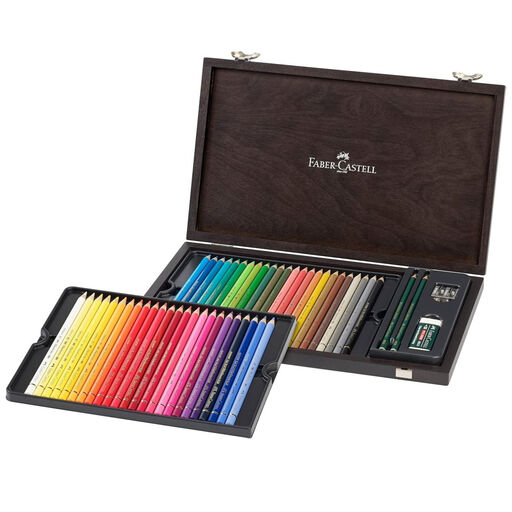
Why we recommend it: This case is for artists seeking absolute performance. Polychromos are legendary for their intense pigmentation, excellent lightfastness, and layering capabilities. The wooden case isn't just for style; it provides perfect protection.
Here, the word "professional" is earned. It's justified by technical facts: very high-quality pigments, certified lightfastness, and an oil-based lead. The wooden case is not a gimmick but a truly protective container.
The 3.8 mm oil-based lead. It allows for incredibly fine gradients and layering without ever saturating the paper (no "wax bloom"). It is also water-resistant and smudge-proof.
Discover our full selection of products that meet our quality criteria and current safety standards.
To protect the lead, it's best to store your pencils in their original box or a case, lying flat, away from moisture and sunlight. Above all, avoid dropping them: even the strongest leads can break inside the wood without any visible damage. Storing them horizontally is highly recommended for high-quality pencils.
For a standard diameter, a good sharpener with a new or sharp blade will do the job perfectly. However, for pastel pencils or larger formats (like Jumbo), a suitable model is essential to avoid damaging the lead or splitting the wood. Seasoned artists may prefer a craft knife to carve a custom point.
Wax-based pencils are often softer, creamier, and ideal for covering large areas quickly. Their limitation: they can saturate the paper and leave a slight shiny film (the infamous wax bloom). Oil-based pencils, like Polychromos, have a harder lead that holds its point longer. They excel at layering multiple coats and allow for unparalleled subtlety in gradients, without ever saturating the support.