
Livraison le jour même ou le lendemain

Qualité garantie

Débloquez vos offres de bienvenue: Livraison GRATUITE | Jusqu'à -80 % | 30 jours d'essai gratuits à JoyPlus
Téléchargez l'application
Choosing a graphite pencil might seem simple, but for an artist, it's a crucial decision that shapes the texture, depth, and precision of their work. Faced with an overwhelming number of options, it's easy to be swayed by misleading marketing claims and end up with disappointing supplies. As the Head of Product Curation at Joybuy, my mission is to empower you to decode the labels and invest in the drawing equipment that truly suits your artistic practice.
Before we get to our top picks, let's review the three most common mistakes people make when choosing a drawing pencil set:
To avoid these pitfalls, simply focus on a few foolproof technical criteria. Mastering them will allow you to choose professional-grade pencils perfectly suited to your style, whether you specialize in quick sketching or precision technical drawing.
A graphite pencil's grade is the number one criterion. It determines the darkness and fineness of the line. The scale is divided into three main families:
A good drawing pencil set must, above all, offer a consistent and well-graduated range of hardness levels to ensure true versatility.
A pencil's quality isn't just about its grade. The lead's formulation and strength are just as important. A superior-quality lead should glide smoothly across the paper without snagging, depositing material evenly.
Break resistance is another key factor. Leading brands like Faber-Castell or Staedtler use advanced manufacturing processes (like SV, for Secural Bonding), where the lead is bonded along the entire length of the wooden barrel. This technique prevents internal breakage, even if the pencil is dropped, and ensures it can be sharpened to a very fine point without shattering.
Packaging isn't just about aesthetics; it serves specific purposes:
Here are a few reliable choices that cater to distinct user profiles, selected based on the quality criteria we've just discussed.
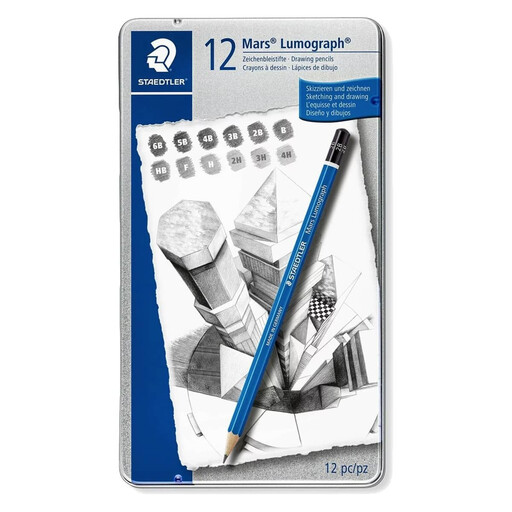
Why it's the right choice: This set is a timeless classic, a reliable choice for art students and discerning hobbyists. It offers a range of 12 hardness levels (from 6B to 4H) that covers all the essential needs, from sketching to shading. It all comes in a sturdy, portable metal tin. A dependable choice for learning the fundamentals with equipment that holds up.
There's no ostentatious luxury here. The quality of Staedtler Lumograph pencils is renowned and consistent. Each grade offers a distinctly different shade, which avoids the trap of sets where half the pencils feel the same.
High-quality, highly break-resistant lead. Versatile and well-graduated range of hardness levels, perfect for learning. Protective and practical metal tin.
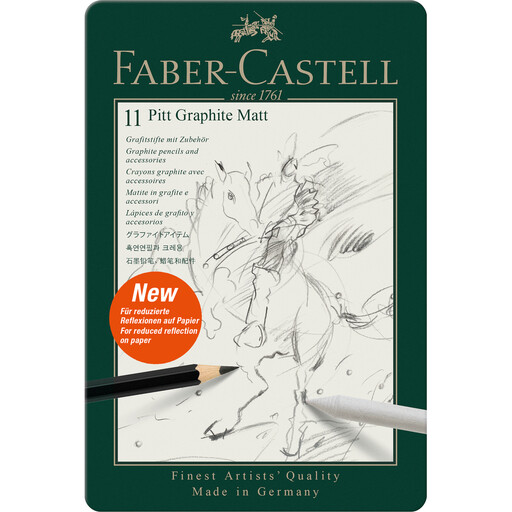
Why it's the right choice: Professionals who scan or photograph their work know this problem all too well: the glossy glare of graphite. This set of Faber-Castell pencils solves it with a revolutionary matte lead formula that absorbs light, delivering exceptionally deep blacks with zero shine.
This isn't just a marketing gimmick. The matte finish is a genuine technical innovation that addresses a very real need for artists. The product focuses on a key feature rather than an overload of useless accessories.
Anti-glare matte finish, ideal for scanning and photography. Very deep, velvety blacks. Faber-Castell build quality and ultra-resistant lead.
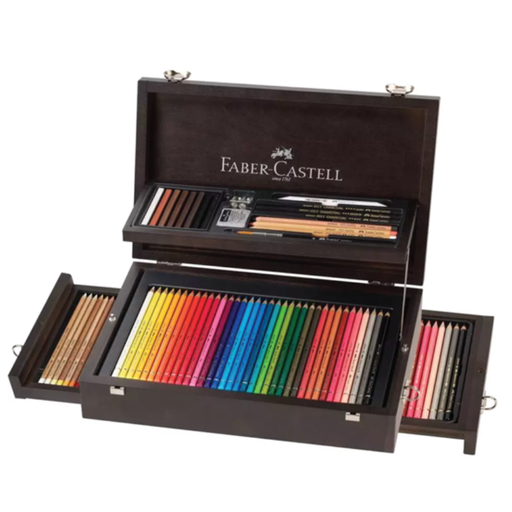
Why it's the right choice: For the artist looking to explore beyond graphite or to give an unforgettable gift, this case is a true collector's item. It brings together the best of the best from Faber-Castell's ranges: Castell 9000 graphite pencils, Polychromos coloured pencils, Albrecht Dürer watercolour pencils, Pitt artist pens, and top-tier accessories.
This is the antithesis of the low-quality "all-in-one" set. Every included product is a benchmark in its category. The quality is consistent and impeccable, from the pencils to the eraser. Here, the wooden case isn't just packaging; it's a true chest designed to last a lifetime.
Ultra-comprehensive collection of very high-quality art supplies. Luxurious presentation and flawless organisation. A long-term investment for any multidisciplinary artist.
Explore our full selection of products that meet our quality criteria and current standards.
A pencil's lifespan depends on how often you use it and the softness of its lead (B-grade pencils wear down faster than H-grade ones). That said, a professional-quality pencil will last much longer because its solid, fully bonded lead resists breaking during sharpening and use. Ultimately, investing in a pencil that doesn't constantly break is far more cost-effective.
Always use a good-quality sharpener with a sharp blade. Low-end models tend to "chew" the wood and fracture more fragile leads. For very soft leads (beyond 6B), some artists prefer to use a craft knife or a scalpel to shave away the wood, then hone the tip on a sandpaper block. This technique offers complete control over the point's shape. Always remember to store your pencils in their case to protect the leads.
Yes, absolutely. Many artists do this to take advantage of the unique characteristics of each brand. Just keep in mind that there can be slight variations in shade or texture between brands for the same grade. For example, a Staedtler 2B won't be exactly identical to a Faber-Castell 2B. The best approach is to do a few tests on a scrap piece of paper to see how the different graphites interact.