
Livraison le jour même ou le lendemain

Qualité garantie

Débloquez vos offres de bienvenue: Livraison GRATUITE | Jusqu'à -80 % | 30 jours d'essai gratuits à JoyPlus
Téléchargez l'application
A graphite pencil can be used for taking notes, drawing up a plan, making a sketch or working on precise shading. However, not all models are suited to the same tasks. Buying a box simply because it contains lots of pencils can mean paying for grades you never use, a lead that's too brittle or a body that's uncomfortable to hold.
To choose graphite pencils that suit everyday use, focus on four things: hardness, lead strength, ergonomics and packaging. Here are the criteria to consider before buying a pencil, a set of graphite pencils or a box intended for drawing.
A box of 24 pencils isn't necessarily more useful than a set of 6. For everyday writing and sketching, grades HB, B and 2B already cover most needs. Artists, architects and designers, on the other hand, can make the most of a wider range, from H leads for light lines to B leads for shadows.
So check the exact list of grades. A mention like "complete assortment" doesn't mean much if the included grades aren't specified.
A lead that snaps while sharpening means you get through more pencils and produces uneven lines. The problem can come from the proportion of graphite and clay, but also from the quality of the bond between the lead and the wood. Mentions like "reinforced lead" or "special bonding" give a useful indication, without guaranteeing perfect performance in every situation.
The sharpener also plays a role: a blunt blade puts more pressure on the lead and the wood.
The hexagonal body stops the pencil from rolling off the table and works well for school supplies and technical drawing. A triangular shape with non-slip grooves helps position the fingers, especially for children and people who write for long periods. "Jumbo" models offer a wider grip but need a compatible sharpener.
The grade tells you about the lead's composition and how it performs on paper:
No single grade works for everything. To start with, an assortment including HB, 2B, 4B and 6B gives you a simple, consistent foundation. HB graphite pencils remain the most versatile for school, the office and light drawing.
A thick lead generally withstands pressure better, but its diameter doesn't make up for careful manufacturing. The STABILO EASYgraph shown below, for example, uses a 3.15 mm graphite lead. Drawing pencils for artists often rely on a blend of graphite and clay, whose hardness affects contrast and how easily it blends.
Some Faber-Castell ranges advertise a matt formulation designed to reduce reflections on paper. This feature can be useful for scanning or photographing a drawing, although the result also depends on the paper, the pressure applied and the lighting.
For a child or someone learning to write, go for ergonomic pencils with a triangular shape and non-slip zones. For technical drawing, a classic hexagonal body makes it easier to rotate the pencil in a controlled way and keep a fine point.
A metal tin protects the tips better during transport. A lighter cardboard box is more suitable for school or home use. In any case, store pencils in a dry place and avoid leaving them loose at the bottom of a bag.
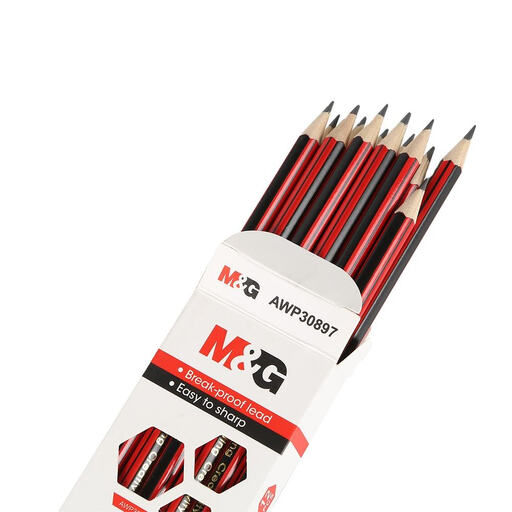
Why this choice suits this profile: This pack of 12 pre-sharpened HB pencils is ideal for homework, note-taking and first sketches, with enough stock for home or the classroom.
The HB grade is clearly stated and the hexagonal shape stops the pencil from rolling. The pack doesn't overload you with unnecessary grades for everyday use.
12 pieces, HB lead, hexagonal wooden body and pre-sharpened pencils.
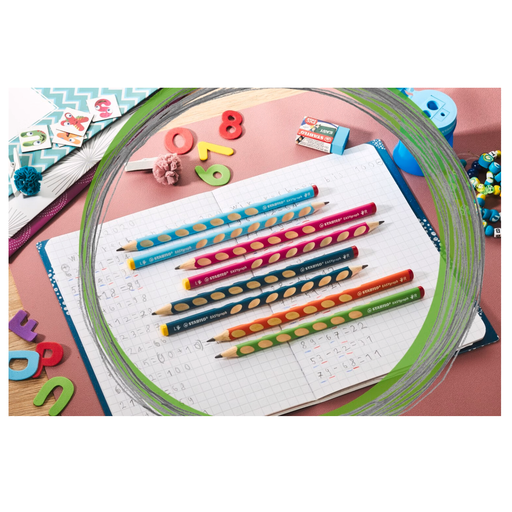
Why this choice suits this profile: The left-handed version is recognisable by its yellow tip and non-slip grooves along the whole length, which help position the fingers correctly.
The left-handed version is clearly labelled, so you avoid choosing an ergonomic model without checking its orientation.
Triangular shape, guiding grooves, 3.15 mm HB lead and pack of 6.
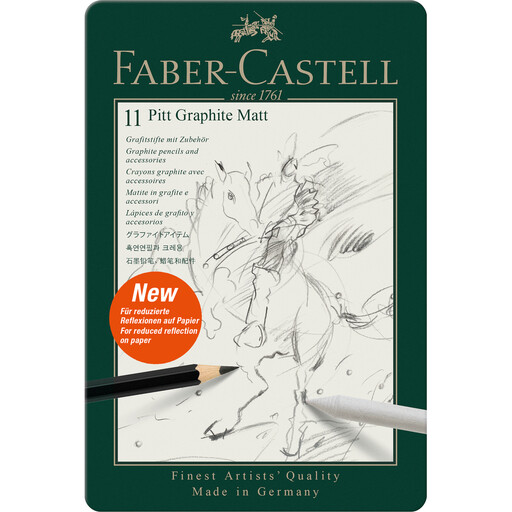
Why this choice suits this profile: This metal tin brings together 11 grades, from 6B to 4H according to the description provided, for moving from light sketches to the deepest shadows.
The hardness range is detailed and the tin protects the tips. The matt finish is advertised to reduce reflections, without guaranteeing identical results on all papers.
11 grades, advertised matt graphite formulation and metal storage tin.
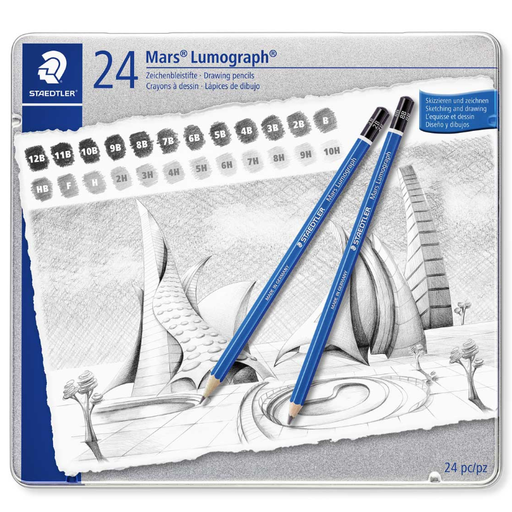
Why this choice suits this profile: The 24 advertised degrees, from 12B to 10H, cover a wide range for artistic drawing, illustration and technical drawing.
Each grade is printed on the pencil and the selection covers both light lines and dark values, which reduces the need for separate purchases.
24 assorted hardnesses, advertised break-resistant graphite-clay leads and storage box.
We've put together a comprehensive, real-time updated selection of products that meet these demanding criteria and European safety regulations.
Graphite pencils don't need refills or power: their running cost mainly depends on how often you sharpen them, how much you sharpen off and how break-resistant they are.
Grade HB is a balanced choice for writing, school exercises and annotations. A B model will produce a darker line, while an H grade will leave a lighter, finer mark.
A pencil stored correctly can remain usable for several years. Its lifespan, however, depends on how often you use it, how much you sharpen off and any knocks it takes. The wood must stay dry and the tip protected to minimise waste.
Not necessarily. A set of 6 well-chosen grades is enough to learn the basics. A box of 12 to 24 pencils becomes worthwhile if you regularly do portraits, illustration, architecture or use artist pencils to work on more shadow transitions.