
Livraison le jour même ou le lendemain

Qualité garantie

Débloquez vos offres de bienvenue: Livraison GRATUITE | Jusqu'à -80 % | 30 jours d'essai gratuits à JoyPlus
Téléchargez l'application
As a product expert at Joybuy, I've noticed a growing interest in cookware that ticks all the boxes?: aesthetics, health, and performance. The borosilicate glass pot is often the star of this search. Its transparency, which lets you monitor a dish without lifting the lid, and its inert material—the promise of healthy, PFAS-free cooking—are major reasons for its popularity.
However, choosing the right model isn't so simple. The market is flooded with products that look similar but perform radically differently. Before you decide, it's crucial to be aware of a few pitfalls that can turn a promising purchase into a real disappointment.
The appeal of a transparent pot is undeniable, but certain technical details can make all the difference between a durable utensil and a fragile, impractical item.
To make the right choice, focus on these three fundamental criteria. They are the foundation of a reliable, high-performance, coating-free piece of cookware.
The key to durability and safety?? The type of glass. Borosilicate glass is a high-performance material made of silica and boron trioxide. This composition gives it a very low coefficient of thermal expansion.
Before any purchase, verifying compatibility is a non-negotiable step.
The size of your pot should match your cooking habits. A large 4?L pot is ideal for a family of four or for preparing large batches of soups and stews. For a couple or for side dishes, a 2 to 3-litre capacity will be more suitable and easier to store.
Also, consider the details that make all the difference?: sturdy, integrated handles for safe handling (always with oven mitts?!), and a well-fitting lid to retain heat. Some models even feature a pouring spout, a small but very welcome bonus for everyday use.
To illustrate how these criteria apply in practice, here is a selection of products suited for different profiles.
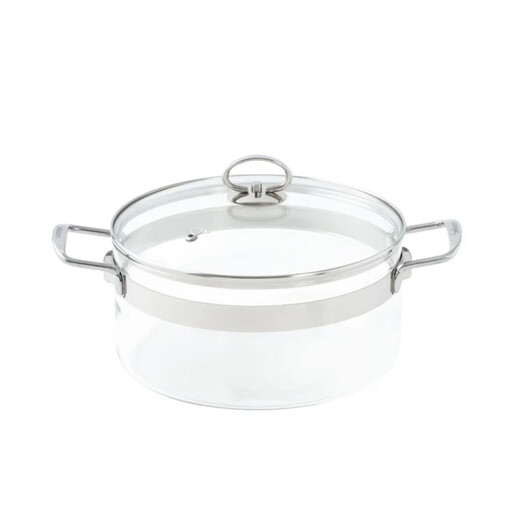
Why we chose it : Its large 4.2 L capacity is designed for family meals, from pasta to hearty soups. The complete transparency allows you to keep an eye on your cooking without interrupting the boil.
This model is made from borosilicate glass designed for stovetop cooking (gas and electric), which eliminates any risk of confusing it with a simple serving dish.
Healthy material (PTFE/PFAS-free); oven-safe up to 180 °C; practical pouring spout.
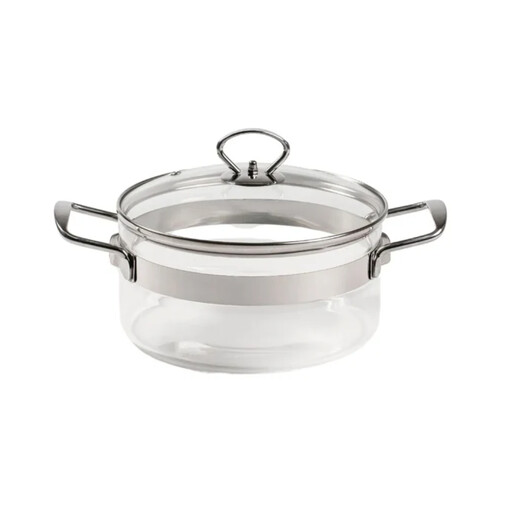
Why we chose it : With its 2.5 L capacity, this Dutch oven is perfect for everyday meals, smaller portions, or side dishes. Its compact size makes it easy to use and store.
Same guarantees as the larger model : a cook-safe borosilicate glass and clearly stated compatibility (gas, electric, and induction via a diffuser plate).
Versatile size for daily use; healthy, coating-free material; oven-safe up to 180 °C.

Why we chose it : For those looking for more than just a pot, this multi-cooker replaces 9 appliances. It offers an alternative to stovetop cooking, with automatic programs for a wide variety of dishes.
As a standalone electric appliance, it completely bypasses the issue of hob compatibility. Its inner pot has a non-stick ceramic coating guaranteed to be PTFE-free.
9-in-1 (pressure cooker, slow cooker, yogurt maker…); 12 automatic programs; XXL 7.6 L capacity.
Discover our full selection of products that meet our high standards for quality, from materials to design.
No, not directly. Glass is not a ferromagnetic material and therefore won't react with the magnetic field of an induction hob. To use it, you must place an induction diffuser plate between the hob and the pot. Be sure to choose a high-quality plate of the correct size for even heating.
The golden rule is to avoid sudden temperature changes. Never place a hot pot on a cold, wet surface (like a marble or granite countertop). Likewise, do not pour cold liquid into a very hot pot. Always let it cool down gradually before washing.
Yes, without a doubt. Borosilicate glass is one of the most stable and inert materials for cooking. Its major advantage is the absence of any chemical coating (like PTFE or PFAS) that could degrade and leach into food at high temperatures. It doesn't retain odours or flavours and doesn't react with acidic foods (like tomatoes), which guarantees absolute purity of taste.