
Livraison le jour même ou le lendemain

Qualité garantie

Débloquez vos offres de bienvenue: Livraison GRATUITE | Jusqu'à -80 % | 30 jours d'essai gratuits à JoyPlus
Téléchargez l'application
Standing water in the sink, foul odours wafting from the shower… When faced with a clogged drain, the go-to reflex is often a gel unblocker, promising a quick fix. But be warned, not all products are created equal: a poor choice can be ineffective or, even worse, damage your plumbing.
As a product expert for Joybuy, my mission is to help you cut through the noise. Let's forget the marketing speak and get straight to the point: how do you choose a product that actually works, without any nasty surprises? Here are the pitfalls to avoid and the criteria you should never overlook.
In an emergency, it's easy to fall for marketing ploys. However, two common mistakes can cost you dearly, both literally and figuratively.
To make the right choice, there are three key pieces of information to decode on the label.
The effectiveness of an unblocker depends on its active ingredient. There are two main product families:
The concentration of the active ingredient is often a good performance indicator. Whatever the formula, wearing gloves and ensuring good ventilation are non-negotiable safety precautions.
A good gel unblocker must be dense. Look for terms like "thick gel" or "concentrated formula" as positive signs. A dense gel will not only cut through standing water but also cling to the pipe walls to work at the heart of the clog, instead of being uselessly diluted on the surface.
Always check for the "safe for all pipes" label or the manufacturer's specifications. This is your guarantee that the product won't attack your PVC pipes, the enamel of your sink, or your septic tank (if you have one). A simple check that can save you from very costly repairs.
To help you take action, here is a selection of products that meet specific needs, all evaluated against the criteria we've just discussed.
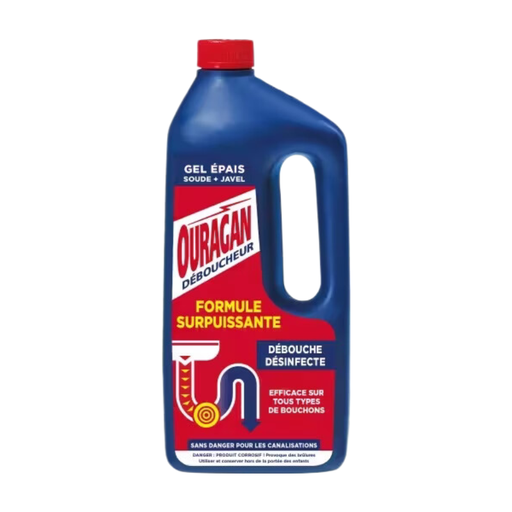
The verdict: Perfect for everyday clogs (hair, soap, grease) when you need a versatile, fast, and hassle-free solution.
Its thick, concentrated gel formula is designed to cut through standing water without becoming diluted. It thus avoids the trap of a product that's too thin. The manufacturer also guarantees it is safe for all pipe types.
Its versatility. Its formula tackles all organic matter (grease, hair, etc.) and promises to work in just 15 minutes.
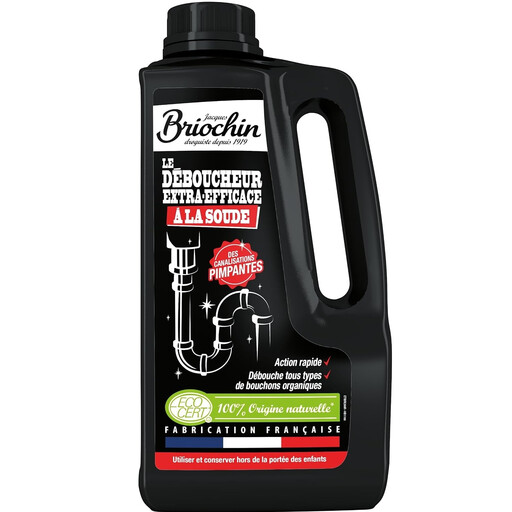
The verdict: The premium solution for those who want an ultra-concentrated formula, renowned for its targeted effectiveness on grease and soap clogs typical of kitchen sinks and bathtubs.
The transparency of its composition: 20% caustic soda. No empty promises, just a single ingredient with proven effectiveness. It thus avoids the pitfall of a 'do-it-all' product that ultimately does nothing well.
Its power, thanks to its high concentration of caustic soda. This is the benchmark active ingredient for pulverising grease and other organic residues.
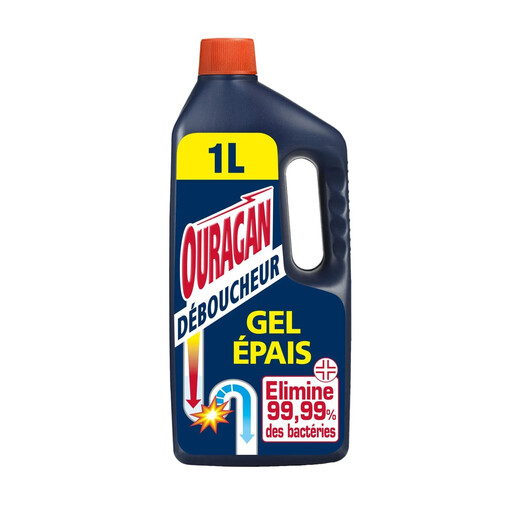
The verdict: The heavy artillery for critical cases. When the clog is stubborn and persistent odours signal bacterial growth, this is the one to call on.
By combining caustic soda and bleach, it treats the problem at its source. It doesn't just unblock: it sanitises. It works on two fronts—the physical blockage and the bacteria causing the odours.
Its dual action. Its soda and bleach formula doesn't just dissolve the clog; it also eliminates 99.99% of bacteria (according to the manufacturer), neutralising bad odours.
To explore further, discover our full selection of products that meet our strict selection criteria and current regulations.
This is a perfectly valid concern. Rest assured, the majority of commercial gel unblockers are designed to be compatible with modern materials like PVC. The key is to always check the packaging for labels like "safe for plastic" or "safe for all pipes". For older plumbing or if in doubt, opt for a specifically adapted product or, failing that, strictly adhere to the recommended application time.
The application time depends on the product and the severity of the clog. Generally, allow between 15 and 30 minutes for a standard clog. For more serious cases, some products can be left to work overnight. The most important thing is to follow the manufacturer's instructions to the letter. Leaving it on for longer than recommended won't necessarily improve the result and could, on the contrary, weaken your pipes.
Absolutely, but with the utmost caution. Harsh chemicals can disrupt the vital bacterial balance essential for your tank's proper functioning. It is therefore imperative to choose a product that clearly displays the "septic safe" label. These formulas are designed not to harm the tank's ecosystem. Occasional and moderate use of a suitable product is possible, but repeated and excessive use should be avoided.