
Same-day & Next-day Delivery

Quality Guaranteed

Unlock Your Welcome Offers: FREE Delivery | Up to 80% OFF | Free 30-day JoyPlus trial
Download the APP
Secateurs that crush stems, loppers that are too short for shrubs, or a cordless hedge trimmer that runs flat before you finish the hedge: these are the classic disappointments that come from choosing a tool based solely on its price or a marketing promise.
To find the right garden pruning tools for your garden and your habits, three criteria really matter: branch diameter, frequency of use and ergonomics. Here are the points to consider before buying, along with a selection suited to several types of gardener.
The cutting capacity shown on a product page does not mean that the tool will handle every type of wood of that diameter. A fresh, flexible branch does not offer the same resistance as dry or particularly hard wood. Secateurs rated for 19 mm are mainly suitable for stems and small, easily accessible branches. For larger diameters, it is better to switch to long-handled loppers.
Avoid pushing a small tool beyond its limits: you could bend the blade, jam the mechanism or prematurely wear out the spring.
The mention of SK5 steel is useful, but it is not enough to assess the quality of a pruning tool. Also examine the shape of the blade, its coating, the locking system, the spring and the grip. A robust blade fitted to a mechanism that does not move smoothly will still be tiring to use.
For precise cuts, particularly on roses and shrubs, choose bypass secateurs, also known as cross-cut secateurs. When the blades are properly aligned, they make a clean cut and help prevent damage to plant tissue.
A cordless hedge trimmer lets you work without dragging a cable around, but its runtime varies depending on the battery capacity and the density of the hedge. A telescopic pruning saw, meanwhile, provides greater reach, although it can become tiring to hold at shoulder height.
Before ordering, compare the total weight, blade length, adjustable shaft length and, for electric models, the stated runtime. This information is far more useful than vague claims about power or comfort.
SK5 steel can provide good mechanical strength, depending on the tool’s overall design. However, it should still be cleaned after every use and protected from moisture, even when an anti-corrosion coating is advertised.
Allow some leeway based on the work you carry out most often:
These figures do not mean that you should always cut at the maximum diameter. The tool will generally be more comfortable and effective if you stay within its usual working range.
A non-slip handle, an automatic-opening spring and a reliable locking mechanism reduce unnecessary movements. On loppers, long handles increase leverage, but they also add bulk and weight to manage.
Wear gloves and safety glasses when branches could send splinters flying. On powered devices, remove the battery before cleaning or storing them. Do not use a hedge trimmer in the rain or on a wet hedge, and keep children and pets away from the work area.
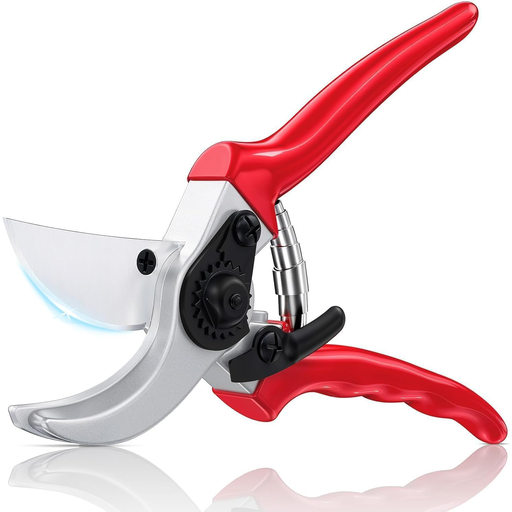
Why this model could be suitable: it is designed for everyday work on roses, shrubs, fruit trees and bonsai, with a stated capacity of up to 25 mm.
The stated capacity and cutting type are clearly specified: you can reserve it for fresh branches of this diameter, without asking it to do the work of loppers.
SK5 steel blade, aluminium handle described as ergonomic and non-slip surface.
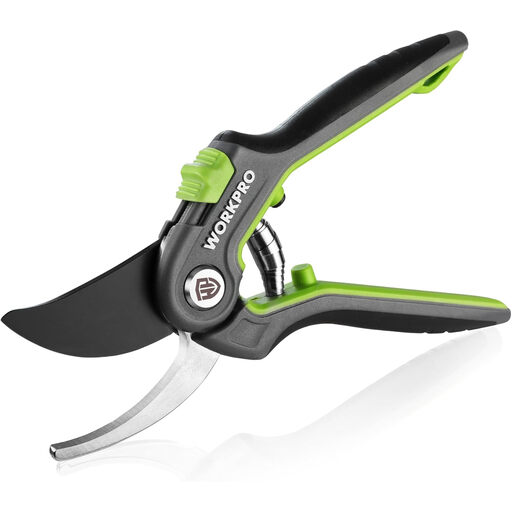
Why this model could be suitable: its 210 mm format and bypass action are suitable for regularly pruning small trees, shrubs and ornamental plants.
The maximum capacity of 19 mm is clearly stated, reducing the risk of using it on wood that is too thick.
SK5 blade with protective coating, automatic spring and safety lock.
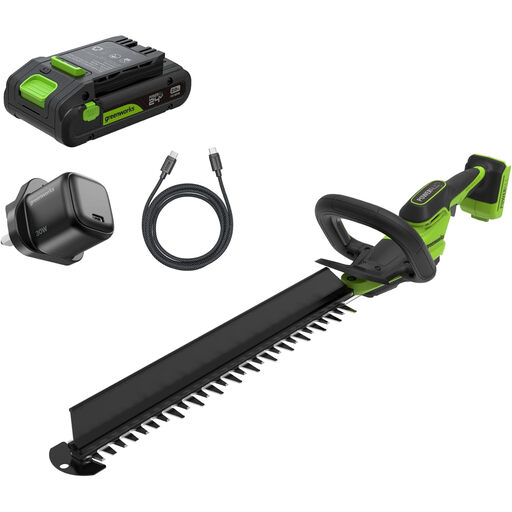
Why this model could be suitable: it is aimed at homeowners who regularly maintain their hedges and bushes without relying on a mains cable.
The stated runtime can reach 25 minutes, making it possible to estimate whether a single charge will be enough for your hedge.
51 cm double-action blade, 28 mm tooth gap, 24 V 2.0 Ah battery and USB-C charger included.
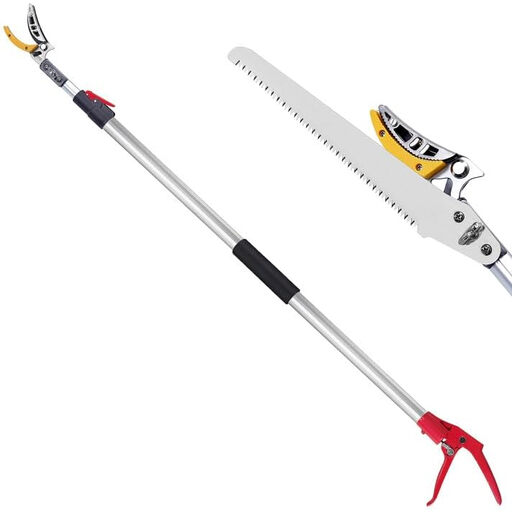
Why this model could be suitable: its adjustable length makes it easier to reach high branches and pick fruit without constantly having to move a ladder.
The length is specified as 135 to 223 cm, and the locking mechanism must be secured before each use, so the reach is not presented as unlimited.
Aluminium shaft, 30.5 cm SK5 toothed blade and non-slip handle for two-handed use.
We have put together an up-to-date selection of tools that meet these selection criteria and the safety requirements applicable in France.
After each session, remove sap and leaves with a dry cloth. Dry the blades, then regularly apply a little light oil to the pivot and moving parts. Store the tools in a dry place and leave the lock engaged when the model has one.
On a hedge trimmer, clean the teeth without touching the trigger and remove the battery before carrying out any work. A blunt blade requires more effort and produces a less even cut: check its condition before periods of intensive pruning.
Reinforced secateurs may be suitable for fresh branches up to 25 mm, provided this capacity is explicitly stated. For dry, knotted or difficult-to-reach wood, choose loppers or a pruning saw. Never force secateurs designed for a smaller diameter.
Secateurs are operated with one hand and are used to cut stems and small branches. Loppers, also known as branch cutters, have longer handles that increase leverage and reach. They are bulkier, but better suited to thicker branches. For high branches, a telescopic pruning saw can complement this equipment.
A cordless hedge trimmer avoids the constraints of a cable and is suitable for garden hedges when the stated runtime matches the area to be treated. However, you should plan for recharging, follow the instructions for use and check the weight of the device before starting a long session.