
Livraison le jour même ou le lendemain

Qualité garantie

Débloquez vos offres de bienvenue: Livraison GRATUITE | Jusqu'à -80 % | 30 jours d'essai gratuits à JoyPlus
Téléchargez l'application
A garden secateur might seem simple to choose… until a branch resists, the mechanism jams, or the handle starts to tire your hand. Between promises of a ‘professional’ cut, supposedly stainless steel blades, and electric models with sometimes vague specifications, certain purchases can quickly turn into disappointment.
Before comparing prices, check three essential points: the actual cutting diameter intended, the blade type, and the ergonomics. These criteria make the difference between secateurs designed for roses and shrubs, a proper lopper, and a pruning tool.
A cutting capacity expressed in millimetres does not mean the tool can tackle all wood of that diameter. A bypass secateur is generally designed for green stems and branches. Dry, very hard, or fibrous wood risks damaging the blade and often requires much more force.
For a thick branch, it is better to use branch secateurs, a lopper, or a pruning saw. Always respect the limit stated by the manufacturer.
The mention SK5 steel blade refers to a carbon steel valued for its hardness and ability to hold an edge. However, this alone does not guarantee the tool’s lifespan. The coating, quality of assembly, pivot, and maintenance all play an important role too.
Even if protected against corrosion, a blade must be cleaned and dried after pruning, especially after cutting sap-rich plants.
A handle that is too thin, a spring that is too stiff, or a lock that is difficult to operate can make long pruning sessions particularly uncomfortable. To work for longer without ending up with a sore hand, choose ergonomic secateurs with assisted opening, a non-slip surface, and a weight suited to your grip strength.
The cutting diameter should match your vegetation, not the highest value displayed on the packaging. For small stems and flowers, a capacity of 6 mm may be enough. For routine shrub maintenance, a capacity between 19 and 25 mm offers greater versatility.
Beyond that, choose a garden lopper or a suitable saw. Do not force the blades: a cut that is too difficult can deform the mechanism or cause a sudden movement.
After each use, remove debris with a soft cloth, dry the blades, and occasionally apply a thin layer of lubricant to the pivot. Then store the tool locked, in a dry place out of reach of children.
With pole tools, check the lock before you start working. Avoid any use near power lines and wear gloves and eye protection when branches might fall.
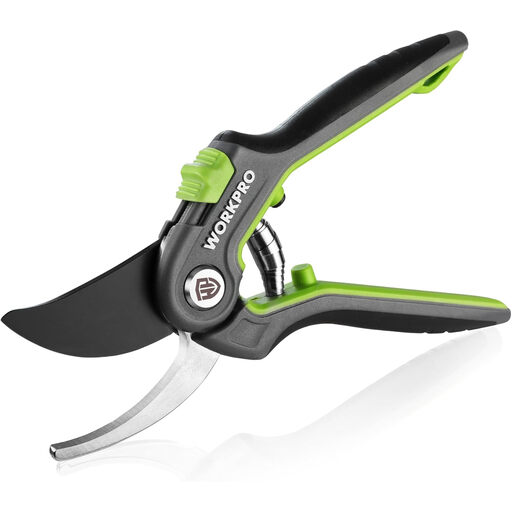
Why this choice suits this profile: At 210 mm, this model is suitable for everyday tasks on roses, shrubs, small trees, and garden harvesting. Its stated capacity reaches 19 mm for green branches.
The 19 mm limit is clearly stated, which prevents using it on wood that is too thick or dry. The safety lock also simplifies storage.
Main blade in SK5 steel with protective coating, automatic spring, non-slip handles, and a stated weight of 220 g.
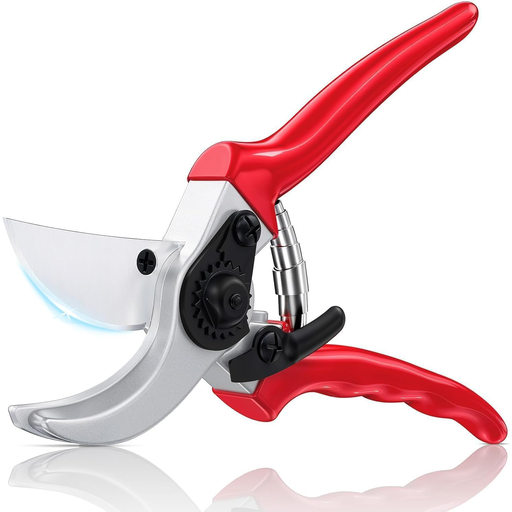
Why this choice suits this profile: This model is stated for roses, shrubs, fruit trees, and bonsai, with a capacity of up to 25 mm. It is aimed at those looking for a versatile manual tool.
The bypass type and maximum diameter are clearly specified. Dry or thicker branches should, however, be left to a suitable lopper.
SK5 steel blade, non-slip aluminium handle, and a design intended for precision pruning.
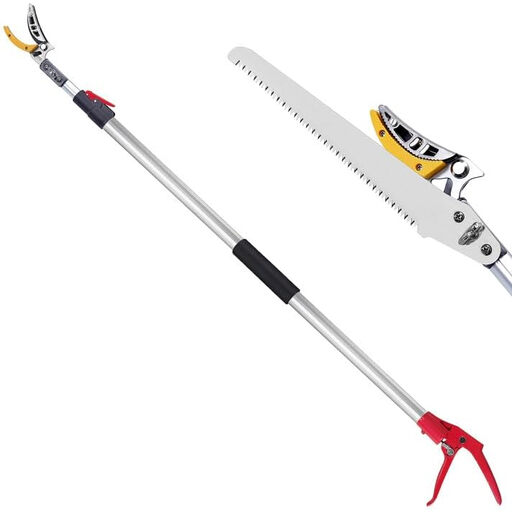
Why this choice suits this profile: Its adjustable pole from 135 to 223 cm makes high pruning and fruit harvesting easier without constantly getting the ladder out. It suits gardens where trees or certain branches are hard to reach.
Its adjustable length meets a specific need, but it does not replace a tool designed for thick branches. The pole lock must be checked before each cut.
Aluminium alloy handle, 30.5 cm SK5 blade with 3D teeth, and adjustable length from 1.35 to 2.23 m.
We have selected a complete range, updated in real time, of products that meet these selection criteria and European safety requirements.
A bypass secateur is generally suitable for green stems, faded flowers, and young branches. Check the maximum diameter stated by the manufacturer and choose a comfortable handle if you need to make many cuts.
The secateur is operated with one hand and is suitable for small branches. The lopper, also called a branch cutter, has longer handles that increase the force applied. It is better suited to thick branches, but it is also more cumbersome to carry.
Clean the blade after each session, remove sap, dry all parts carefully, and lubricate the pivot from time to time. Avoid cutting metal wire, wood exceeding the stated capacity, or materials for which the tool is not designed. Regular, appropriate sharpening will then help maintain a clean, consistent cut.