
Same-day & Next-day Delivery

Quality Guaranteed

Unlock Your Welcome Offers: FREE Delivery | Up to 80% OFF | Free 30-day JoyPlus trial
Download the APP
A flower pot that shatters at the first frost? Colours that fade to a dull grey after just one summer? It's the classic, costly disappointment every gardener dreads. While beautifying your garden, terrace, or balcony is a true pleasure, choosing the right containers is a crucial step to ensure your investment doesn't fall to pieces.
As the head of product selection at Joybuy, my mission is to guide you through the jungle of options to find the features that truly make a difference. Let's forget the marketing jargon and focus on what's essential: the objective criteria that guarantee a long-lasting purchase. Here are the pitfalls to avoid and the key points to check before you pull out your credit card.
Investing in an outdoor planter shouldn't feel like a gamble. Yet, between misleading labels and design flaws, it's easy to get it wrong.
To be certain your planter will withstand the seasons without issue, three technical points deserve your full attention.
The choice of material is decisive. Each solution presents a trade-off between aesthetics, weight, and durability.
This is the number one checkpoint. The pot must have pre-drilled drainage holes. If it doesn't, check that the plastic is designed to be easily drilled without cracking. The best option remains the removable plug: it offers complete versatility, allowing the pot to be used indoors (with the plug in) or outdoors (with the plug removed). On large planters, a raised bottom or a double wall are bonuses that promote air and water circulation.
The pot's size should be chosen for the plant at its mature size, not just at the time of purchase. Don't forget that a large outdoor planter offers better thermal inertia, protecting the roots more effectively from frost. For XXL models, integrated casters are not a gimmick: they are life-changing when it comes to moving the pot to clean the terrace or bring it indoors for the winter. Finally, a self-watering planter is a real plus, especially for a highly exposed balcony planter, as it significantly reduces watering chores.
To move from theory to practice, here are a few models that perfectly illustrate these criteria and meet specific needs.
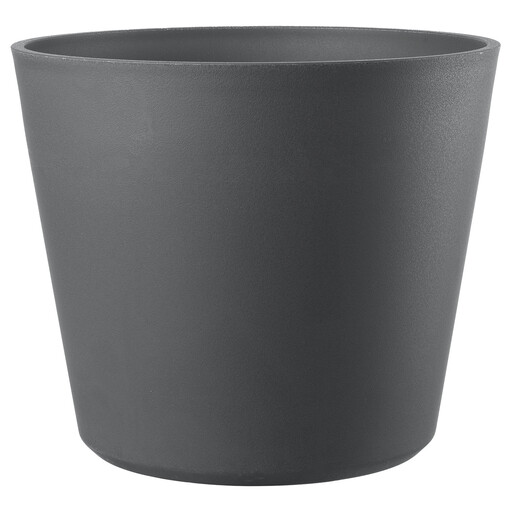
Why we love it: Its compact size is perfect for adding greenery to a balcony or small terrace. Lightweight, easy to handle, and with a versatile design, it's the hassle-free solution for bringing your outdoor space to life.
Made from recycled plastic treated to be frost- and UV-resistant, it's built to last. Its removable drainage plug guarantees all-weather versatility, eliminating the risk of cracking due to frost.
Its modularity, thanks to the drainage plug, which makes it equally at home indoors or outdoors.
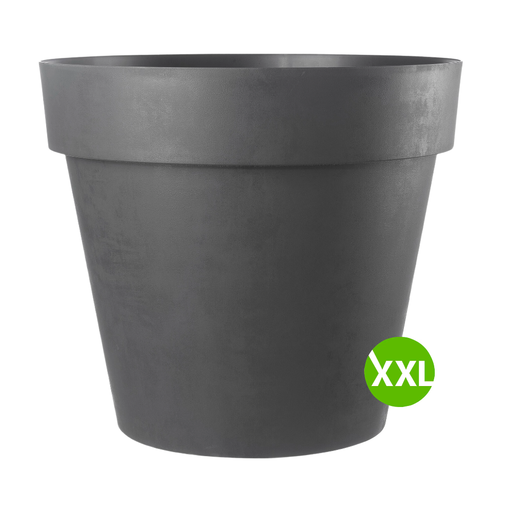
Why we love it: With its generous volume, it's perfect for a shrub or large-scale floral arrangements. Its contemporary design and anthracite finish make it a statement piece for a terrace or entryway.
Its recycled injection-moulded plastic design ensures triple resistance: to shocks, frost, and UV rays. The drainage is pre-drilled, guaranteeing perfect water evacuation without any extra effort.
Its large volume (79 cm high) combined with the lightness and robustness of the material. An excellent size-to-performance ratio.
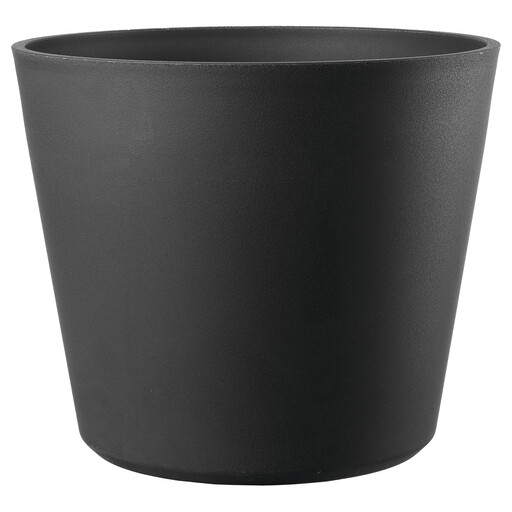
Why we love it: A must-have for those who love to rearrange their terrace or need to move large planters for winter storage and cleaning. This large pot combines volume and mobility thanks to integrated casters that are as discreet as they are effective.
It's a flawless performer: frost- and UV-resistant material, versatile drainage with a plug, and the ultimate solution to the weight problem of large containers.
The integrated casters, which turn the chore of moving a filled 80 cm pot into child's play.
We've put together a complete selection of products that meet our criteria for durability and performance.
Even with a frost-proof pot, a few precautions are helpful. Check that the drainage holes are not clogged with leaves or compacted soil. Ideally, raise the pot slightly off the ground with pot feet or blocks to insulate it from the cold ground. This prevents it from sitting in standing water or melted snow and ensures drainage remains effective at all times.
A quality recycled plastic planter, with a good UV-resistant treatment, can easily last between 5 and 10 years, and even longer depending on its sun exposure and maintenance. Unlike a low-grade plastic, it won't become brittle over time, and its colour will remain stable for much longer.
Yes, without a problem, if the system is well-designed. Generally, the water reservoir is separated from the soil by a grid, and an overflow outlet automatically drains excess rainwater. This means the soil is never waterlogged, which protects the roots from rot and limits the amount of water that could freeze inside the pot. It's a practical and relevant feature for all seasons.