
Livraison le jour même ou le lendemain

Qualité garantie

Débloquez vos offres de bienvenue: Livraison GRATUITE | Jusqu'à -80 % | 30 jours d'essai gratuits à JoyPlus
Téléchargez l'application
Making your own dried fruit, creating crispy vegetable chips, or even preparing homemade beef jerky is a tempting idea. An electric food dehydrator promises healthy, cost-effective, and additive-free food preservation. The problem? The market is flooded with models making tempting promises that often hide major flaws. To help you see things more clearly and avoid buyer's remorse, we've identified the three most common pitfalls.
The principle is simple: a flow of hot air circulates to extract moisture from food. However, on many entry-level models, the ventilation is poorly designed. The hot air, usually propelled from the base (vertical flow), struggles to reach all trays evenly.
Heat and food contact are an unforgiving combination: the materials must be impeccable. A rock-bottom price often hides low-grade plastic trays that warp with heat or crack after just a handful of uses. More alarmingly, some plastics are not guaranteed bisphenol A-free (BPA-free), a chemical compound to avoid in contact with food.
A dehydrator without an adjustable thermostat or a timer is a risky gamble. Every food has its ideal drying temperature:
An appliance that only offers a single temperature or a simple "on/off" switch will never have the versatility or precision needed to make your recipes a success.
To avoid these disappointments, focus on a few non-negotiable technical features. These are what will guarantee the performance and longevity of your future fruit and vegetable dryer.
A good dehydrator should put you in control.
The drying surface area is a critical factor. A couple preparing a few weekly snacks won't have the same needs as a family with a bountiful garden. A 5-tray dehydrator is often an excellent compromise: it remains compact enough not to take over your kitchen while offering sufficient capacity for most uses, including making pet treats in good quantities.
Ensure the trays are made of sturdy, BPA-free plastic or, for more premium models, stainless steel. Dishwasher-safe trays are a significant plus that will make your life easier. Finally, check that the appliance's design ensures good air circulation between each level.
Rather than an endless list of products, we chose to highlight one model that checks all the boxes for versatile family use.
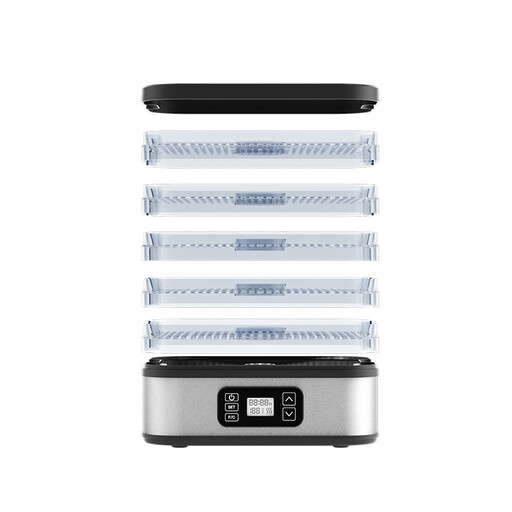
Why it's perfect for this profile: This is the ideal entry point for those who want to get started with dehydration without breaking the bank. Its 5-tray capacity is perfect for preparing weekly snacks, preserving garden surpluses, or making homemade pet treats.
This model includes an adjustable thermostat and a timer, giving you full control over the drying process. It thus avoids pitfall #3. Its design is optimised for good air circulation, even for a vertical flow model.
The combination of the timer, precise temperature control, and a versatile 5-tray capacity makes it an ultra-functional appliance capable of adapting to a multitude of recipes.
And if you'd rather taste before you invest, our selection of quality dried fruits will whet your appetite.
Discover our selection of dried fruits and healthy snacks, carefully prepared for maximum flavour.
A dehydrator's power consumption is actually quite modest, typically ranging from 250 to 700 watts. To give you an idea, a 500W appliance running for 8 hours at 60°C will consume about 4 kWh, costing less than a dollar at the current standard electricity rate. This is often more economical than using your oven, even in convection mode at a low temperature.
A very wide variety of foods are suitable for dehydration: fruits, vegetables, mushrooms, herbs, lean meats (for beef jerky), and fish. However, you should avoid very fatty foods like avocados, fatty meats, or dishes in sauce. The reason is simple: fat doesn't evaporate and can go rancid, compromising preservation.
Most quality plastic trays are safe to place in the top rack of the dishwasher. For stubborn residue (like sticky fruit sugar), a quick soak in warm, soapy water followed by a gentle scrub with a soft brush will do wonders. Just be sure to dry them thoroughly before storing to prevent any trace of mould.