
Livraison le jour même ou le lendemain

Qualité garantie

Débloquez vos offres de bienvenue: Livraison GRATUITE | Jusqu'à -80 % | 30 jours d'essai gratuits à JoyPlus
Téléchargez l'application
A duvet or a blanket might seem simple to choose… until it turns out to be too hot, slips off during the night or loses its fluffiness after a few washes. For adults, couples, families and students alike, the right choice depends less on appearance and more on three concrete criteria: the material, the dimensions and the care.
A very bulky duvet isn’t necessarily the best option for cooler nights. Its warmth level also depends on the filling, the weave and the airflow. If you tend to sweat at night, a lightweight duvet, a summer blanket or a cooling blanket can be more comfortable than a thick model.
A blanket that’s too short leaves your feet exposed and tends to shift during the night. Conversely, a model that’s too large can be difficult to handle in a small washing machine. Check the width of your mattress, the height of your bed and how much overhang you want on the sides.
As a guide, a 140 cm wide bed typically needs a duvet at least 200 cm wide to maintain a proper overhang. However, the ideal dimensions should always be adapted to your mattress, your bed base and your habits.
The term all-season blanket doesn’t correspond to a single regulated warmth level. It could refer to a lightweight blanket suitable for spring and summer, or a model designed to be used with another layer. It’s better to examine its composition, weight, breathability and care recommendations.
The microfibre duvet often appeals for its lightness, relatively simple care and consistent feel. A brushed microfibre can offer a softer sensation, while a quilted fabric helps keep the filling in place.
If you tend to feel hot, look at the duvet’s construction and the fabric’s ability to let air circulate. A cooling side can change the sensation on contact, but it doesn’t replace a properly ventilated room or a suitable duvet cover.
Before buying, check the maximum temperature, the recommended programme and the drying conditions. A machine-washable duvet must also fit in your washing machine, leaving enough room to be properly rinsed.
The models shown here generally recommend a delicate wash at 30 °C or lower, without bleach. Always follow the product label. Bedding that isn’t dried properly can retain moisture and develop an unpleasant odour: it must be completely dry before being stored.
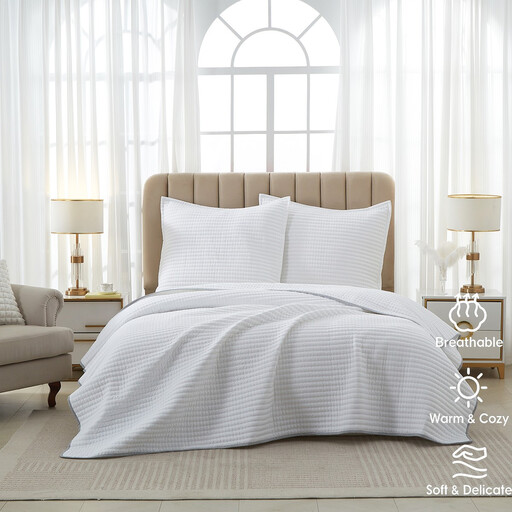
Why this choice suits this profile: With its 140 × 200 cm size, this model is suitable for a single bed. It can be used as a bedspread, a lightweight layer or an extra blanket.
The diamond quilted construction helps keep the filling in place, while the reinforced edges reduce wear on the borders.
100% polyester microfibre, lightweight, one 65 × 65 cm pillowcase and machine washable at 30 °C or lower.
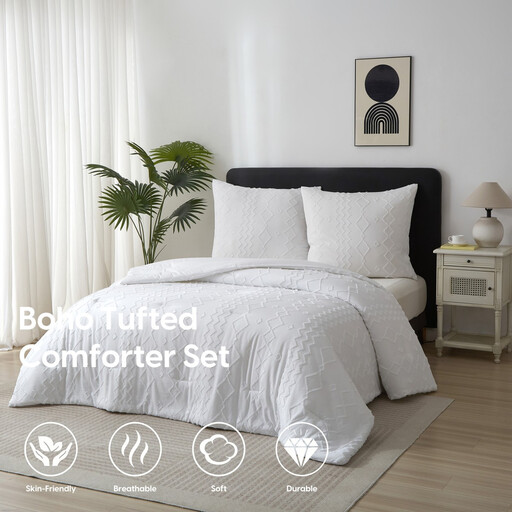
Why this choice suits this profile: This set combines a geometric quilted finish with two 80 × 80 cm pillowcases, for a bedroom that’s understated and perfectly coordinated.
The subtle quilting and corner ties help limit filling movement and make it easier to fit a duvet cover.
100% polyester microfibre, lightweight microfibre filling, envelope closure on pillowcases and delicate wash at under 30 °C.

Why this choice suits this profile: This hooded fleece blanket is designed for reading, watching television or relaxing on the sofa. Its size is suitable for one person.
Its use is clearly intended for relaxation, not for a double bed. This helps you avoid choosing an extra blanket to replace a bed duvet.
Polyester fleece, integrated hood, 120 × 150 cm size and delicate wash at 30 °C, no bleach or tumble dryer.
We’ve selected a complete range, updated in real time, of products that meet these demanding criteria as well as European safety requirements.
Go for a thin, breathable model that’s easy to wash. A double-sided cooling blanket can provide a cool sensation on contact, while a lightweight microfibre duvet is more versatile. The room temperature, your bed linen and the clothes you wear at night also affect your comfort.
Start by checking your washing machine’s capacity and the care label. Run a delicate cycle at the indicated temperature, without bleach, then dry the duvet completely. If tumble drying is allowed, choose a low temperature. Otherwise, air-dry it in a well-ventilated area.
No. Its weight and usage instructions must be checked before buying. Young children and people with certain medical conditions may not be suitable for this type of product. If in doubt, ask a healthcare professional for advice. Never use a weighted blanket with an electric blanket without first checking their compatibility.
A duvet is mainly intended for sleeping and is usually used with a cover. A quilted bedspread protects and dresses the bed, while adding a lightweight layer. A blanket is more versatile: depending on its size and design, it can be used on a bed, a sofa, in a car or while travelling.