
Livraison le jour même ou le lendemain

Qualité garantie

Débloquez vos offres de bienvenue: Livraison GRATUITE | Jusqu'à -80 % | 30 jours d'essai gratuits à JoyPlus
Téléchargez l'application
An always-cluttered countertop, a permanent puddle of water… a familiar scenario in many kitchens. What if the culprit is your dish rack? This seemingly harmless accessory can quickly become a real headache. Poorly chosen, it turns into a limescale trap, rusts within months, or proves to be simply wobbly and ill-suited for your dishes.
To avoid buyer's remorse, it's best to know the common pitfalls. It's easy to be seduced by a sleek design, only to be disappointed by deal-breaking flaws: an inefficient drainage system that lets water stagnate, low-quality materials that rust in record time, or a design so poorly thought-out that it can't accommodate your large plates or wine glasses.
To find a model that is both practical and durable, forget the marketing claims and focus on the essentials: the technical specifications.
The material directly impacts the lifespan and maintenance of your dish rack.
The number one mission of a good dish rack: keeping your countertop dry. To achieve this, two systems compete:
The ideal configuration depends on the size of your household and the space you have on your countertop.
Also, consider dedicated compartments: an integrated cutlery holder or utensil caddy is essential for organising forks and knives, while specific holders for glasses or cups are a real plus.
To illustrate these criteria concretely, here is a selection of models suited to different needs.
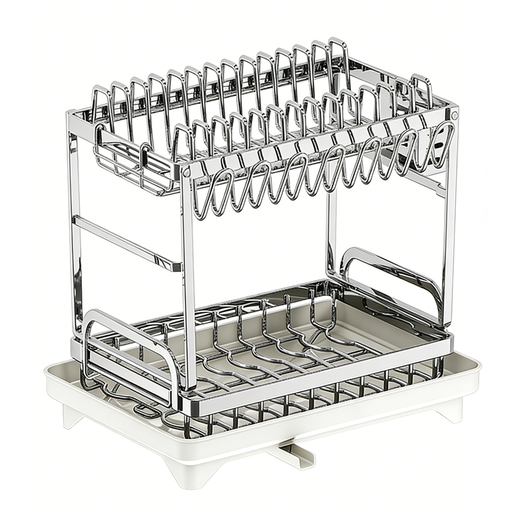
Why this model is a great fit: Its two-tier structure offers XXL drying capacity, ideal for handling a family's dishes after every meal, while optimising vertical space on the countertop.
Its stainless steel and PP construction resists rust, even in a very humid environment. The integrated drain pipe continuously evacuates water, preventing stagnation and limescale buildup.
Very large storage capacity thanks to its two tiers and dedicated compartments, for impeccable organisation and easy access.
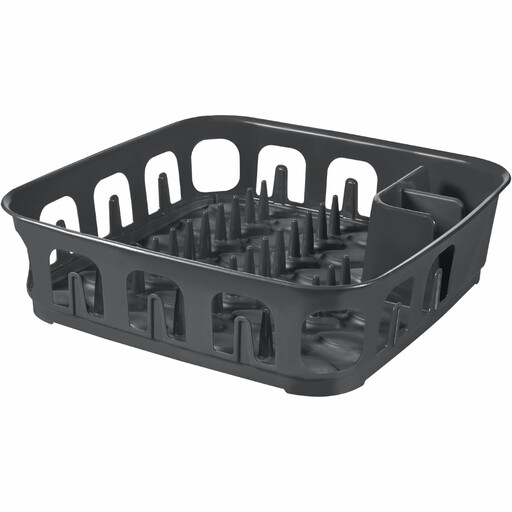
Why this model is a great fit: Its square, compact format is specially designed for small countertops. It offers sufficient capacity for the daily dishes of a couple or a small family, without ever cluttering the space.
Made of polypropylene, it eliminates any risk of rust. Its simple, one-piece design makes it not only sturdy but also very easy to clean, preventing dirt buildup.
Compact and clever design, with external holders for cups to maximise space. It's dishwasher-safe for effortless maintenance.
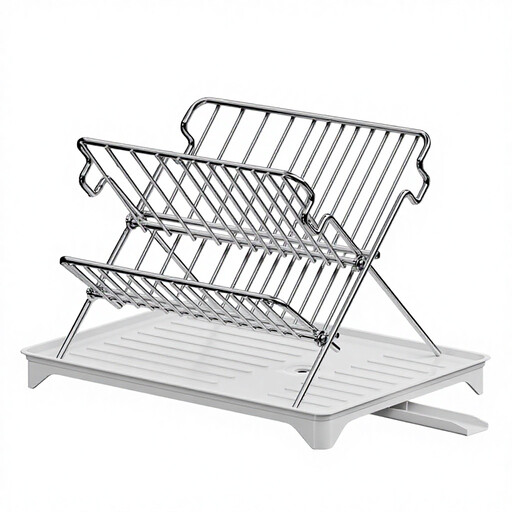
Why this model is a great fit: It combines the sturdiness of stainless steel with a very clever foldable design. It offers a large capacity when unfolded, then stores away ultra-compactly to free up the countertop.
Its materials (stainless steel and PP) ensure excellent resistance to moisture and corrosion. The integrated drainage pipe ensures efficient water evacuation, thus avoiding problems related to stagnant water.
Foldable design for maximum space-saving. Its sturdy structure supports a heavy load without warping.
Explore our full selection of products that meet our criteria for quality and durability.
The best prevention is to choose a model made of high-quality stainless steel, such as type 304. Regular cleaning is also essential: wipe it down from time to time to prevent limescale deposits, which trap moisture and can eventually attack even lower-quality steels. Finally, ensure the drainage system works perfectly so that no water stagnates.
A weekly cleaning is recommended to prevent the buildup of limescale and bacteria. If your plastic model is compatible, a run through the dishwasher is the easiest solution. For others, a little soapy water or white vinegar will do the trick perfectly. And if your rack has a drip tray, remember to empty and clean it daily.
The stability of a 2-tier dish rack depends entirely on its design and the quality of its materials. Well-designed models have a wide base and non-slip feet. The sturdiness of the uprights is also crucial. In use, a rule of thumb: distribute the weight evenly, always placing the heaviest items (pots, large plates) on the lower level.