
Livraison le jour même ou le lendemain

Qualité garantie

Débloquez vos offres de bienvenue: Livraison GRATUITE | Jusqu'à -80 % | 30 jours d'essai gratuits à JoyPlus
Téléchargez l'application
A dashcam can work perfectly well with a charger plugged into the cigarette lighter. However, this often leaves a cable trailing around the cabin and doesn't always allow you to record when the car is parked. To power the camera continuously, a dashcam power kit connected to the fuse box or OBD port provides a cleaner, more discreet installation.
You still need to choose a model that is compatible with your vehicle and your camera. Several common mistakes crop up time and again at the point of purchase.
A USB-C cable for a dashcam simply connects a power source to the camera. It does not necessarily convert the vehicle's 12 or 24 V current into a voltage suitable for the camera.
The UGREEN Type C M-M 2.0 cable, for example, advertises an output of up to 5 V/3 A, with support for PD and PPS. However, its specification states that it is intended for charging phones and similar electronic devices, mainly indoors and in a dry environment. It therefore does not replace a hardwire cable for a dashcam, which is designed for automotive installation.
Parking mode continues to draw on the battery when the engine is off. Without automatic cut-off, continuous recording can reduce the reserve available for starting, or even prevent the vehicle from restarting.
Choose a model with low-voltage protection, with a clearly stated threshold. Some kits advertise a cut-off at 11.8 V on a 12 V circuit or 23.6 V on a 24 V circuit. Check these values in the technical data sheet: they can vary from one model to another.
USB-A, USB-C, mini-USB and proprietary connectors are not interchangeable. You also need to identify the fuse format used by your vehicle: Mini, Micro2, Low-Profile Mini or ATO, for example.
A dashcam wiring kit may be compatible with the vehicle's voltage, but unusable if its connector or fuse holder does not match. On a recent vehicle, consult the manual or ask a professional for advice if in doubt.
A 12 V/24 V dashcam power supply is suitable for many cars, vans and some motorhomes. Nevertheless, check the voltage stated by the kit manufacturer and that of the circuit in question.
The output voltage must also match the camera's requirements. The AZDOME JYX05 kit, for example, converts an input of 12 to 24 V into a maximum output of 5 V/2.5 A. This figure should be compared with the precise specifications of your dashcam.
Three solutions are generally available to you:
To install a dashcam without using the cigarette lighter, the connection is usually made via the fuse box or an OBD cable for a dashcam. In both cases, the cable must be properly secured so as not to obstruct the pedals, airbags or field of vision.
24-hour parking mode does not depend solely on the power supply. The dashcam must also offer this function and be able to switch automatically from normal recording to surveillance when the vehicle is parked.
Some kits use an ACC wire to detect when the vehicle is powered on. Others rely on the OBD port or the camera's internal management. So check compatibility with the exact model of your dashcam, not just its brand.
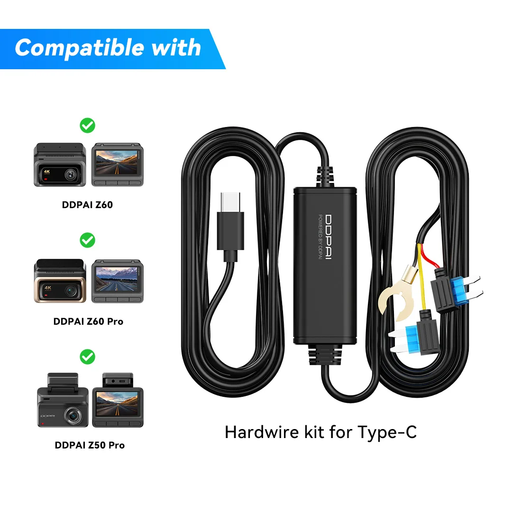
Why this choice suits this profile: This kit is aimed at drivers with a dashcam from the Z90, Z60, Z60 Pro, MINI2X, Z50 Pro or N2 series, who want to add a dedicated power supply for parking mode.
Compatibility with several models is stated in the product name. However, you must select the correct series before purchasing.
A dedicated solution for 24-hour parking mode, designed for several specific dashcam models.
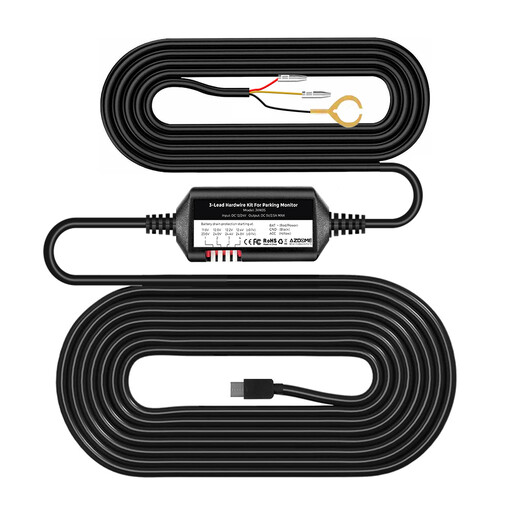
Why this choice suits this profile: With its USB-C connector and conversion from 12–24 V to 5 V/2.5 A, this kit is suitable for those who want a fixed installation without monopolising the vehicle's 12 V socket.
The data sheet mentions protection with cut-off at 11.8 V or 23.6 V, as well as several fuse holder formats. These must be checked according to the vehicle.
Input 12–24 V, USB-C output 5 V/2.5 A, ACC detection and four variants of fuse holders advertised.
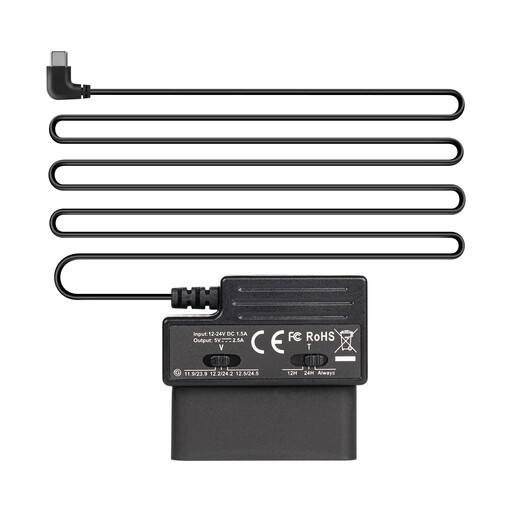
Why this choice suits this profile: The OBD to USB-C connection may appeal to drivers who want to avoid tampering with the fuse box and prefer a plug-and-play installation.
The OBD format avoids handling fuses. However, check the compatibility of the OBD port and the dashcam before ordering.
OBD to USB-C adapter, 24/7 parking mode advertised and three-level low-voltage protection according to the product data sheet.
We have compiled a complete, real-time updated selection of products that meet these demanding criteria, while also taking into account European safety regulations.
Before you start, turn off the ignition and consult the vehicle's manual as well as the kit's instructions. If you are not comfortable with automotive circuits, getting a professional to do it reduces the risk of wiring errors.
Then check the following points:
Yes, provided you use a power supply designed for this purpose and a camera compatible with parking mode. Automatic cut-off in the event of low voltage is essential to limit the drain on the battery. However, no kit guarantees the same autonomy in all situations: temperature, battery condition and parking duration also come into play.
The OBD cable simplifies installation and avoids direct intervention on the fuse holder. The fuse box connection generally offers more customisation options, but you need to identify the correct format and the appropriate circuit. The choice therefore depends on the vehicle, the dashcam and the level of simplicity you are looking for.
The price depends on the type of connection, the connectors, the low-voltage protection and the accessories supplied. A simple cable usually costs less than a complete kit with fuse adapters or ACC detection. Above all, compare compatibility, output voltage and included features, rather than just the displayed price.