
Livraison le jour même ou le lendemain

Qualité garantie

Débloquez vos offres de bienvenue: Livraison GRATUITE | Jusqu'à -80 % | 30 jours d'essai gratuits à JoyPlus
Téléchargez l'application
A car dashcam can provide invaluable video evidence after an accident, a collision or an act of vandalism. But not all dashcams are created equal, and they don't all meet the same needs. A high resolution doesn't necessarily guarantee a readable number plate, while a parking mode advertised as "24H" often requires a permanent power supply.
Before you make a purchase, it's worth checking the video coverage, night-time image quality, storage capacity and the installation requirements specific to your vehicle.
In good conditions, a 4K dashcam captures more detail than a Full HD model. However, the final quality also depends on the sensor, the lens aperture, the video bitrate, the compression and the lighting. A poorly configured 4K camera with mediocre optics can produce images that are less usable than a good 2K camera.
Pay particular attention to the sensor sensitivity, the presence of HDR or WDR processing and the lens aperture, for example F1.8 or F2.0. These features play an important role in the readability of signs and number plates, especially at night.
A front and rear dashcam usually requires running a cable between the windscreen and the rear window. Check its length, the type of connector used and whether it can be concealed within the trim. A makeshift installation can obstruct your view or come unstuck in hot weather.
If you plan to use the camera to monitor your car while it's parked, the cigarette lighter socket may not be sufficient. A dashcam hardwire kit or a compatible OBD adapter may then be necessary.
The microSD card, mounting bracket, rear cable and parking mode wiring are sometimes sold separately. Also check the maximum supported capacity and the recommended speed class. 4K videos quickly fill up the available space.
GPS, WiFi and a mobile app can simplify managing your recordings, but they won't compensate for a poorly executed installation or an unstable power supply.
For everyday use in the city and on the motorway, a 2K front camera generally offers a good balance. 4K can be worthwhile if you want to examine distant details, provided you use a sufficiently fast memory card.
A wide-angle car camera covers a larger area, but too wide an angle can distort the edges of the image. Compare the stated angle and the resolution of each camera. In a front and rear pack, the rear camera may have a different resolution to the one fitted at the front.
Three or four-channel systems also record the interior and the sides of the vehicle. These are aimed more at drivers who want extensive coverage, taxi drivers, professionals or motorists who regularly park their car in high-risk areas.
A night vision dashcam must maintain a sufficiently contrasted image in the face of headlights, streetlights and poorly lit areas. HDR, WDR functions and sensitive sensors can help balance dark and bright areas, without guaranteeing a readable number plate in every situation.
The G-sensor detects impacts and can automatically lock the corresponding footage. When the card is full, loop recording overwrites files that haven't been protected. Remember to regularly back up important videos to your phone or computer.
A dashcam with GPS can record the location, route and sometimes speed in the video metadata. Use this information with discretion and check its content before sharing a recording with an insurer or a third party.
A WiFi dashcam usually allows you to view or download videos via an app, without having to remove the memory card. However, the range is limited to the immediate vicinity of the vehicle.
The 24H parking mode often requires a dedicated hardwire kit. Choose a model with battery discharge protection and check its exact compatibility with your camera. In the UK, images captured on public roads must also be used in accordance with privacy laws and data protection regulations.
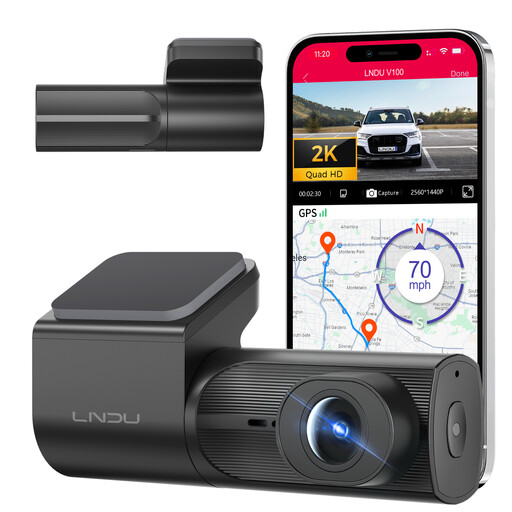
Why this choice suits this profile: its compact size, 2K resolution, built-in WiFi and app make a first installation straightforward for urban and everyday journeys.
The listing mentions loop recording, night vision and G-sensor locking. The parking mode does require a separate kit, however, so factor that cost into your budget.
2K recording, F1.8 lens, WiFi, mobile app and compatibility with parking mode via a suitable hardwire kit.
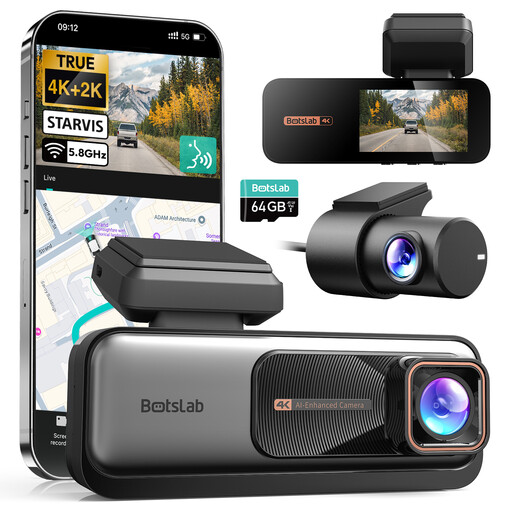
Why this choice suits this profile: this system is aimed at motorists who want front and rear coverage, built-in GPS and the ability to manage their videos from their phone.
The front camera records in 4K, while the rear module only manages 2K. The 24/7 parking mode requires a separate hardwire kit, which makes the installation requirements clear from the outset.
4K resolution at the front, 2K at the rear, 170° and 150° angles, GPS, 5.8 GHz WiFi and a 64 GB microSD card included.
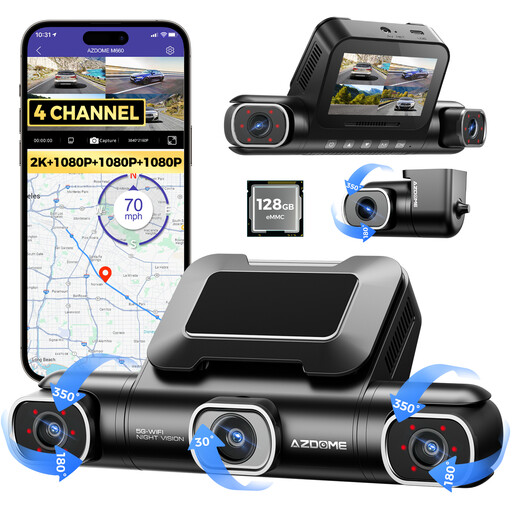
Why this choice suits this profile: its four channels are aimed at drivers who want to record the front, rear and sides, particularly when their vehicle is regularly parked on the street.
Having four cameras reduces reliance on a single lens. The 128 GB eMMC storage is built-in, but you'll need to check separately for the availability and compatibility of the hardwire kit for parking mode.
Front, rear, left and right channels, 3-inch IPS screen, GPS, 5G WiFi, infrared night vision and 128 GB eMMC storage.
Install the camera behind the rear-view mirror, without encroaching on the driver's field of vision. Clean the windscreen before applying the adhesive and make sure the lens remains level. For a rear camera, run the cable away from side airbags and boot hinges.
Use a microSD card that meets the manufacturer's recommendations. Format it regularly from the camera and check the recordings once the installation is complete. If you're using a permanent connection, choose a kit with deep discharge protection and make sure it's compatible with your model.
Its use is generally permitted in a private vehicle, provided you follow road safety rules and protect privacy. Do not operate the device while driving and be cautious when sharing images that show faces or number plates.
It depends on the memory card capacity, the chosen resolution and the recording mode. When the memory is full, loop recording overwrites files that haven't been locked. In parking mode, the runtime depends on the vehicle's battery and the power system used.
In many cases, yes. This kit powers the camera when the engine is off and can include battery discharge protection. Always check the exact reference compatible with the dashcam you've chosen.