
Livraison le jour même ou le lendemain

Qualité garantie

Débloquez vos offres de bienvenue: Livraison GRATUITE | Jusqu'à -80 % | 30 jours d'essai gratuits à JoyPlus
Téléchargez l'application
A cordless robot lawn mower can save you countless manual mowing sessions and keep your lawn looking neat week after week. However, this term covers several different technologies: some models operate without a perimeter wire, while others rely on an RTK antenna, a camera or precise mapping. Before placing your order, it is therefore worth looking beyond the marketing claims and checking that the mower is genuinely compatible with your garden.
A robotic lawn mower without a perimeter wire is not necessarily ready to use straight out of the box. Models equipped with RTK navigation may require the installation of a reference mast and charging station. Those that rely on a camera or computer vision also need to map the garden and receive their virtual boundaries through the app.
Take the time to check the box contents, mapping steps and requirements for maintaining a stable GPS or Wi-Fi signal.
A figure such as “800 m²” generally refers to the recommended maximum area under specific conditions. A garden made up of several zones, crossed by narrow passages, covered in dense vegetation or featuring slopes may significantly reduce the area that the autonomous robot lawn mower can actually handle.
Allow for a safety margin and check in particular:
A camera or 3D sensor can identify many obstacles, but no system eliminates the need to prepare the lawn. Garden hoses, flat cables, small toys and other very thin objects may go undetected depending on the lighting and their position.
Before each mowing cycle, remove any objects left on the lawn and keep children and pets away from the blades while they are operating.
A robot lawn mower with RTK navigation uses positioning signals to define virtual boundaries and follow more consistent mowing paths. This technology is particularly well suited to open gardens, but reception can be affected by large trees, walls or buildings.
A robot lawn mower with AI vision uses cameras and, in some cases, depth sensors. It can recognise certain obstacles and operate without a perimeter wire, but low light, fog or very flat objects may reduce detection reliability. Systems that combine RTK, cameras and 3D sensors offer a more comprehensive approach, although they generally require more involved installation and calibration.
When choosing a robot lawn mower for your garden, compare the technical limits with the actual layout of your property. An open 500 m² plot does not present the same challenges as a 300 m² garden divided by a pathway.
If your outdoor space includes several areas, look for a multi-zone robot lawn mower. This allows you to create mowing zones, no-go areas and separate schedules from the app. The maximum slope should be stated clearly, either as a percentage or in degrees. Never exceed the value specified by the manufacturer.
Battery life should not be considered in isolation: charging time and the mower’s ability to resume mowing precisely where it stopped are just as important. Depending on the model, the products featured below claim around 90 to 110 minutes of runtime, or more. Mowing frequency will also depend on grass height, moisture and the contours of the terrain.
You should also check:

Why it suits this profile: a solution designed for small lawns of up to 150 m², with autonomous operation and advertised wire-free installation.
The stated coverage area reduces the risk of choosing a machine that is oversized for a small garden. However, the mower must be protected from rain in accordance with the supplied instructions.
Automatic movement, advertised obstacle detection and operation on a rechargeable battery.
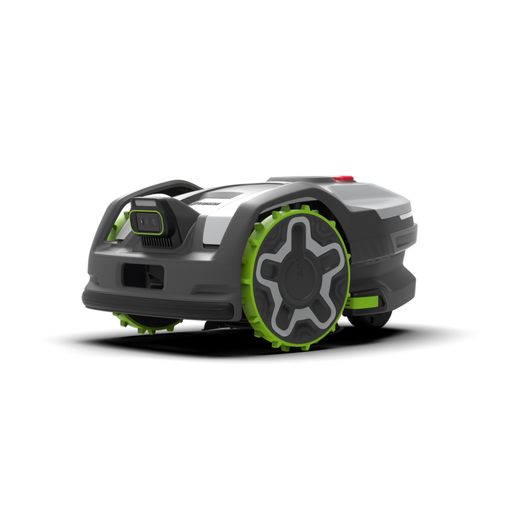
Why it suits this profile: this wire-free model is rated for 800 m², with RTK navigation and vision, multi-zone management and app-based control.
The 800 m² capacity and virtual boundaries are clearly specified. However, the RTK mast must be installed in an open location and positioned perfectly vertically.
Cutting height adjustable from 20 to 90 mm, a stated slope capability of up to 45% and a specified noise level of 58 dB(A).
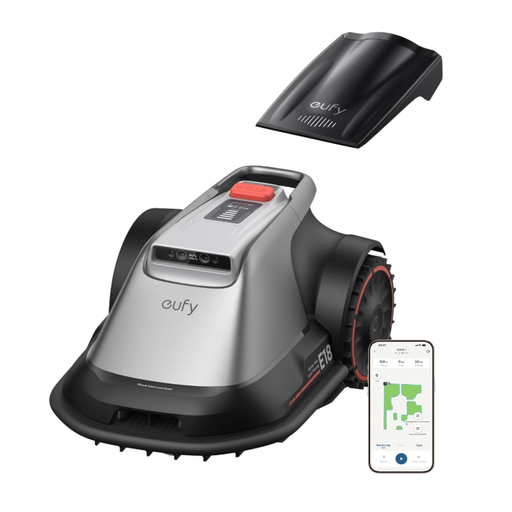
Why it suits this profile: designed for lawns of up to 1,200 m², it combines wire-free navigation, TrueVision vision and GNSS, with app-based control.
The technical specifications highlight potential limitations in very low light, fog and when dealing with thin objects. These conditions should be considered in light of how you intend to use the mower.
Cutting width of 20.3 cm, adjustable height from 25 to 75 mm, claimed runtime of 90 to 110 minutes and slope capability of up to 40%.
For an 800 m² lawn with camera and RTK navigation, the THOMSON THOM 8 is also worth considering. It claims 100 minutes of runtime, a MowMate app, an adjustable cutting height from 20 to 70 mm and a maximum slope of 22°. Hilly gardens may also make the Roborock RockNeo Q110 worth comparing, as it is rated for 1,000 m² and features NetRTK + VSLAM navigation with obstacle clearance of up to 4 cm.
Browse our updated selection of garden maintenance solutions and compare their features before making your choice.
No. Dense trees, high walls, heavily shaded areas and narrow passages can interfere with positioning or vision. Before buying, check signal coverage as well as the minimum passage width.
Regularly clean the underside of the mower, the wheels, the sensors and the charging station. Check the blades with the mower switched off and replace them as soon as they show signs of wear. In winter, follow the manufacturer’s recommendations for battery storage and keep the mower in a dry place.
Power consumption depends on mowing frequency, the area being maintained and charging time. You should also budget for periodic blade replacement, sensor maintenance and, for some models, a possible connectivity subscription. Check these details in the product specifications and service terms before ordering.