
Livraison le jour même ou le lendemain

Qualité garantie

Débloquez vos offres de bienvenue: Livraison GRATUITE | Jusqu'à -80 % | 30 jours d'essai gratuits à JoyPlus
Téléchargez l'application
Choosing the right cordless drill driver can often feel like a daunting task. Between promises of power, endless accessory kits, and sometimes obscure technical jargon, it's easy to get lost. Our guide is here to help you avoid the most common pitfalls and invest in the tool that truly meets your needs.
Before you even start comparing models, it's crucial to know how to spot a deal that's too good to be true. Here are three pitfalls that cost unwary DIYers dearly.
To choose a drill driver that will last, focus on these three features that truly make a difference.
High torque (expressed in Nm) is your drill's muscle. It's what allows it to drive screws into dense materials or drill large-diameter holes without breaking a sweat.
Most models offer two mechanical speeds: a slow one for screwdriving (more control and force) and a fast one for drilling.
Voltage (V) gives an idea of the power class, but it's the capacity (Ampere-hours, Ah) that dictates the runtime. At the same voltage, a 2.0 Ah battery will last much longer than a 1.3 Ah one. For regular use, a drill driver kit with two batteries of at least 1.5 Ah is a solid foundation.
The keyless chuck is standard, and for good reason. It allows you to change bits and drivers in the blink of an eye, without any tools. Check its maximum diameter (usually 10 or 13 mm), which determines the size of compatible bits. Finally, a complete and sturdy drill case is more than an afterthought: it protects your investment and makes transport and storage simple.
Rather than aiming for a universal "ideal" model, it's better to find one that matches your specific use case. Here are some kits that meet very specific needs.
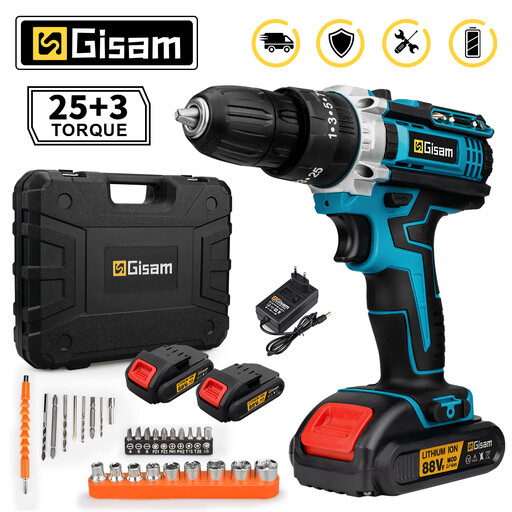
Why we chose it: The perfect all-in-one solution to get started without breaking the bank. Ideal for assembling furniture, putting up shelves, or for small everyday repairs. The kit is very comprehensive for beginners.
With its two batteries, the frustration of an interrupted project is over. It's the detail that makes all the difference compared to entry-level kits.
An unbeatable price-to-feature ratio. Its cordless hammer drill function is a real bonus for occasional drilling into brick or drywall.
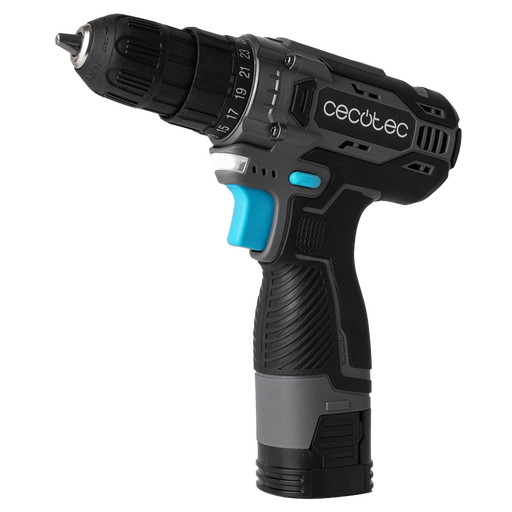
Why we chose it: For those who do DIY projects often and demand a certain level of performance. This model offers an excellent balance of power and handling to tackle more serious projects.
It doesn't hide behind voltage: it highlights a hefty 38 Nm of torque and 2.0 Ah batteries. Here, the power is real.
Its comfortable runtime, thanks to the two 2.0 Ah batteries, and its driving power allow you to take on ambitious jobs without taking a break.
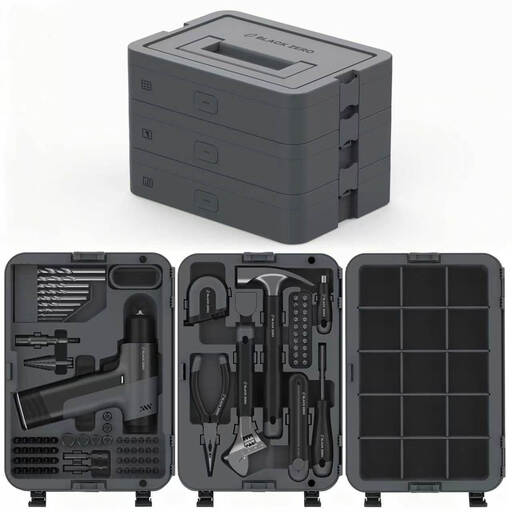
Why we chose it: For those who find a well-organised workshop as satisfying as the work itself. The focus is on a flawless user experience, from the workbench to storage.
It shatters the "mega-kit" catch-all mirage. Instead, it offers a patented and ultra-functional storage case. Quality and organisation take precedence over quantity.
Its 3-tier storage system, with a moulded compartment for the drill, is simply brilliant. It ensures optimal protection and access for all your tools.
We have put together a complete selection of drill drivers that meet our quality criteria and European safety standards.
A standard drill driver is perfect for drilling into wood, metal, and plastic, and of course for driving/removing screws. The hammer mode on a cordless hammer drill adds a percussive action that makes it easier to tackle masonry materials (brick, cinder block, cellular concrete...). For home use, the hammer function is a welcome bonus for added versatility.
A modern lithium-ion battery can handle between 500 and 1000 full charge cycles, which represents years of use for a typical individual. Our tips for taking care of it: avoid fully discharging it to 0% and don't store it in a freezing cold garage in winter or in direct sunlight in summer.
Yes, and then some! For most household tasks, 25 Nm of torque is ideal. Assembling flat-pack furniture, securing shelves, installing curtain rods, or driving screws into softwood and drywall... you'll do it all without the slightest difficulty.