
Livraison le jour même ou le lendemain

Qualité garantie

Débloquez vos offres de bienvenue: Livraison GRATUITE | Jusqu'à -80 % | 30 jours d'essai gratuits à JoyPlus
Téléchargez l'application
A clothes rail can free up space in a bedroom, bring order to a hallway or simplify storage in a utility room. The key is choosing the right model: if it is the wrong size, it can quickly become bulky, unstable or awkward to move. Before comparing prices or relying on photographs, take the time to check a few practical features.
A high maximum capacity does not necessarily mean that every rail or shelf can support that weight. You need to distinguish between the total static load, the capacity of a hook and that of a shelf. The way the weight is distributed also matters: several heavy coats grouped at one end can throw the whole unit off balance.
An extendable or telescopic clothes rail offers more width, but its stability depends on the structure, base and tube-locking system. A fully extended rail loaded unevenly places considerable strain on the uprights.
The stated dimensions sometimes refer only to the bare frame, without allowing for clothes, castors or side components. In a narrow hallway, measure the available depth, passage space and ceiling height. For a hallway clothes rail, also consider the space needed to open a door or move around in front of a piece of furniture.
A metal clothes rail is generally suitable for coats, jackets and bulky clothing, provided the joints are tightened properly. Steel is particularly common on mobile models and structures designed to support a substantial load.
In particular, check the following:
A clothes rail with castors makes it easy to move clothes between a bedroom, utility room or professional space. Swivel castors make changing direction easier. Make sure there are at least two brakes to keep the rail in place while it is being used.
To avoid disappointment, consider the type of flooring: small castors can be difficult to manoeuvre on a thick carpet or uneven surface. The brake should also be easy to reach, without having to move the entire structure to operate it.
A telescopic clothes rail can adapt to different spaces. Look at its minimum and maximum width rather than just the dimension highlighted in the title. Lower rails can hold boxes, while hooks and shelves are useful for bags, hats and other accessories.
When organising a hallway, a coat rack with shoe storage or a hallway unit with a bench can combine several functions in a single piece of furniture. In that case, check the bench depth, the capacity of each hook and the maximum load of the shelves.
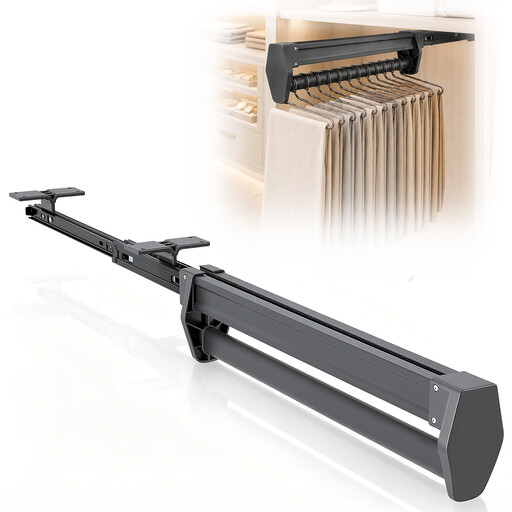
Why this choice suits this profile : Its extendable design is ideal for organising your first wardrobe or fitting out a space whose width may change over time.
The adjustable width helps you avoid choosing a unit that is too large. However, you must respect the stated load capacity and distribute clothes evenly.
A steel structure and telescopic design suited to both small wardrobes and adaptable spaces.
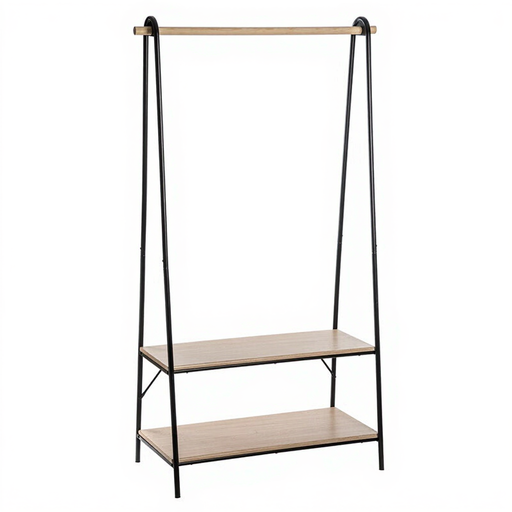
Why this choice suits this profile : Its combination of metal and wood fits easily into a bedroom, dressing room or professional space where style matters just as much as storage.
Its two shelves stop everything from resting on a single rail and provide dedicated space for shoes, accessories and folded clothes.
A 120.5 cm rail, two MDF shelves and a stated capacity of 40 kg. Assembly is required.
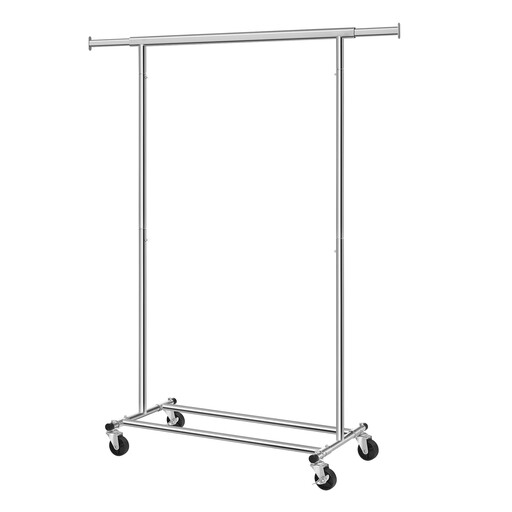
Why this choice suits this profile : Anyone who regularly moves coats or clothes from one room to another will appreciate this design, which is both mobile and extendable.
Its four swivel castors, two of which have brakes, make it easy to move without allowing the rail to roll away while you are putting clothes away.
An adjustable width of 92 to 132 cm, two lower rails and a stated total static load of 100 kg.
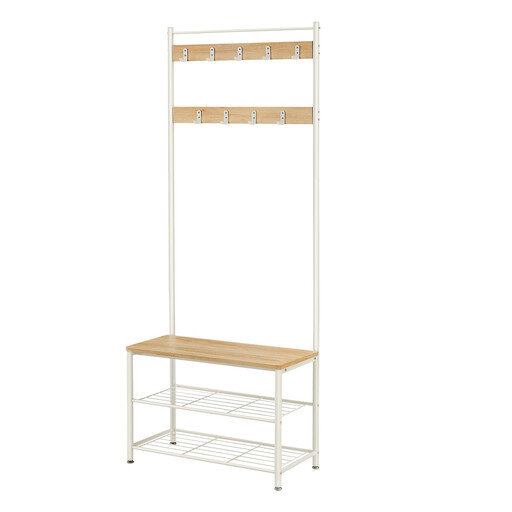
Why this choice suits this profile : This hallway unit brings coats, bags and shoes together in one dedicated space, while providing a practical seat for putting on your shoes.
The hooks, shelves and bench stop clothes from piling up on the floor. The anti-tip kit must be secured to the wall.
Nine hooks, a bench supporting up to 136 kg and wire shelves. Each hook is rated for 3 kg.
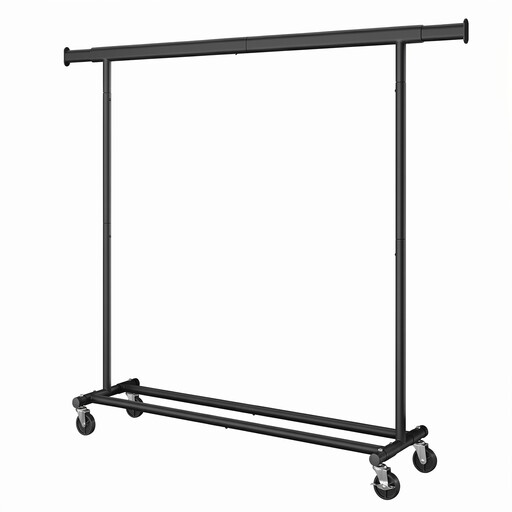
Why this choice suits this profile : Its adjustable width and castors make it suitable as a mobile wardrobe in a bedroom or utility room, or for storing seasonal clothing.
The brakes limit unwanted movement, while the lower rails prevent boxes from being placed directly on the floor.
A width of 160 to 200 cm, a height of 161.5 cm and a stated static load of 150 kg. Assembly is described as requiring no tools.
To assemble a clothes rail correctly, first lay all the parts out on a clear surface and identify them using the instructions. Tighten the joints gradually, without forcing the tubes. Once the unit is installed:
A slightly damp cloth is generally all you need to clean a metal structure. However, avoid leaving the unit in a poorly ventilated utility room or somewhere exposed to persistent damp. Keep it away from heat sources too.
Place the heaviest items in the centre and at the bottom, then apply the brakes. On an uneven floor, choose a model with adjustable feet or a wide base. Avoid moving the rail when it is heavily loaded.
It depends on the model. You need to distinguish between the total load and the load supported by the rail, hooks and shelves. A stated capacity of 100 or 150 kg refers to a static load: it does not mean that the clothes rail can be moved frequently with that much weight on it.
Yes, provided that its minimum width, depth and height fit the available space. Also measure the circulation area and allow extra room for hangers and bulky clothing.