
Same-day & Next-day Delivery

Quality Guaranteed

Unlock Your Welcome Offers: FREE Delivery | Up to 80% OFF | Free 30-day JoyPlus trial
Download the APP
The carbon steel wok is a staple of Asian cuisine, prized for its lightning-fast heating and perfectly even cooking. However, faced with sometimes vague marketing claims, choosing the right model can quickly become a headache. Our mission? To help you cut through the noise. This guide breaks down the essential criteria for finding the wok that truly suits your kitchen and your cooking style.
Before we get into the technical details, let's debunk the common misconceptions that often lead to culinary disappointment.
To make the right choice, focus on these three fundamental points. They are the key to the performance and longevity of your future utensil.
Carbon steel is THE gold standard material for woks. Lighter than cast iron, it heats up much faster—an essential quality for achieving the perfect sear. Its thickness, which ranges from 1.2?mm to 2?mm, is an excellent indicator. A thinner wok will be more responsive and easier to handle, while a thicker model will retain heat better, approaching the performance of cast iron without its prohibitive weight.
This criterion depends entirely on your hob.
The seasoning of a wok is the art of creating a protective, non-stick patina by polymerising a thin layer of oil at high temperature. It's this process that makes a carbon steel wok better with every use. A new wok requires this initial step, followed by simple maintenance: cleaning with hot water (without harsh detergents), drying completely, and applying a light coat of oil. This is the care that forges a truly natural non-stick wok—healthy, ultra-durable, and guaranteed PFOA- and PTFE-free.
To help you visualise how these criteria apply, here are a few options suited to different user profiles.
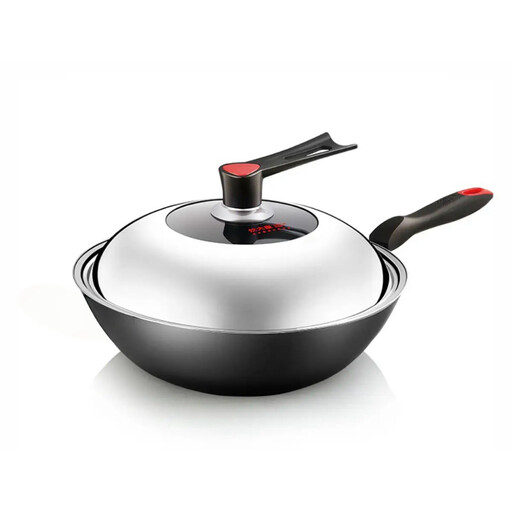
Why we love it: This model perfectly embodies the traditional approach. Made from raw steel, it is designed to be seasoned and maintained, improving over time. It's the ideal choice for those who cook on gas and enjoy taking care of their equipment.
It doesn't promise an instant miracle. Its strength lies in its raw, durable material, which lets you create your own non-stick patina—a much healthier and more sustainable solution than a low-quality coating.
Perfect thermal responsiveness on a flame. The wok with lid is a real bonus for simmering dishes or keeping food warm.
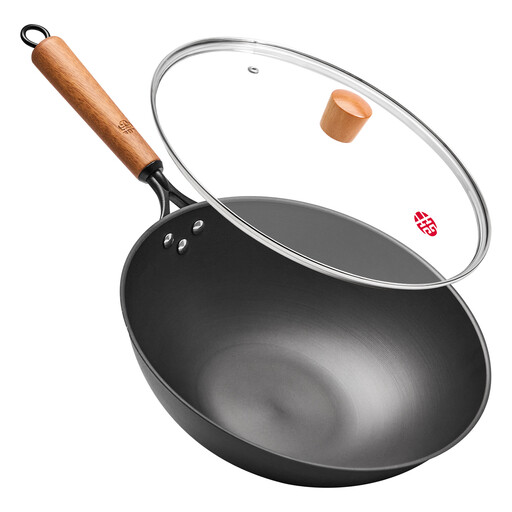
Why we love it: This wok was designed for today's kitchens. Its flat-bottom wok design ensures perfect compatibility with all hobs, especially induction. It's a truly lightweight wok (1.1 kg), making it incredibly easy to handle for tossing vegetables without straining your wrist.
It checks all the boxes: it solves the compatibility problem with its flat bottom, and its light weight sidesteps the pitfall of a wok that's too heavy and impossible to handle.
Absolute versatility (gas, induction, electric, ceramic) and record-breaking manoeuvrability thanks to its feather-light weight. Its honeycomb texture is designed to reduce sticking and help food release easily.
Discover our full selection of woks that meet our quality criteria and all current safety standards.
1. Is seasoning a carbon steel wok complicated? Not at all, but it does require a little know-how at the start. The initial seasoning simply involves heating the wok with a film of oil until it smokes slightly, then letting it cool. Repeat this two or three times to create the base. After that, daily maintenance is all it takes: clean with hot water, dry thoroughly, and add a drop of oil to condition it. The patina will strengthen with each use.
2. What is the lifespan of a carbon steel wok? Properly maintained, it will last you a lifetime. This is its great strength compared to pans with synthetic coatings that wear out. A carbon steel wok, on the other hand, gets better with time. It isn't afraid of metal utensils and can even be "restored" with a new seasoning if you accidentally leave it on the heat.
3. Can a wok without a chemical coating really be non-stick? Absolutely, and that's the genius of seasoning. The famous smooth, black patina that forms is nothing more than a layer of polymerised oil that makes the surface naturally slick. It's an ancient technique, proven long before the arrival of modern coatings, and it remains the healthiest and most durable solution.