
Same-day & Next-day Delivery

Quality Guaranteed

Unlock Your Welcome Offers: FREE Delivery | Up to 80% OFF | Free 30-day JoyPlus trial
Download the APP
The desire to recapture the smoky, authentic flavour of Asian stir-fries—that coveted wok hei—has convinced you to take the plunge. The carbon steel wok for induction stands out as the ideal solution: it's responsive, durable, and capable of developing a natural non-stick patina. But be warned, the market is full of pitfalls that can turn your purchase into a real disappointment, especially if you cook on modern cooktops.
As a product specialist at Joybuy, my mission is to decode the marketing jargon for you and guide you toward a truly informed choice. Let's break down the common mistakes to avoid and the essential technical points for finding the wok that won't let you down.
Before you even start comparing models, let's learn how to see through false promises and spot the design flaws that make a wok simply unusable on an induction or glass-ceramic cooktop.
To avoid falling into the trap, here are the technical specifications on which you should make no compromises.
On a gas stove, a round-bottom wok is a classic. However, for induction, glass-ceramic, or electric cooktops, a flat-bottom wok is essential. The base must be wide and thick enough to ensure perfect stability and maximum contact with the cooking surface. This is a non-negotiable condition for rapid heating and even heat distribution, guaranteeing an effective sear across the entire surface.
The material is the heart of the engine. Carbon steel is prized for its ability to get very hot, very fast. There are two main finishes:
A standard diameter of 32 cm is often the sweet spot for a family of 2 to 4. It provides enough volume to toss ingredients without them crowding and steaming instead of stir-frying. Weight is also a key factor: a lighter wok will be easier to handle for one-handed tossing, while a heavier model will offer better heat retention, ideal for maintaining a constant temperature.
Based on these criteria, here is our selection of carbon steel woks for 2026, designed for different types of cooks.
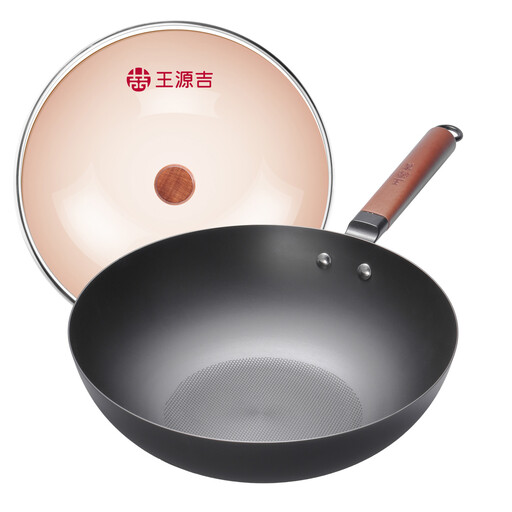
Why we love it: Ideal for those new to wok cooking or who prioritise manoeuvrability. Its feather-light weight (1.1 kg) lets you toss food effortlessly—an essential technique for fast, even cooking.
Its flat bottom is designed for stable, complete contact with induction cooktops, ensuring fast and efficient heating—a far cry from unstable models that wobble on the stove.
Its nitriding surface treatment gives it far greater rust resistance than raw steel, which greatly simplifies daily maintenance.
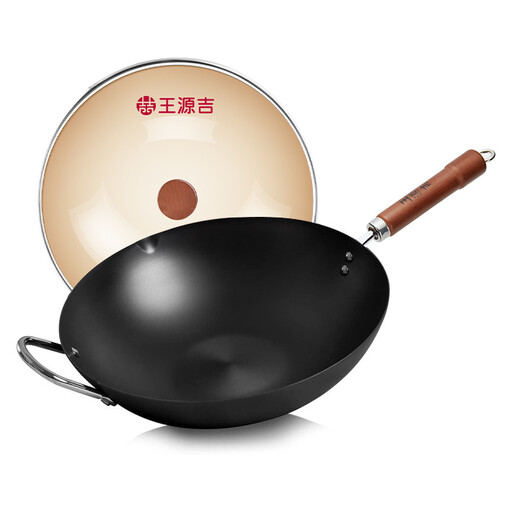
Why we love it: For those seeking maximum heat retention to achieve a perfect Maillard reaction. Its thicker walls store energy and maintain a high temperature, even when cold ingredients are added.
This model is the real deal—a true uncoated wok. It involves you in the seasoning ritual to create a natural and virtually eternal patina, saving you from the disappointment of coatings that always end up failing.
Its helper handle is a real bonus: it ensures a secure grip for handling the wok with two hands when it's full and heavy.
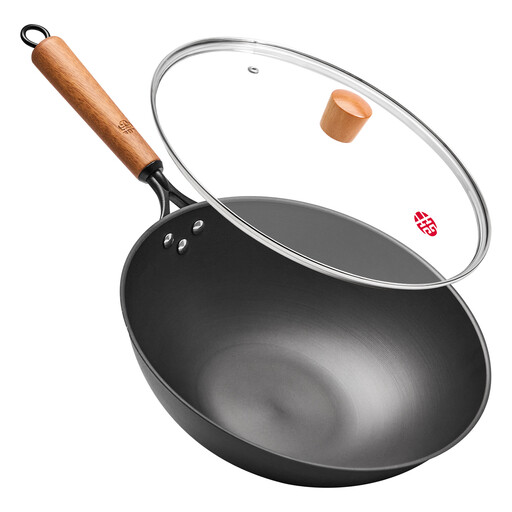
Why we love it: Perfect for modern kitchens where every square inch counts. The wooden handle detaches easily, allowing you to slide the wok into a drawer or cupboard with ease.
It combines a 14 cm flat bottom, compatible with all cooktops including induction, with a clever design that solves a major kitchen problem: storage.
Not only is storage a breeze, but cleaning it in a standard-sized sink is also made much easier.
Carbon steel offers an authentic cooking experience, but its maintenance requires a certain commitment. If you prefer a simpler day-to-day solution or are looking for different cooking properties, other materials like glass-ceramic could be an excellent alternative.
Yes, seasoning a wok is entirely achievable on an induction cooktop. The process is similar to doing it on a gas stove.
When properly maintained, a carbon steel wok is literally a lifetime purchase. Unlike pans with chemical coatings that degrade, a carbon steel wok gets better with time. Its patina strengthens with each use, making it more and more non-stick. The secret? Wash it by hand without harsh detergents, dry it completely (ideally by placing it on the hot cooktop for a few moments), and apply a protective film of oil before storing.
This is a legitimate concern for many users. To avoid any scratches, ensure the bottom of your flat-bottom wok is perfectly smooth and well-finished. The golden rule: never slide the wok on the cooktop; always lift it to move it. Also, always check that the bottom of the wok and the surface of your cooktop are spotless before you start cooking. A stray grain of salt or sugar trapped between them can be enough to cause a scratch.