
Livraison le jour même ou le lendemain

Qualité garantie

Débloquez vos offres de bienvenue: Livraison GRATUITE | Jusqu'à -80 % | 30 jours d'essai gratuits à JoyPlus
Téléchargez l'application
A carbon steel wok can quickly become an essential kitchen tool: it lets you sear vegetables, prepare stir-fries, simmer dishes and cook noodles. But not all models are created equal. Handles that become scorching hot, an unstable base on induction, rust appearing after just a few uses or a capacity that does not suit the number of diners: there are plenty of potential pitfalls.
Before comparing the different models, three common traps deserve your attention.
A wok without a coating is not used like a ready-to-use non-stick frying pan. Carbon steel generally needs to be seasoned: it is heated with a thin film of oil to gradually create a protective, naturally non-stick patina. The quality of this surface then depends on washing, drying and storage.
“Uncoated” therefore does not mean “maintenance-free”. If you want to start cooking straight away, without any special preparation, a coated wok will be easier to use. However, you will need to respect its maximum temperature and avoid metal utensils.
A traditional round-bottomed wok often requires a support ring and has only limited contact with an induction hob. In a kitchen equipped with a ceramic or induction hob, it is therefore better to choose a flat-bottomed wok.
Do not rely solely on the diameter given at the top of the wok: also check the width of its base. A sufficiently wide base improves stability and heat transfer. The models featured here are advertised as compatible with gas, induction, electric hobs and ceramic hobs. It is still best to compare the base dimensions with those of your hob’s cooking zone.
A diameter of 32 cm provides plenty of capacity, but the weight can quickly become substantial once the wok is full. When tossing food, manoeuvrability matters just as much as available volume. A lightweight wok will be more comfortable to use in a small kitchen, for everyday meals or if you need to move it regularly.
A thicker construction does retain heat more effectively, however, which is an advantage for anyone who often cooks over high heat. The right compromise therefore depends on the number of portions you prepare and how you handle the utensil.
Carbon steel is an uncoated material that heats quickly and can develop a patina through repeated seasoning. It can nevertheless rust if it remains damp. Some models in this selection feature a nitriding treatment, which the manufacturer describes as a hardened layer based on iron nitride, designed to improve resistance to oxidation and wear.
This finish does not remove the need for the usual precautions: hand washing, thorough drying and applying a light layer of oil after use. If you are looking for a PFAS-free wok, read the technical specification carefully. In particular, distinguish between an uncoated product and a model with a ceramic coating advertised as PFAS-free.
Here are some useful guidelines:
An overfilled wok loses efficiency: the food releases water instead of searing properly. For a family, a 32 cm diameter can therefore be a sensible choice, provided the weight remains manageable.
A wooden handle provides a comfortable grip, but it generally means avoiding the dishwasher and sometimes the oven. A removable handle, on the other hand, makes it easier to store the wok in shallow cupboards. With a wok with a glass lid, you can monitor simmering food without repeatedly lifting the lid.
After each use, remove any residue with hot water and a soft sponge. Dry the wok immediately over a heat source, then apply a thin layer of oil. Avoid abrasive products, prolonged soaking and the dishwasher, particularly when the handle is made of wood.
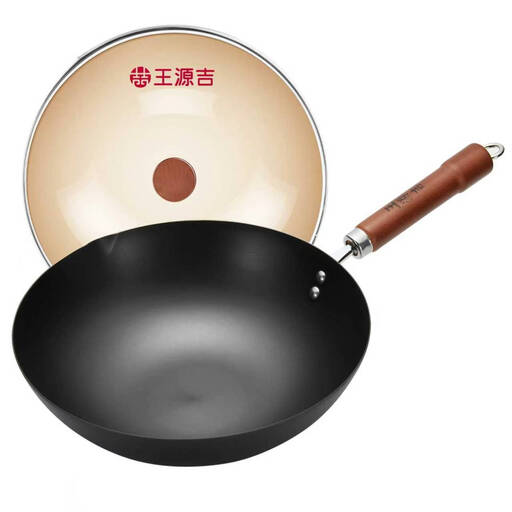
Why this choice suits this profile : Its 11.8-inch diameter is advertised as suitable for one to three portions. It is ideal for everyday meals in a compact kitchen and comes with a glass lid and a wooden handle.
Its flat base is advertised as compatible with induction, gas, electric hobs and ceramic hobs. The product information also details the care precautions, so you will not mistake it for a maintenance-free pan.
Uncoated carbon steel, an advertised nitriding treatment and a textured surface designed to encourage patina formation after seasoning.
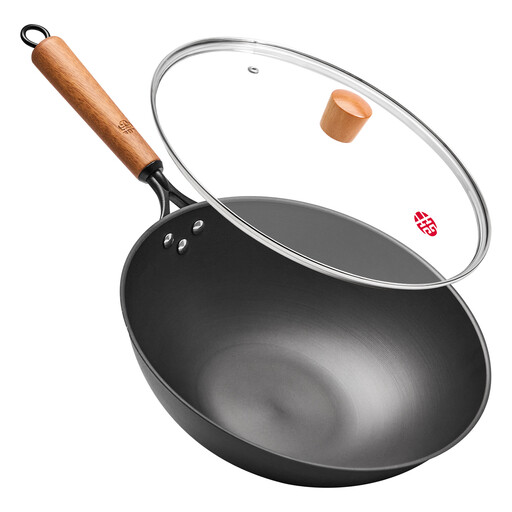
Why this choice suits this profile : This 12.6-inch model is designed for households looking for a complete set for three to four people. It comes with an iron spatula, a glass lid and a removable handle.
Its 5.51-inch flat base is advertised as designed to remain stable on several types of hob. The removable handle also makes storage easier.
Advertised thickness of 1.5 mm, stated weight of 1.17 kg, nitriding treatment and included accessories.
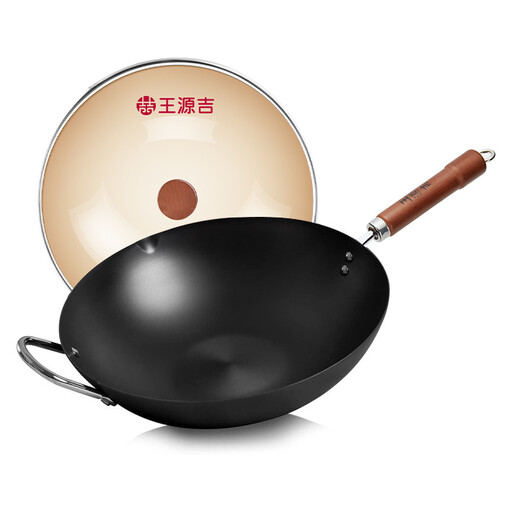
Why this choice suits this profile : Advertised as suitable for two to four portions, this wok has an auxiliary handle that makes it easier to move, even when well filled. A real advantage for frequent cooking.
The second handle lets you hold it with both hands. Its flat base is advertised as compatible with induction, gas and electric hobs.
Stated weight of 1.51 kg, tempered glass lid, thick sides and uncoated surface.
We have put together a complete, real-time-updated list of products that meet these demanding selection criteria and European safety standards.
To keep a carbon steel wok compatible with all types of hob in good condition:
The wok reaches very high temperatures during cooking. Use an oven glove, keep the wooden handle away from direct flames and never leave the utensil unattended at high power. Unless otherwise stated in the product information, the models featured are not advertised as oven-safe.
Yes, provided you choose a flat-bottomed model with a base suited to the cooking zone. A round-bottomed wok is less practical on induction. Also check that the diameter of its base matches that of the hob.
Rust mainly appears when moisture remains in contact with the steel. Wash the wok by hand, dry it immediately, then apply a thin layer of oil. According to the manufacturer’s information, a nitriding treatment may improve resistance to oxidation, but it does not replace these care steps.
Seasoning creates a patina of cooked oil that gradually reduces sticking. The result depends on the temperature, the amount of oil used, the food being cooked and the cleaning method. However, you should not expect it to behave like an industrial non-stick coating from the very first use.