
Livraison le jour même ou le lendemain

Qualité garantie

Débloquez vos offres de bienvenue: Livraison GRATUITE | Jusqu'à -80 % | 30 jours d'essai gratuits à JoyPlus
Téléchargez l'application
Finding the ideal 28cm induction frying pan can quickly become a headache. Between the different materials, non-stick coating promises, and compatibility issues, it's easy to get lost. Are you looking for a high-performance, durable pan that's safe for your food?? This guide is here to help you make sense of it all.
As the Head of Product Selection at Joybuy, my mission is to provide clear, objective information to help you make the right choice, free of marketing jargon. We'll break down the essential criteria for you before presenting a selection of models designed for specific uses.
Before diving into our top picks, let's review the three key points to check to ensure you make the right choice.
The choice of material largely determines your pan's cooking performance and longevity.
The PFOA-free label, and now PFAS-free, has become a non-negotiable purchasing criterion. These perfluorinated compounds, once common in non-stick coatings, are now being phased out by reputable manufacturers. Healthy alternatives rely on reinforced ceramic coatings (sometimes with titanium or diamond particles) or on carbon steel, which becomes naturally non-stick once seasoned.
A good frying pan must be versatile. Check that it is marked as "all stovetops, including induction". This compatibility depends on the presence of a ferromagnetic base. An oven-safe pan opens up a world of possibilities?: you can start cooking on the stovetop and finish in the oven, whether to brown a dish or perfect a slow-cooked meal. Just remember to check the maximum temperature it can withstand, including the handle.
Here are three models that stand out from the crowd, designed for different types of cooks.
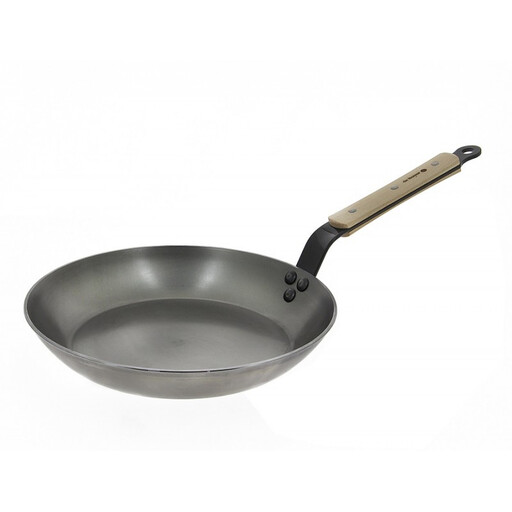
Why it stands out Made in France, this carbon steel pan is a staple in professional kitchens. It's built to last and gets better with age. Its secret?? Seasoning, a simple process that creates a natural, protective non-stick layer.
Pros
Who is it for?? For purists and enthusiasts who appreciate beautiful tools and seek restaurant-quality searing. It requires a bit of care (seasoning, hand-washing without detergent), but the reward is a durable pan with unparalleled performance.
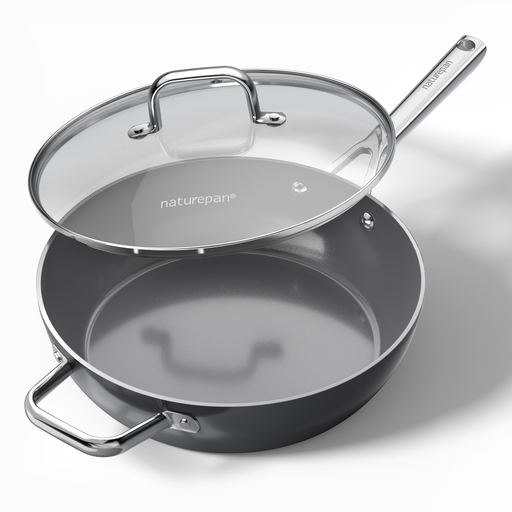
Why it stands out This model shines with its versatility. With its high sides and lid, it doubles as a sauté pan or a small Dutch oven, perfect for saucy dishes and slow-simmered meals. The manufacturer highlights its ceramic coating, reinforced with diamond and titanium particles for enhanced durability.
Pros
Who is it for?? For everyday cooking, when you need a healthy, practical, all-in-one solution. Its sauté pan design and ease of cleaning make it a great ally for families and anyone who loves preparing complete meals in a single pan.
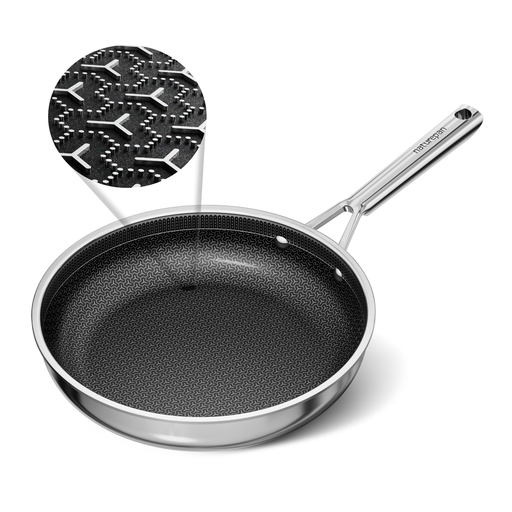
Why it stands out This pan features an ingenious hybrid technology. Its surface combines a raised stainless steel hexagonal mesh with "valleys" filled with a ceramic non-stick coating. This unique structure promises the best of both worlds?: the searing power of stainless steel and the ease of a non-stick surface.
Pros
Who is it for?? For kitchen tech enthusiasts who want a modern, ultra-high-performance pan. It's perfect for those who are torn between stainless steel and non-stick and are looking for a tool that can do it all, from a ribeye steak to fried eggs, with superior longevity.
Our selection focuses on three distinct types of cooks, but the market is full of models. If these pans don't quite meet your needs or if you want to explore other materials and designs, feel free to browse our full category.
??Discover our full range of Steel and Ceramic Frying Pans.
1. How do I maintain a carbon steel pan to prevent it from rusting?? Maintenance is key. After use, deglaze the still-hot pan with a little water, then clean it with a soft sponge, never using dish soap. Dry it immediately and thoroughly with a cloth. Apply a thin layer of oil to the entire inner surface before storing it away from moisture. This routine protects the steel from oxidation and strengthens the seasoning over time.
2. Is a ceramic pan truly safe?? Yes. Modern ceramic coatings are made from a sand and silicon derivative (sol-gel technology) and are guaranteed to be free of PFOA, PTFE, and PFAS. They are considered one of the healthiest alternatives to older non-stick coatings. To preserve their properties, simply avoid heating them while empty and use wooden or silicone utensils.
3. Why isn't my pan being detected by my induction stovetop?? For a pan to work on an induction stovetop, its base must be ferromagnetic. If your stovetop doesn't "see" it, its base is not compatible. The foolproof trick to check is this?: if a magnet sticks firmly to the pan's outer bottom, it is compatible. Also, always look for the "induction" pictogram (a coil symbol) on the packaging or under the pan.