
Livraison le jour même ou le lendemain

Qualité garantie

Débloquez vos offres de bienvenue: Livraison GRATUITE | Jusqu'à -80 % | 30 jours d'essai gratuits à JoyPlus
Téléchargez l'application
Peeling an apple, carrot or potato seems simple… until the blade catches, the handle becomes uncomfortable or a large part of the food ends up in the sink. For everyday use, choosing a fruit and vegetable peeler therefore deserves a little consideration.
Some marketing claims can also steer you towards an impractical purchase. A blade described as “ultra-sharp” does not guarantee a comfortable grip. A multifunction model can quickly become cumbersome if you never use its accessories. And a material presented as easy to clean is not necessarily dishwasher-safe or resistant to knocks.
Here are the criteria to consider before choosing a vegetable peeler, paring knife or peeler set.
An effective blade should remove a thin layer of peel and glide smoothly over the food’s surface. However, the shape of the handle, its grip and the utensil’s overall balance also have a direct impact on precision. If it is too smooth, a handle can become difficult to control with wet hands.
A stainless steel peeler generally withstands moisture well and rinses easily. However, quality also depends on how it is assembled and on the thickness of the blade. Ceramic retains its cutting performance for a long time and does not rust, but it is more vulnerable to knocks and twisting.
A multifunction peeler may combine a standard blade, a grater, a bottle opener or even an attachment for making julienne strips. These options are useful if they match your cooking habits. Otherwise, they take up space and can make cleaning more time-consuming.
With a vegetable peeler, a short, unobstructed blade makes it easier to work on small foods. A 7 to 8 cm paring knife is particularly suitable for apples, shallots, small courgettes and precise cutting.
A swivel blade follows the curves of a pear or potato more easily. A fixed model, on the other hand, provides a more direct feel, which is often appreciated for precise movements. In both cases, the blade should remain accessible enough to rinse without difficulty.
Choose a handle that remains stable, including when handling freshly washed vegetables. Wood offers a pleasant, warm feel, but requires careful drying. Plastic and ABS are practical for everyday use, while composite materials can sometimes make sets lighter.
Even when a product is advertised as dishwasher-safe, washing it by hand and drying it immediately can help preserve the sharpness, handle and rivets for longer. For ceramic models, refer to the product listing and avoid the dishwasher if the manufacturer advises against it.
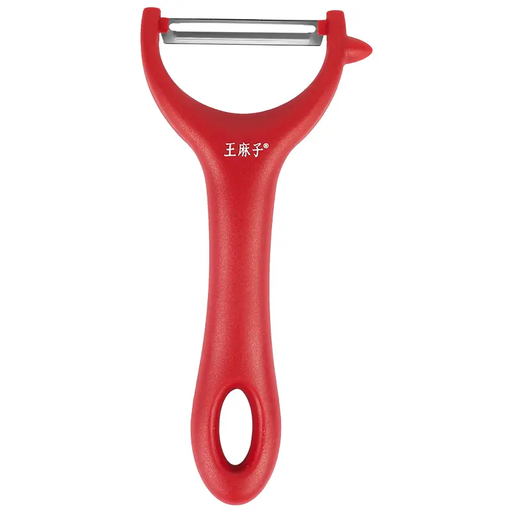
Why this choice suits this profile : This paring knife is suitable for everyday preparation and for anyone looking to get started with a simple utensil for everyday fruit and vegetables.
Its design focuses on peeling, without adding accessories that could make care more complicated.
The product listing specifies a stainless steel blade and a handle designed to provide a secure grip. The product is presented as suitable for apples, potatoes, carrots and ginger.
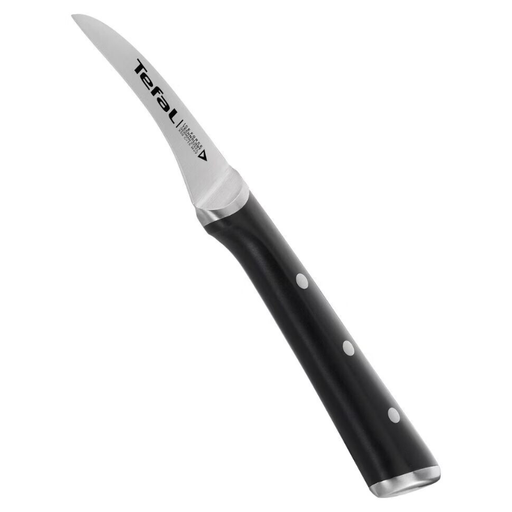
Why this choice suits this profile : With its 7 cm format, it is aimed at users looking for a precise paring knife for small cuts and finishing touches.
The product listing specifies a finger guard and explains the recommended uses in detail. This helps you avoid using the knife as a lever or for cutting frozen food.
7 cm German stainless steel blade, ABS handle, finger guard and a breakage guarantee advertised for 10 years, subject to registration and compliance with the terms of use.
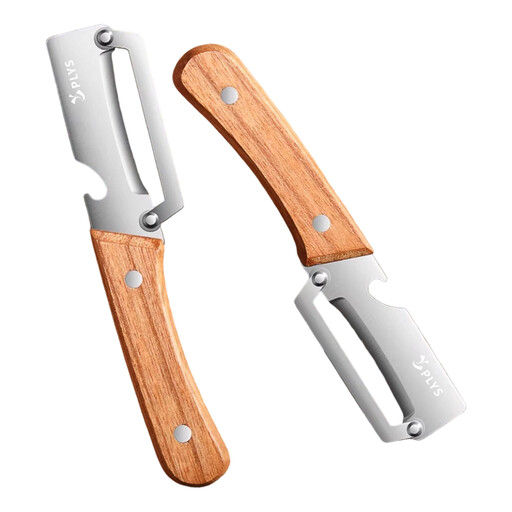
Why this choice suits this profile : This two-piece set is practical for a family, a second home, a motorhome or several food preparation areas.
Both utensils remain dedicated to peeling, with a configuration that is easy to distribute and store.
The product listing mentions a stainless steel blade, two wooden handles and an overall length of approximately 19 cm per piece.
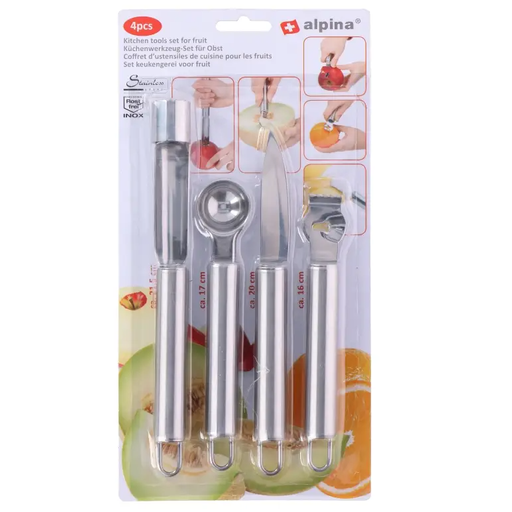
Why this choice suits this profile : This set is suitable for people who regularly prepare fruit and want to complement peeling with dedicated accessories.
Each tool has a specific purpose : coring apples, making melon balls, cutting fruit or removing citrus zest.
The set contains four stainless steel pieces and is advertised as dishwasher-safe. However, hand washing remains preferable to preserve the tools’ condition.
To minimise wear on your kitchen peeler, always place the food on a stable chopping board and keep your fingers away from the blade’s path. Do not use a vegetable peeler to open packaging, prise things apart or cut frozen food.
After each use, rinse off any residue, dry the utensil immediately and store it in a divided drawer, a block or with a blade guard. Check regularly for cracks, looseness around the handle or chips on a ceramic blade. Any damaged accessory should be replaced.
A stainless steel model with a non-slip handle is generally suitable for these vegetables. A swivel blade may follow their rounded shapes more easily, while a fixed paring knife offers greater precision in smaller areas.
Its lifespan depends mainly on how carefully the utensil is treated. Ceramic is resistant to corrosion and can retain its sharpness for a long time, but it is less able to withstand drops, twisting and very hard foods. Storage and washing, carried out in accordance with the manufacturer’s instructions, remain key factors.
A set can be useful if several people cook, if you want to keep a utensil in different rooms or if you regularly use additional functions. For use limited to peeling fruit and vegetables, a single well-chosen model may be perfectly sufficient.