Joybuy Insights

60cm Angled Cooker Hood: A Guide to Choosing the Right One

Choosing a new cooker hood? It can be a real headache. Between the sleek designs and overwhelming spec sheets, it's easy to get lost. Yet, a hood is more than just a decorative object: its performance is key to clean air and a pleasant kitchen environment. Be aware that a few common pitfalls can turn a promising purchase into a major disappointment.

Before you pull out your credit card, keep an eye on these three often-overlooked points that make all the difference in daily use:

  1. The 'Silent' Myth: Beware of deceptively low decibel ratings. These measurements are often taken at the minimum speed. In real-world conditions, at full power, your "silent" hood is likely to drown out the TV and turn your open-plan kitchen into a noise-polluted zone.
  2. The Maintenance Nightmare: A flawless design can hide a real cleaning ordeal. Grease filters that are impossible to unclip, overpriced charcoal filters that need changing every three months... These details are anything but trivial.
  3. Mismatched Power: A poorly calibrated power level is a guarantee for disappointment. If it's too weak, it won't extract anything in your open kitchen. If it's oversized for a small room, it will just drive up your electricity bill for no reason.

Keeping these pitfalls in mind is half the battle in making a smart choice focused on what truly matters.

The Criteria That Really Count

To find the perfect 60cm angled extractor hood, you need to read between the lines of the technical sheet. Here are the key indicators for objectively judging a model's performance.

The Performance/Noise Balance: Airflow and Sound Level

A hood's effectiveness lies in the balance between its extraction capacity and the noise it generates.

  • Airflow (in m?/h): This indicates the volume of air the hood can extract in one hour. For optimal efficiency, the airflow should be able to renew the air in your kitchen 10 to 12 times per hour. The calculation is simple: calculate your kitchen's volume (length x width x height) and multiply it by 10. For a standard-sized kitchen, a real-world airflow between 300 and 600?m?/h is a good benchmark.
  • Noise Level (in decibels, dB): This is the ultimate comfort criterion, especially in open-plan kitchens. Below 65?dB at full power, a hood is considered comfortable. Insist on this value: it's the one you'll use every day, not the eco-mode setting you'll never touch.

Installation: Ducting or Recirculation, the Crucial Choice

Your home's layout will dictate your choice. Most modern wall-mounted hoods, including angled models, offer both options.

  • Ducting Mode: Unquestionably the most effective solution. The air is captured, stripped of grease, and then expelled outside through a duct. This mode guarantees the complete removal of smoke, humidity, and odours. The only constraint: you must be able to drill through a wall to install the ducting hose.
  • Recirculation Mode: The ideal solution for apartments or if you can't (or don't want to) drill through a wall. The air is drawn in, passed through a grease filter and then an activated charcoal filter that neutralises odours, before being released back into the kitchen. Its effectiveness depends entirely on the quality of the charcoal filters, which need to be replaced every 3 to 6 months on average (a budget to factor in!).

Offering a hood with both ducted and recirculation options is a mark of versatility, allowing it to adapt to any kitchen.

Design and Energy Class: The Union of Aesthetics and Savings

Beyond its appearance, a hood's design has practical implications.

  • Energy Class: Opting for a hood rated A+ or higher is a smart investment. For an appliance that runs almost daily, the savings on your electricity bill are very real.
  • Materials and Controls: A 60cm white hood in tempered glass, for example, modernises a kitchen and cleans with a single wipe. Touch controls integrated into the glass are a plus: a perfectly smooth surface means fewer nooks where grease can hide.

The Editor's Pick: The Perfect Balance

To illustrate these criteria in practice, here is a model that ticks all the boxes for a modern kitchen: design, versatility, and performance.
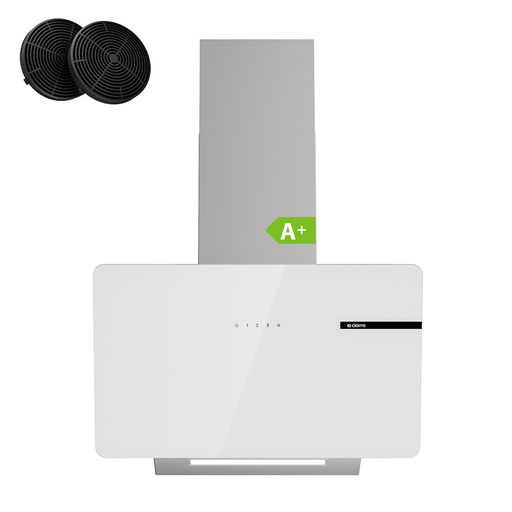
IDEAL FOR: THE MODERN AND VERSATILE KITCHEN
Ciarra 60cm Wall-Mounted Slanted Cooker Hood, 580m?/h Airflow, Energy Class A+, 3-Speed Touch Controls, Vented & Recirculation, White Glass with LED Strip Lighting CBCS6765B

Ciarra 60cm Angled Wall Hood (CBCS6765B): 580m?/h, A+ Class, Touch, White Glass

The Editor's Verdict: Perfect for standard 60cm hobs, its angled white glass design frees up your line of sight and modernises the space. It's the ideal compromise for those who refuse to choose between style and performance, with the added bonus of total installation flexibility.

Why It Avoids the Common Pitfalls

This Ciarra model offers an excellent balance: an airflow of 580 m?/h, perfect for most kitchens, with a contained noise level of 64 dB at full power. Its aluminium grease filter is dishwasher-safe. Goodbye, cleaning chores!

Key Strengths

Its A+ energy class ensures low energy consumption. The dual installation (ducting or recirculation) makes it ultra-versatile. Bonus point: the charcoal filters are included for immediate use in recirculation mode.

Explore Other Models

Discover our full selection of cooker hoods that meet our criteria for performance, design, and safety.

Your Questions, Our Answers

1. What power (airflow) for a 60cm hood?

For a 60cm hob, a hood with an airflow between 300 and 600?m?/h is a good starting point. The final choice depends on your kitchen's volume and your cooking habits (frequent frying, etc.). For an open-plan kitchen larger than 20?m?, opt for a more powerful model, around 600?m?/h.

2. Is a recirculation hood really effective?

Yes, provided you use high-quality charcoal filters and change them regularly (every 3 to 6 months, depending on the manufacturer). Note that this mode does not remove humidity from cooking, unlike ducted mode.

3. How do you clean an angled glass hood?

Nothing could be simpler. For the glass surface, a simple microfibre cloth and a glass cleaner are enough to remove fingerprints and splatters. The metal grease filter should be cleaned every 2 to 4 weeks. Most filters today are dishwasher-safe, which makes the chore much easier.