
Livraison le jour même ou le lendemain

Qualité garantie

Débloquez vos offres de bienvenue: Livraison GRATUITE | Jusqu'à -80 % | 30 jours d'essai gratuits à JoyPlus
Téléchargez l'application
In a modern kitchen, aesthetics and functionality must go hand in hand. Long relegated to the status of a simple utility appliance, the cooker hood is now a true design statement. Especially valued for its contemporary look and ergonomic design, the 90?cm angled cooker hood has become a staple in many homes. But be warned: behind the marketing promises lie pitfalls that can quickly turn a good investment into a daily disappointment.
To avoid buyer's remorse, here are the key points to watch out for and the mistakes to avoid.
To avoid falling into these traps, focus on a few objective technical specifications. They are the true measure of your future hood's performance and durability.
Airflow, expressed in cubic metres per hour (m?/h), indicates the volume of air the hood can extract. For a medium-sized kitchen (around 15-20?m?) and a 90?cm hob, an airflow rate of approximately 600 to 700?m?/h is recommended to effectively remove intense cooking fumes and steam.
However, this power must be weighed against the noise level, measured in decibels (dB).
Always check the noise level at maximum speed to get a real idea of the potential disturbance.
The choice of ventilation system is crucial and depends on your home's layout.
Good to know: many models are versatile and compatible with both installation modes.
A hood's electricity consumption should not be overlooked. An A+++ energy class hood ensures minimal consumption for optimal performance, which means savings on your bills.
In terms of convenience, modern technologies are game-changers. A WiFi-connected hood can be controlled remotely from an app on your smartphone. You can turn it on before you even enter the kitchen or adjust the speed without interrupting your cooking.
To illustrate these criteria in practice, let's review a selection of models suited to different profiles.
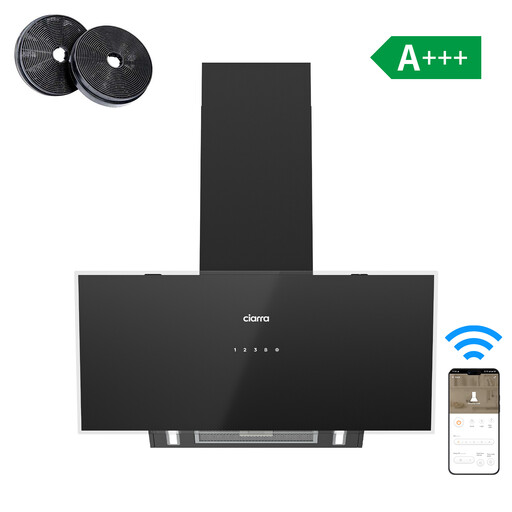
Why this model fits the profile: This model is tailored for those seeking the pinnacle of technology and efficiency. It combines a 90 cm designer cooker hood with an impressive spec sheet: A+++ energy class, WiFi connectivity for app control, and a powerful 650 m?/h extraction rate.
It sidesteps the "brute force" trap by offering a high extraction rate while maintaining a controlled noise level of 60 dB. The app control and responsive touch buttons avoid the "form over function" pitfall.
The innovative Dual Intake system captures fumes more effectively. Its A+++ class ensures negligible energy consumption (13 kWh/year).
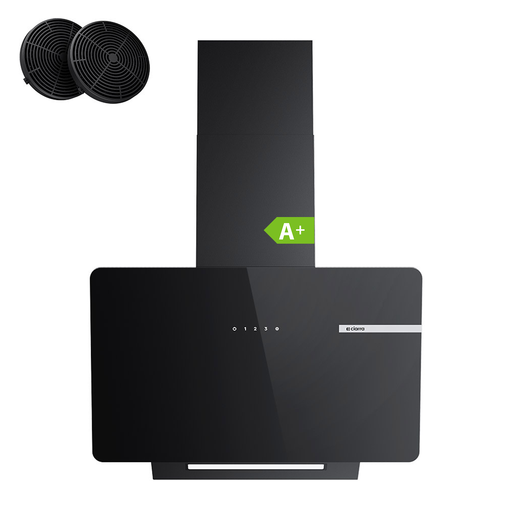
Why this model fits the profile: Ideal for standard-sized kitchens or tighter budgets, this 60 cm model offers a modern angled design and solid performance. It strikes the perfect balance between aesthetics, efficiency (580 m?/h), and price.
It focuses on the essentials: an extraction power suitable for daily use, without an excessive noise level (64 dB). Its dual compatibility (ducting and recirculation) makes it versatile and prevents installation surprises.
Its value for money is its key advantage. The metal grease filters are reusable and dishwasher-safe, which simplifies maintenance and reduces long-term costs.

Why this model fits the profile: For those who prioritise a clean and bright aesthetic, this 60 cm model with its white glass and stainless steel finish offers an elegant alternative to traditional black. It's a true designer cooker hood that integrates seamlessly into contemporary kitchens.
This model doesn't sacrifice performance for style. It offers an airflow rate of 580 m?/h and an A+ energy class, thus avoiding the "form over function" trap. The touch controls are harmoniously integrated into the glass surface.
Its white glass design is its main standout feature. The integrated LED light strip effectively illuminates the cooking area while adding a touch of modern ambiance.
We have curated a complete range of products that meet our strict selection criteria and European safety standards.
For a 90 cm hob, choose a hood with an airflow rate of at least 600 m?/h. If you frequently cook dishes that generate a lot of smoke or steam (frying, grilling), a model around 700 m?/h will provide comfortable headroom to maintain healthy air in your kitchen.
Yes, a recirculation hood can be very effective, provided you follow two golden rules. First, choose a model equipped with high-quality charcoal filters capable of absorbing a large quantity of odour compounds. Second, replace these filters regularly according to the manufacturer's recommendations (usually every 3 to 6 months), as their absorption capacity is not infinite.
Cleaning a glass hood is simple but requires a bit of care to avoid scratches. Use a soft microfibre cloth and a glass cleaning product or a mixture of warm water and white vinegar. Above all, avoid abrasive sponges and harsh chemicals. For the metal grease filters, most can be removed and are dishwasher-safe, which greatly simplifies maintenance.