
Livraison le jour même ou le lendemain

Qualité garantie

Débloquez vos offres de bienvenue: Livraison GRATUITE | Jusqu'à -80 % | 30 jours d'essai gratuits à JoyPlus
Téléchargez l'application
Living in an apartment or a small house has its charms, but space optimization is a major challenge. The washer-dryer then emerges as the silver bullet: a single appliance to wash and dry your laundry, freeing up valuable space. However, what seems like a great idea on paper can quickly turn into a nightmare if you don't know the pitfalls to avoid.
As a product expert at Joybuy, I'm here to guide you through the jungle of models and help you make the right choice, beyond the marketing hype.
The market is flooded with models making tempting promises. To avoid being fooled, here are the three key points that separate a smart purchase from a costly mistake.
To ensure your future appliance simplifies your life, focus on these essential technical points.
This is the non-negotiable criterion. For a seamless wash-to-dry process, the drying capacity must match the volume of your laundry loads.
Under the new regulations, the energy label is twofold. On the left is the rating (from A to G) for the wash cycle alone. On the right is the rating for the complete wash + dry cycle. Don't be surprised to see an excellent rating (A or B) for washing, but a much lower one (D or E) for the full cycle: condensation drying is very energy-intensive. Be sure to analyse this dual information to anticipate your electricity bill.
If every centimetre counts, a space-saving washer-dryer (often called "slim," with a depth of less than 50?cm) is an attractive option. But there's another solution for those who would prefer two separate appliances but lack the floor space: the washer-dryer stacking kit. This clever accessory allows you to safely install your dryer on top of your washing machine, creating a stable and highly efficient laundry tower.
Instead of an endless list, here are a few targeted solutions for different needs, keeping in mind the criteria we've just discussed.
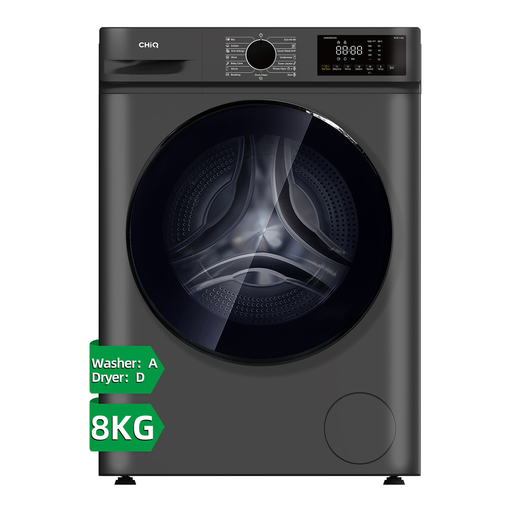
Why we chose it: With its 8 kg / 5 kg capacity ratio, it's perfectly sized for a couple's needs. Its shallow depth and "One-Touch" program, which automatically adjusts everything, make it a simple and incredibly effective everyday ally.
It's upfront about its dual capacity (8 kg wash / 5 kg dry), preventing any nasty surprises. Its features (steam, drum light) are useful, not superfluous gimmicks.
Its Inverter motor ensures quieter operation, a major asset in an apartment. Its compact design makes it easy to integrate into a kitchen or a small laundry room.
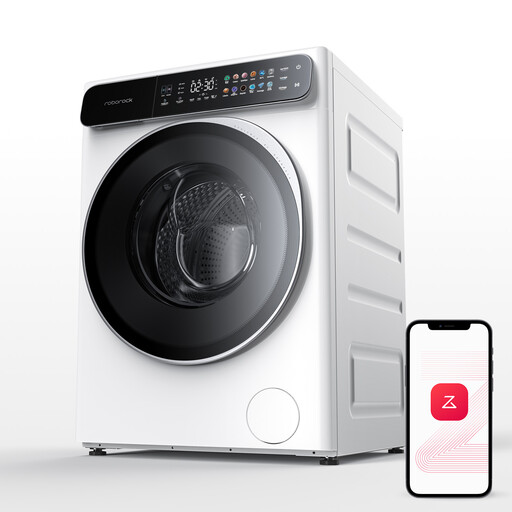
Why we chose it: Perfect for families, this 10 kg / 6 kg model handles large laundry loads. Here, the smart features are genuinely useful: the automatic dispensing for detergent and softener is a real convenience, and the self-cleaning lint filter system significantly reduces maintenance.
It goes far beyond connected gimmicks by offering truly life-changing features. Its low-temperature Zeo-Cycle drying technology cares for delicate fabrics, a common weakness in competing models.
The automatic dispensing and the LintClear self-cleaning system offer total peace of mind, ideal for simplifying the laundry chore for a busy family.
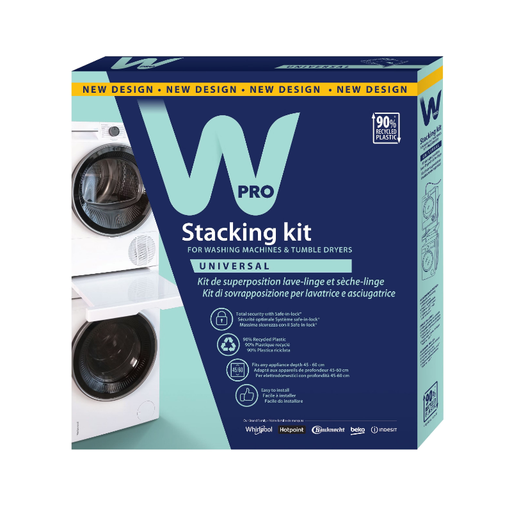
Why we chose it: For those who refuse to compromise on drying performance but lack floor space, this kit is the solution. It allows you to safely stack a standard-sized washing machine and dryer (45 to 60 cm deep).
It bypasses the major flaw of washer-dryers: their limited drying capacity. By opting for two dedicated appliances, you get optimal performance for both washing and drying.
The integrated pull-out shelf is a real ergonomic plus: it provides an extra work surface for loading, unloading, or folding laundry at a comfortable height, without straining your back.
Discover our full selection of products that meet our selection criteria and European safety standards.
Yes, the complete wash + dry cycle is much more energy-intensive than a simple wash. This is why the energy label has a dual rating. The most common technology, condensation drying, uses cold water to condense the steam, which also increases total water consumption compared to a separate washer and dryer pair (especially if the dryer is a heat pump model).
No, and this is a crucial point to understand. If your machine has a 10?kg wash capacity and a 6?kg dry capacity, you cannot wash 10?kg of laundry and then immediately start the drying cycle. The laundry would be too compressed, would dry very poorly, and would come out completely wrinkled. For an automatic, continuous cycle, you must load your machine based on its drying capacity—the lower of the two.
Its lifespan is comparable to that of a standard washing machine, provided it is meticulously maintained. The critical point is cleaning the drying circuit. Unlike a dedicated dryer, the lint filter is not always easily accessible. It is often cleaned via a dedicated maintenance program or, on more advanced models, through a self-cleaning system. Refer to the user manual for the recommended procedure and frequency.