
Livraison le jour même ou le lendemain

Qualité garantie

Débloquez vos offres de bienvenue: Livraison GRATUITE | Jusqu'à -80 % | 30 jours d'essai gratuits à JoyPlus
Téléchargez l'application
A good yoga mat can transform your practice, especially if your knees, wrists, or back suffer on hard floors. Opting for a thick yoga mat might seem like the obvious solution. However, thickness alone guarantees neither comfort nor safety. Too many buyers end up disappointed with a mat that compresses, slips, or starts to crumble after just a few weeks of use.
To avoid falling into this trap and investing in an unsuitable product, it's crucial to know the most common pitfalls. As the Head of Product Recommendations at Joybuy, my mission is to help you decode marketing jargon to find the mat that's truly right for you.
Here are the two most frequent mistakes to avoid:
To choose a sports mat that is both comfortable and high-performing, you need to look beyond the millimetres. Here are the two technical characteristics that make a real difference.
The choice of material is decisive: it determines the grip, weight, lifespan, and even the feel of your mat.
Safety is non-negotiable. A good non-slip fitness mat is one that anchors you to the floor and allows you to hold your poses with complete confidence, without your hands or feet slipping. The secret? A textured surface. Quality models often feature a dual texture: one side with patterns designed to grip the floor (tile, wood, etc.) and another optimised for contact with your body. This is a true guarantee of stability, whether you're using your exercise floor mat for yoga, Pilates, or strength training.
Rather than aiming for the "one-size-fits-all" holy grail, it's better to choose a mat that matches your practice and your priorities. Here is our selection, designed for different types of users.

Why we chose it: This mat was specifically designed to offer maximum cushioning. Its 10 mm thickness is a real bonus for protecting the knees, elbows, and spine, especially during exercises on hard floors like tile or concrete.
Thanks to its high-density TPE construction, it provides firm cushioning that doesn't compress under weight, unlike entry-level NBR foam mats. It successfully combines thickness for comfort with density for support, ensuring a perfectly stable base.
Its dual-textured surface (lines for hand grip, waves for floor grip) ensures impeccable traction. It's the perfect ally for sensitive joints and a truly safe and comfortable gym mat.
Why we chose it: When you're starting out, comfort and convenience are paramount. This 10 mm yoga mat is particularly reassuring and forgiving of minor imbalances. The fact that it comes with a carrying strap is a major asset, simplifying both storage and transport. It's the very definition of a well-designed yoga mat with a strap.
The choice of TPE, a durable material, avoids the classic trap of a mat that crumbles or compresses after a few months. It's a smart initial investment that will grow with the practitioner, from home fitness to studio Pilates.
The included carrying strap and the lightweight nature of TPE make it an ultra-practical, all-in-one solution. Another strong point: its moisture-resistant surface cleans in a flash, a significant benefit for a consistent practice.
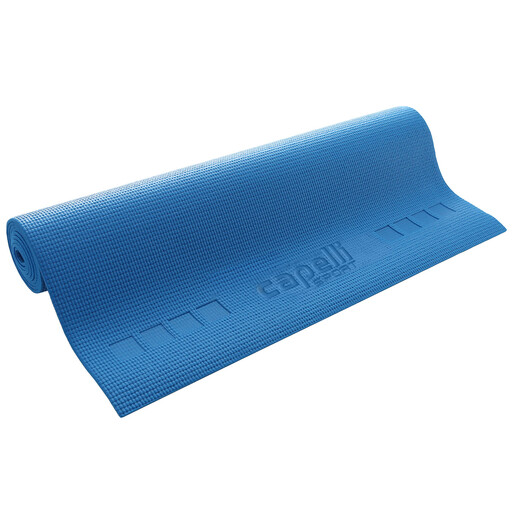
Why we chose it: For those who prioritise portability or are on a budget, a thinner mat is a very relevant option. This 4 mm model is ultra-light and therefore easy to take to class. It's perfect for those who practice on already soft floors (carpet, linoleum) or who are looking for a better connection to the ground for balancing poses.
This mat doesn't pretend to be a thick yoga mat. It meets a very specific need: lightness and an accessible price. By owning its moderate thickness, it represents an honest choice for a targeted use, without the false promise of "extreme comfort."
Its feather-light weight and compact size make it the ideal travel companion. Its embossed PVC surface offers sufficient grip for low-impact fitness and yoga exercises.
Explore our complete selection of mats, all rigorously selected for their quality and compliance with safety standards.
It all depends on the frequency of use and care! A good quality TPE Pilates mat, used several times a week, has a lifespan of 2 to 5 years. To make it last as long as possible, the secret is simple: clean it regularly with a damp cloth, avoid prolonged exposure to the sun, and always let it air dry completely before rolling it up.
A 10?mm yoga mat is ideal for gentle and static styles (Hatha, Yin, Restorative yoga), as well as for Pilates and floor-based strength training. For more dynamic practices like Vinyasa or Ashtanga, which require quick transitions and precise balance, many practitioners prefer a thinner mat (4-6 mm) to better "feel" the ground and gain stability. Ultimately, it's a matter of personal preference and joint sensitivity.
Ideally, you should wipe your mat with a damp cloth after each session to remove sweat and dust. For a deeper clean from time to time, use a soft sponge with a mixture of warm water and a few drops of mild soap (like Castile soap). Rinse with a clean, damp cloth, and then be sure to let it air dry completely before storing it. Most importantly, never use a washing machine, abrasive brush, or chemical detergents: you could damage its surface and cause it to lose all its non-slip properties.