
Livraison le jour même ou le lendemain

Qualité garantie

Débloquez vos offres de bienvenue: Livraison GRATUITE | Jusqu'à -80 % | 30 jours d'essai gratuits à JoyPlus
Téléchargez l'application
Switching from plastic to stainless steel is a smart move for healthier, more sustainable food storage. But be warned: the market is full of tempting promises that don't always deliver. The wrong choice can quickly turn a good investment into a real disappointment. As a product expert at Joybuy, I'm here to separate fact from fiction and help you identify the criteria that truly matter.
Before you buy a stainless steel food container set, let's review the most common pitfalls and, more importantly, how to avoid them.
The "All Stainless Steel Is the Same" Myth: The mere mention of "stainless steel" doesn't guarantee uniform quality. Some entry-level products use low-grade alloys that can rust or pit after just a few months, especially when in contact with acidic or salty foods. Durability and food safety are directly linked to the grade of steel used.
The "Absolutely" Leakproof Promise: Nothing is more frustrating than a stainless steel lunch box that leaks and ruins the contents of your bag. The problem rarely lies with the container itself, but almost always with the lid. A simple press-on lid, without a gasket or locking clips, will never provide the seal needed to confidently transport a saucy dish. The lid's design is therefore just as crucial as the container itself.
Versatility on Paper, Not in Practice: Many containers boast about being freezer and dishwasher-safe. In reality, this compatibility often comes with caveats. A poor-quality plastic lid can warp from heat, while a low-grade silicone gasket can crack in the cold, rendering the container useless. A stainless steel container with a lid must be evaluated as a whole: each component must be as durable as the others.
To make an informed choice, you need to focus on objective technical features. Here are the two non-negotiable points to check.
Stainless steel is an alloy, and its composition determines its strength. For food use, two grades stand out:
plastic-free food container. Its composition (18% chromium, 8% nickel) gives it excellent resistance to corrosion and oxidation. It's perfectly suited for most daily uses, including as a stainless steel freezer container.The leakproof performance of your stainless steel meal box depends entirely on its lid. Look closely at the locking mechanism:
airtight stainless steel bento. The clips (usually 2 or 4) apply even pressure on a silicone gasket, creating a foolproof barrier against leaks. Ensure the silicone is food-grade and the clips feel sturdy.Every user has different needs. Here are a few options that cater to specific use cases, taking into account the quality criteria we've just discussed.
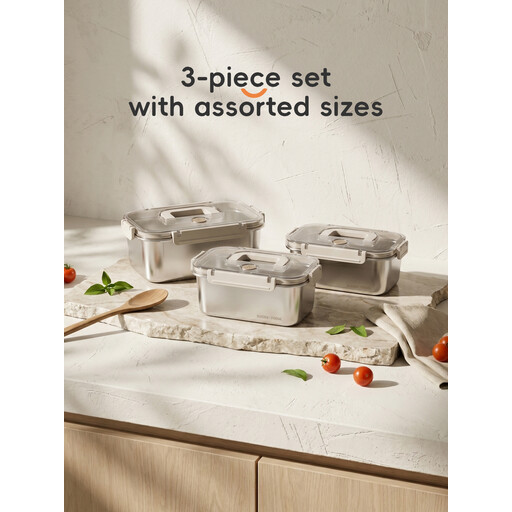
Why we chose it: Ideal for those who take their lunch to the office. The integrated handle on the lid and sturdy clips make it easy to carry, while the different sizes accommodate a full meal, from starter to dessert.
Its 4-clip locking system, combined with the silicone gasket, ensures a completely leakproof seal. It's a design made for transport, eliminating the risk of spills.
Food-grade 304 steel, BPA-free PP lids with a convenient carrying handle. Removable gasket for flawless cleaning.

Why we chose it: Perfect for weekly meal prep and fridge organisation. The large capacities (up to 3000 ml) and deep shape are great for storing large salads, saucy dishes, or family leftovers. The glass lids let you identify the contents at a glance.
This set avoids the false versatility trap. The 304 stainless steel body is freezer-safe, and the borosilicate glass lid can handle thermal shock, offering a reliable storage solution from freezer to table (after reheating in a suitable dish).
Large capacities and a stackable design for maximum space-saving. The EU-standard silicone gasket ensures perfect preservation in the fridge.

Why we chose it: For those who refuse to compromise on quality and longevity. 316 steel is an investment in a product that will stand the test of time and handle all types of food, even the most corrosive.
It shatters the "all stainless steel is the same" myth by using 316 steel, the benchmark grade. The result: unbeatable corrosion resistance that prevents rust or stains, even after years of use.
Premium material (316 stainless steel) for uncompromising hygiene and durability. A set of three versatile sizes (600, 1100, and 2200 ml) that are stackable for optimised storage.
We have compiled a complete, up-to-date list of products that meet these strict selection criteria and safety regulations.
Absolutely not! It's the golden rule: never place any metal object, including a stainless steel container, in a microwave oven. Metal reflects microwaves, which can damage the appliance and even cause a fire. To reheat your food, simply transfer it to a suitable dish (glass, ceramic).
Stainless steel is very easy to maintain. Hand washing with warm, soapy water is usually sufficient. For stubborn stains or limescale marks, a paste of baking soda and water, or a little white vinegar, works wonders. Absolutely avoid abrasive sponges that would scratch the surface. Most stainless steel bases are dishwasher-safe, but be sure to check the manufacturer's instructions for the lid.
No, a single-wall stainless steel food container is not insulated. It will only maintain the temperature of your food (hot or cold) for a very limited time, unlike a double-wall insulated lunch box. Its primary purpose is to store and transport food in a healthy, airtight manner, not to keep it hot or cold for hours.