
Livraison le jour même ou le lendemain

Qualité garantie

Débloquez vos offres de bienvenue: Livraison GRATUITE | Jusqu'à -80 % | 30 jours d'essai gratuits à JoyPlus
Téléchargez l'application
A cluttered entryway, piles of shoes, and a constant sense of disarray? If this scenario sounds familiar, you know that a good shoe cabinet is the key. But be warned: while the purchase may seem simple, many models prove disappointing in practice. To avoid making the wrong choice, it's essential to know how to sidestep the most common pitfalls and invest in a solution that truly combines style and everyday practicality.
As our editorial team's product expert, my mission is to help you see things more clearly. Let's break down the mistakes to avoid and the criteria that really make a difference.
The market is flooded with options, but they are far from equal. Here are three common design flaws that can turn a promising purchase into a real headache after just a few months.
To ensure you don't regret your purchase, focus on these three fundamental parameters. They are the guarantee of your cabinet's practicality and longevity.
First and foremost, measure the available space in your entryway, bedroom, or hallway. Note the maximum width, depth, and height. Depth is a crucial point: under 30 cm, the cabinet may not be suitable for larger shoe sizes (above a UK 10 / US 10.5).
Next, examine the interior layout. A unit with adjustable or removable shelves makes all the difference. It will allow you to adapt the space to accommodate everything from stilettos to winter boots, thereby optimising every square centimetre.
Your choice will depend on your priorities: quick access, a clean look, or versatility?
The lifespan of your cabinet will directly depend on its materials. Particleboard (MDF) is common and affordable, but its quality varies greatly. Ensure the surface is covered with a moisture- and scratch-resistant melamine coating—a crucial feature for an entryway where shoes are often damp. Metal or solid wood feet guarantee better stability and durability than simple plastic ones.
Rather than searching for a single one-size-fits-all model, it's better to find the one that truly matches your lifestyle. Here are a few options recommended by our editors, each tailored to a specific user profile.
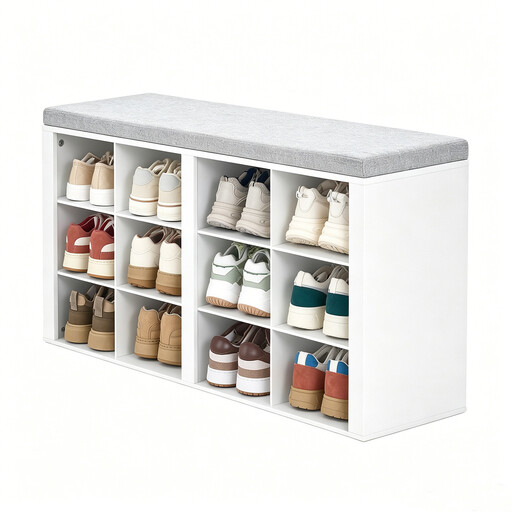
Editor's Take: Ideal for families who need an ultra-practical unit in the entryway. The integrated seat makes daily routines easier, and the open compartments allow everyone, young and old, to put away their shoes quickly.
This bench solves the problem of rigid compartments thanks to its height-adjustable shelves. You can finally store ankle boots and high-tops without squashing them.
Combines seating and storage; removable cushion for easy cleaning; 150 kg max load capacity ensures excellent stability.
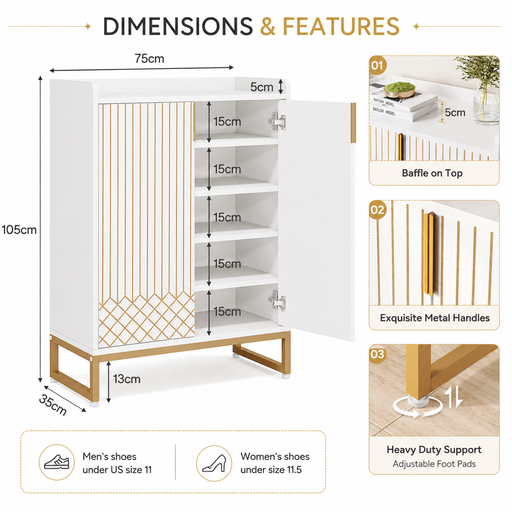
Editor's Take: For those who prioritise an impeccable aesthetic and want to conceal any hint of clutter. Its modern white and gold design fits beautifully into a contemporary living room, bedroom, or hallway.
This model ticks the capacity box with its 5 tiers holding up to 25 pairs. Its closed design protects from dust while maintaining an ultra-clean line.
Large concealed storage capacity; sturdy wood structure with metal feet; elegant design with refined finishes (diamond pattern, gold handles).
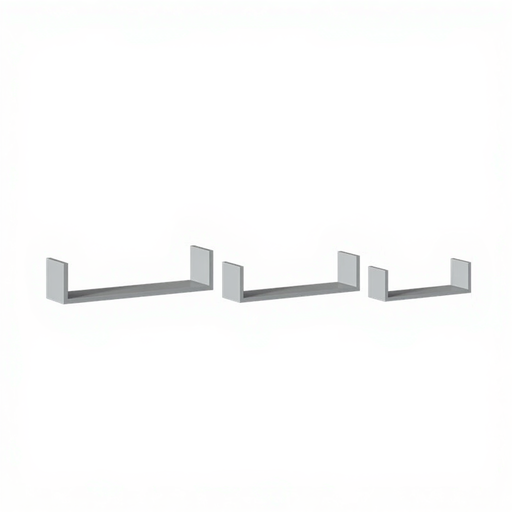
Editor's Take: The perfect solution for those short on floor space or who want to display their best pairs like decorative objects. A smart and modular wall-mounted **small storage unit**.
This **designer wall shelf** radically bypasses the problem of floor clutter. Its modularity allows you to create a custom composition for your shoes or other objects.
Frees up floor space; creative and customisable installation; minimalist design that fits anywhere (bedroom, living room, hallway).
To prevent odours, the first rule is to always store perfectly dry shoes. You can also place bamboo charcoal bags, baking soda, or cedar blocks inside the cabinet: they absorb moisture and neutralise odours naturally.
A depth of 33 to 35 cm is generally ideal to comfortably accommodate most adult shoe sizes (up to a UK 11 / US 12) without the shoes sticking out. For narrower spaces, tip-out cabinets are an excellent alternative as they are much shallower.
The durability of a particleboard (MDF) cabinet depends mainly on its density and the quality of its coating. Opt for high-density panels with a thick melamine finish. This type of coating protects the wood from moisture and scratches, significantly extending the life of your furniture, even with heavy use.