
Livraison le jour même ou le lendemain

Qualité garantie

Débloquez vos offres de bienvenue: Livraison GRATUITE | Jusqu'à -80 % | 30 jours d'essai gratuits à JoyPlus
Téléchargez l'application
A cluttered entryway quickly becomes frustrating to use: mismatched shoes, pairs exposed to dust, boots too tall for the compartments and a cabinet that is too deep for the hallway. However, choosing a shoe storage cabinet is not simply a matter of counting the number of pairs promised by the manufacturer.
Depth, opening type, stability and interior dimensions have a much more tangible impact on everyday convenience. Here are the mistakes to avoid, along with a selection of solutions suited to different French homes.
A cabinet advertised as holding 20 or 25 pairs may prove too small for a collection made up of bulky trainers, high-top shoes or boots. Actual capacity depends on shoe size, the width of each style and whether the shelves can be removed or repositioned.
Before ordering, measure your bulkiest shoes. If the cabinet is intended for the whole family, leave some spare capacity as well: filling every compartment to the limit is rarely practical for everyday use.
A shoe cabinet that is too deep can prevent a door from opening fully or make the passageway narrower. Conversely, an especially slim model may be less stable and accommodate fewer shoe styles.
Measure the available area while accounting for skirting boards, light switches and the clearance required to open doors. In a small hallway, a slim shoe cabinet, open shelving or stackable boxes may be more suitable than a bulky unit.
Doors protect shoes from dust and keep clutter out of sight. However, a fully enclosed cabinet requires a few precautions: shoes should be stored clean and completely dry. Boxes with ventilation openings encourage airflow, but they do not replace the need to dry shoes beforehand.
A closed cabinet is therefore well suited to a tidy entryway, while an open shoe rack makes it easy to grab the pairs worn every day.
Start by comparing the overall dimensions with the space available to you: width, height and depth. Then examine the dimensions of each compartment, which are far more informative than those of the cabinet as a whole.
For space-saving shoe storage, transparent boxes measuring 35 × 25.2 × 19 cm or models measuring 33.3 × 23.1 × 14.3 cm can fit inside a dressing room, beneath a shelf or in a cupboard. Nevertheless, check the size and volume of each pair before placing your order.
Lightweight and easy to clean, polypropylene is well suited to individual boxes. Metal is commonly used for open shelving and creates a visually lightweight structure. Particleboard offers a finish closer to that of a traditional piece of furniture, although stability then depends on the quality of the assembly and anchoring.
For a tall cabinet, check for an anti-tip device and carefully follow the wall-mounting instructions. Also take the manufacturer’s stated maximum load into account: the capacity specified for one shelf does not automatically apply to the entire unit.
The products below address different requirements. The stated capacities, dimensions and materials are based on the information provided in the product listings.
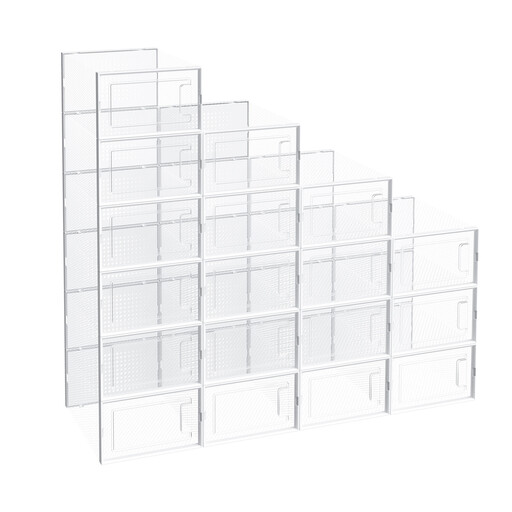
Why this option works: This set of 18 boxes helps organise a collection in a cupboard, entryway or dressing room without installing a fixed cabinet.
The dimensions of each box are clearly stated: 35 × 25.2 × 19 cm. You can therefore check compatibility with your shoes before buying.
PP boxes, front opening, stackable design and ventilation openings. The listing states compatibility up to UK size 11.
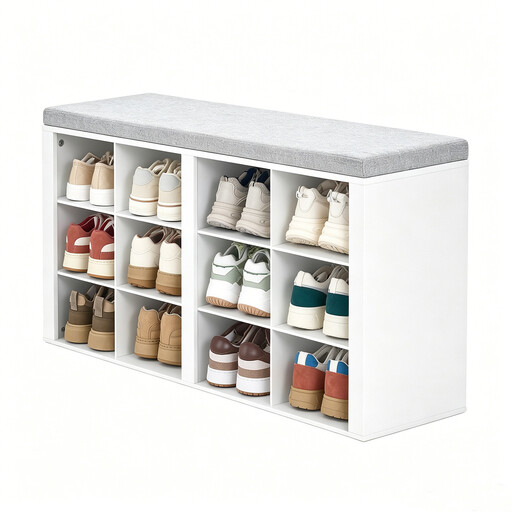
Why this option works: This entryway shoe cabinet combines storage with a bench, making it a practical choice for families and homes where people put their shoes on near the door.
The shelves are height-adjustable, allowing you to tailor the layout for trainers, high-top shoes or heels.
Dimensions of 30.5 × 104.5 × 49.5 cm, removable seat cover and a stated maximum load of 150 kg.
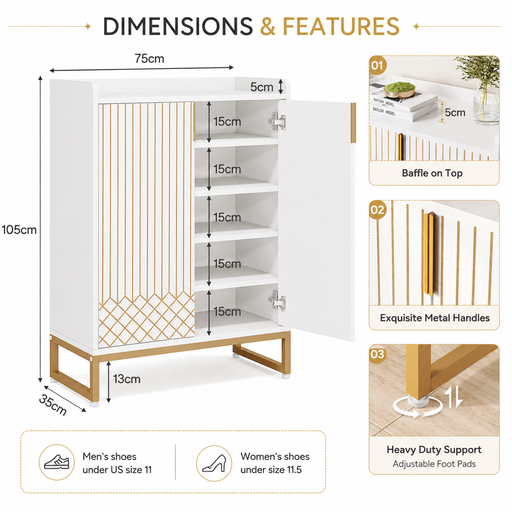
Why this option works: Its enclosed design is ideal for households that prefer to keep shoes out of sight in the living room, hallway or entryway.
The stated capacity of 22 to 25 pairs is based on five tiers, a low open shelf and doors. You should still check the volume of your shoes.
Wooden structure, metal feet, doors and a top surface suitable for displaying a few decorative items.
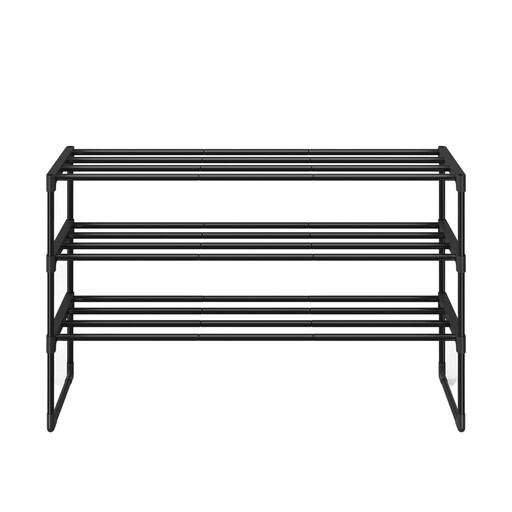
Why this option works: Open and slim, this model fits easily in a hallway, cupboard or small entryway where every centimetre matters.
Its dimensions of 30 × 92 × 55 cm are clearly stated, as is the maximum load: 10 kg per tier and 30 kg in total.
Metal tubes, plastic connectors, tool-free assembly and a configuration that can stand upright, be turned on its side or stacked.
Browse our updated selection of solutions to compare the formats, capacities and styles available for your home.
Allow at least the depth required for your longest shoes, then add the clearance needed to open the doors or drawers. In a hallway, also measure the remaining passage width. Open shelving or a stackable organiser can reduce visual bulk while keeping shoes easy to access.
Do not place wet shoes directly inside an enclosed cabinet. Clean the shelves regularly, respect the stated maximum load and store the heaviest pairs on the lower tiers. For tall cabinets, use the supplied anti-tip fittings whenever recommended by the manufacturer.
No, because their dimensions vary from one model to another. For example, JOYFURNOS boxes measuring 33.3 × 23.1 × 14.3 cm do not offer the same capacity as those measuring 35 × 25.2 × 19 cm. Before choosing your shoe storage solution, measure the length, width and height of your pairs, especially if you own bulky trainers or high-top shoes.